Acacia auriculiformis
A. Cunn. ex Benth.
Black wattle, Ear Pod Wattle
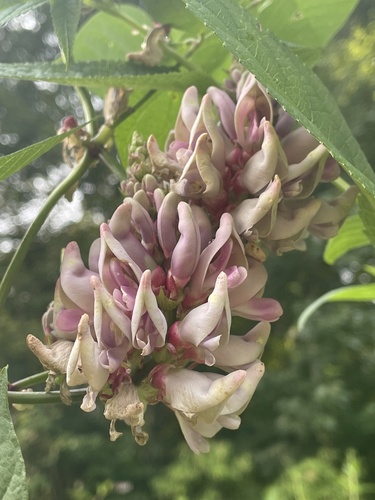
iNaturalist· cc-by-nc-sa
(c) 106611639464075912591, some rights reserved (CC BY-NC-SA), uploaded by 106611639464075912591
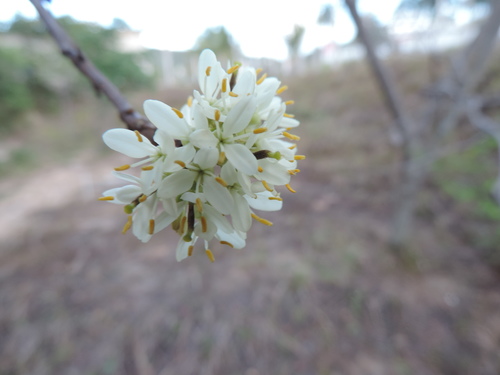
iNaturalist· cc-by-sa
(c) Douglas Goldman, some rights reserved (CC BY-SA), uploaded by Douglas Goldman
iNaturalist· cc-by-nc
(c) Ben Ong, some rights reserved (CC BY-NC), uploaded by Ben Ong
Summary
Source: WikipediaAcacia auriculiformis, commonly known as ear-pod wattle, northern black wattle or Darwin black wattle, is a species of flowering plant in the family Fabaceae and is native to Maluku, New Guinea, the Northern Territory and Queensland. It is a tree with smooth bark, very narrowly elliptic phyllodes, spikes of bright yellow to golden-yellow flowers, and strongly curved to spirally coiled, leathery to woody pods up to 80 mm (3.1 in) long.
Description
A shrub or small tree. It grows 5 m tall. There are prickles along the stem. The leaves are twice divided and there are 8-18 pairs of pinnae. There are up to 50 pairs of pinnules on each pinnae. The flowers are yellow. They are in large clusters at the ends of branches. The pods are flattened.
Edible Uses
The gum is eaten in Australia. Seeds and oil are also edible uses of this species.
Medicinal Uses
None known
Known Hazards
Especially in times of drought, many Acacia species can concentrate high levels of the toxin Hydrogen cyanide in their foliage, making them dangerous for herbivores to eat.
Distribution
They are tropical plants. Often trees grow in monsoon vine forest. In tropical Queensland it grows from sea level to 500 m altitude. They are often along the banks of freshwater streams. It prefers open sunny positions. It can survive drought. It is damaged by frost. It can grow on poor soils. It suits hardiness zones 10-12.
Where It Grows
Africa, Andamans, Argentina, Asia, Australia, Cambodia, Central America, China, East Africa, East Timor, Fiji, India, Indochina, Indonesia, Laos, Malaysia, Mauritius, Myanmar, Nepal, Pacific, Pakistan, Panama, Papua New Guinea, PNG, Philippines, Reunion, SE Asia, Tanzania, Thailand, Timor-Leste, USA, Vietnam,
Cultivation
The tree is predominantly found at low elevations in the seasonally dry tropical lowlands of the humid and sub-humid zones. It is usually found at elevations below 80 metres, but can be found up to 400 metres. In its natural range, the mean annual rainfall varies from 700 - 2,000 mm, and the dry season (i.e. Monthly rainfall less than 40 mm) can be up to 7 months. The mean maximum temperature of the hottest month is 32 - 34°c, and the mean minimum of the coolest month is 17 - 22°c. Frost does not occur in its natural range, but elsewhere, it tolerates light frost. Requires a sunny position, it is very intolerant of shade. Found most commonly on clay soils, it exhibits the ability to grow in a wide variety of soils including calcareous sands and black cracking clays, seasonally waterlogged soils, sandy loams and coral rag. It can also tolerate highly alkaline and saline soils, pH ranging between 4.3 and 9. It has brittle, easily-broken branches and therefore requires a position sheltered from strong winds. Established plants can tolerate periodic inundation and are also very drought tolerant. Often cultivated for timber outside its native range, the tree has escaped from cultivation in many parts of the tropics and has become an invasive weed in some areas. Very fast-growing, an increment in height of 2 - 4 metres per year in the first few years is common even on soils of low fertility. The optimal planting density is not clearly established. Most current plantings are spaced at 2 - 4 x 2 - 4 metres, the closer spacing being more suitable for firewood and pulp plantations. The tree responds well to pollarding. Young trees respond to coppicing better than old trees, but the tree does not sprout vigorously or prolifically. Best results are obtained if the stump is cut at a height of 0.6 - 1 metre above the ground. Under favourable conditions, trees may reach a height of 15 metres in 5 years and produce an annual wood increment of 15-20 cubic m/ha over 10 - 12 years. Recommended rotation is 4 - 5 years for fuel wood, 8 - 10 years for pulp and 12 - 15 years for timber. Removal of lower branches and of young plants has been suggested as a means of improving stem form and of reducing the incidence of multiple stems. The tree has a shallow, spreading root system. Seedlings have the ability to compete with Imperata cylindrica during early growth phases and once mature may reduce the grass to a sparse ground cover. Hybridizes with A. Mangium. The plant flowers and produces fruit throughout much of the year. This species has a symbiotic relationship with certain soil bacteria, these bacteria form nodules on the roots and fix atmospheric nitrogen. Some of this nitrogen is utilized by the growing plant but some can also be used by other plants growing nearby.
Propagation
Seed requires pre-treatment to break down the hard coat — pouring a small amount of boiling water over the seeds and soaking for 12 hours is usually effective, as is making a small incision in the coat to allow water to penetrate. Germination rates of 40–80% occur in 6–15 days. Treated seeds are sown in germination beds and seedlings transplanted into polythene bags at the two-leaf-pair stage; seeds can also be sown directly into polythene bags. Young seedlings should initially be kept at 50% sunlight, increasing to 70% once established. Generally 3–4 months are needed to raise seedlings to a plantable size of 25 cm. Seeds stored in airtight containers at room temperature retain viability for several years. Cuttings and air layering are also viable propagation methods.
Other Uses
The bark contains 13–25% tannin, sufficient for commercial exploitation, and a natural dye extracted from the bark is used in the batik textile industry in Indonesia. The plant has a spreading, superficial, and densely matted root system that makes it suitable for stabilising eroded land; its rapid early growth on infertile sites, ability to fix atmospheric nitrogen, and tolerance of highly acidic and alkaline soils make it popular for stabilising and revegetating mine spoils. Plantations improve soil properties including water-holding capacity, organic carbon, nitrogen, and potassium through litter fall, and the phyllodes provide a good, long-lasting mulch. Its dense, dark-green foliage, which is retained through the dry season, makes it an excellent shade tree, though its tendency to spread into the local environment reduces its value as a pioneer outside its native range. The heartwood is light brown to dark red, demarcated from yellow sapwood; the wood is hard, high in density, fine and straight-grained, often attractively figured, reasonably durable, and finishes well. It is used for turnery articles, toys, carom coins, chessmen, handicrafts, furniture, joinery, and tool handles, and for construction where trees of suitable girth are available. The wood is extensively used for paper pulp and has shown promise for unbleached kraft pulp and high-quality neutral sulphite semi-chemical pulp. It is a major firewood source, with a calorific value of 4500–4900 kcal/kg, and produces very good charcoal that glows well with little smoke and does not spark.
Production
It is fast growing. It is brittle in wind storms. Flowering is May to July with pods in August to October.
Other Information
The gum is eaten in Australia, but it is not known if this is used in PNG.
Notes
There are about 1,350 Acacia species. Over 1,000 occur in Australia. This one can become invasive. It has anticancer properties. Also as Mimosaceae.
Synonyms
Also Known As
Acacia sleuk touch, Akasia kuning, Bunga siam, Earleaf wattle, Kasia, Kathin-narong, Keo bong vang, Keo la-tram, Kratin-narong, Northern Black wattle, Pohon akasia, Pohon akasia hitam, Unar
References (30)
- Ambasta S.P. (Ed.), 2000, The Useful Plants of India. CSIR India. p 4
- Barwick, M., 2004, Tropical and Subtropical Trees. A Worldwide Encyclopedic Guide. Thames and Hudson p 2
- Bodkin, F., 1991, Encyclopedia Botanica. Cornstalk publishing, p 9
- Borrell, O.W., 1989, An Annotated Checklist of the Flora of Kairiru Island, New Guinea. Marcellin College, Victoria Australia. p 94
- Brock, J., 1993, Native Plants of Northern Australia, Reed. p 57
Show all 30 references Hide references
- Cooper, W. and Cooper, W., 2004, Fruits of the Australian Tropical Rainforest. Nokomis Editions, Victoria, Australia. p 301
- Doran, J.C., & Turnbull, J.W. (Eds), 1997, Australian Trees and Shrubs: species for land rehabilitation and farm plantings in the tropics. ACIAR Monograph No 24. p 112
- Dunlop, C.R., Leach, G.J. & Cowie, I.D., 1995, Flora of the Darwin Region. Vol 2. Northern Territory Botanical Bulletin No 20. p 6
- Elliot, W.R., & Jones, D.L., 1982, Encyclopedia of Australian Plants suitable for cultivation. Vol 2. Lothian. p 19
- Engel, D.H., & Phummai, S., 2000, A Field Guide to Tropical Plants of Asia. Timber Press. p 54
- Etherington, K., & Imwold, D., (Eds), 2001, Botanica's Trees & Shrubs. The illustrated A-Z of over 8500 trees and shrubs. Random House, Australia. p 49
- Flora of Pakistan. www.eFloras.org
- Friday, J. B., 2005, Forestry and Agroforestry Trees of East Timor. http://www.ctahr.hawaii.edu/forestry/data/Timor/Timor trees.html
- Hearne, D.A., & Rance, S.J., 1975, Trees for Darwin and Northern Australia. AGPS, Canberra p 9, Pl.1
- Kintzios, S. E., 2006, Terrestrial Plant-Derived Anticancer Agents and Plant Species Used in Anticancer research. Critical Reviews in Plant Sciences. 25: pp 79-113
- Krishen P., 2006, Trees of Delhi, A Field Guide. DK Books. p 82
- Latham, P. & Mbuta, A. K., 2017, Plants of Kongo Central Province, Democratic Republic of Congo. 3rd ed p 12
- Lazarides, M. & Hince, B., 1993, Handbook of Economic Plants of Australia, CSIRO. p 2
- Levitt, D., 1981, Plants and people. Aboriginal uses of plants on Groote Eylandt. Australian Institute of Aboriginal Studies, Canberra. p 100
- Llamas, K.A., 2003, Tropical Flowering Plants. Timber Press. p 210
- London J. Bot. 1:377. 1842
- Marinelli, J. (Ed), 2004, Plant. DK. p 442
- Mbuya, L.P., Msanga, H.P., Ruffo, C.K., Birnie, A & Tengnas, B., 1994, Useful Trees and Shrubs for Tanzania. Regional Soil Conservation Unit. Technical Handbook No 6. p 48
- McMakin, P.D., 2000, Flowering Plants of Thailand. A Field Guide. White Lotus. p 18
- Pham-Hoang Ho, 1999, An Illustrated Flora of Vietnam. Nha Xuat Ban Tre. p 820
- Swaminathan, M.S., and Kochnar, S.L., 2007, An Atlas of Major Flowering Trees in India. Macmillan. p 132
- Verdcourt, B., 1979, Manual of New Guinea Legumes. Botany Bulletin No 11, Division of Botany, Lae, Papua New Guinea. p 163
- Wightman, Glenn et al. 1992. Mudburra Ethnobotany: Aboriginal Plant Use from Kulumindini (Elliott) Northern Australia. Northern Territory Botanical Bulletin No 14. Parks and Wildlife Commission of the Northern Territory. p 5, 7.
- Wightman, G. M. & Andrews, M.R., 1989, Plants of Northern Territory Monsoon Vine Forests (Vol 1). Conservation Commission of Northern Territory. p 14
- World Checklist of Useful Plant Species 2020. Royal Botanic Gardens, Kew