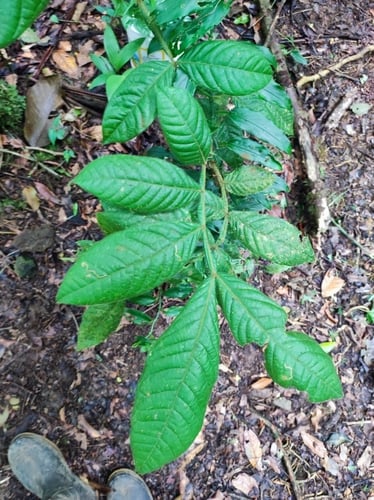
Eperua purpurea
Benth.
wikimedia· cc0
Wikimedia Commons - Unknown
gbif· cc-by-nc
Field Museum of Natural History - Botany Department | GDI 2013-2015
Description
A tropical tree in the Fabaceae family (formerly classified as Caesalpinaceae), a legume.
This description is brief — help expand it
Edible Uses
The fruit is edible.
Distribution
It is a tropical plant.
Where It Grows
Amazon, Brazil, Colombia, South America, Venezuela,
Cultivation
This species has a symbiotic relationship with certain soil bacteria, these bacteria form nodules on the roots and fix atmospheric nitrogen. Some of this nitrogen is utilized by the growing plant but some can also be used by other plants growing nearby.
Other Uses
The beautiful rose-purple flowers are sometimes made into a tea for bathing the hair in the belief that it strengthens the growth of the hair. The red-coloured bark is tough and does not decay under water. A strip 9 metres or more long, 30cm wide and 3mm thick is wrapped round a tube, 30 - 90cm long, formed of a portion of a young trunk of the Paxuiba palm (Iriartea enorrhiza) in a slightly oblique direction, so as to form a widening spiral which extends considerably below the tube and forms a musical instrument which is blown into like a trumpet and gives a deep sound that is heard from afar. The wood is heavy. It is used for making bridges and general construction.
Notes
Caesalpinaceae.
Also Known As
Avina, Backaike, Boo-roo-go, Guapa. Guayacac cavio, Iebaru, Ieparo, Jevaro, Kiyeli, Pega-ega, Pegante, Poo-ko, Yevaro, Yevaro morado
References (2)
- Grandtner, M. M. & Chevrette, J., 2013, Dictionary of Trees, Volume 2: South America: Nomenclature, Taxonomy and Ecology. Academic Press p 220
- Roa, J. A. G. & Boada, D. S. G., 2018, Fundación para el Fortalecimiento de la Fruticultura y Plantas Alimenticias no Convencionales en Colombia.