Cordyline indivisa
(G. Forst.) Steud.
Broad-leafed cabbage tree
iNaturalist· cc-by
(c) Jon Sullivan, some rights reserved (CC BY)
iNaturalist· cc-by
(c) Joe Potter Butler, some rights reserved (CC BY)
Summary
Source: WikipediaCordyline indivisa is a monocot tree endemic to New Zealand. It is commonly known as mountain cabbage tree or bush flax. It is also known as the broad-leaved cabbage tree, and in the Māori language as tōī.
Description
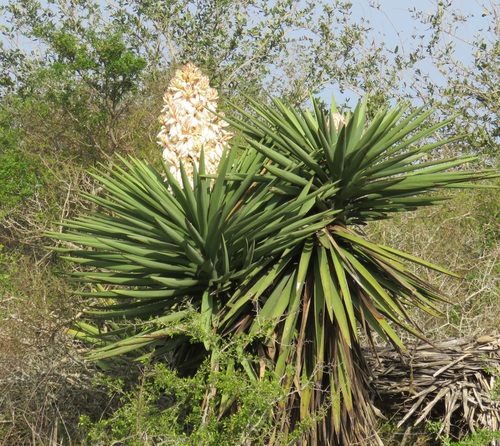
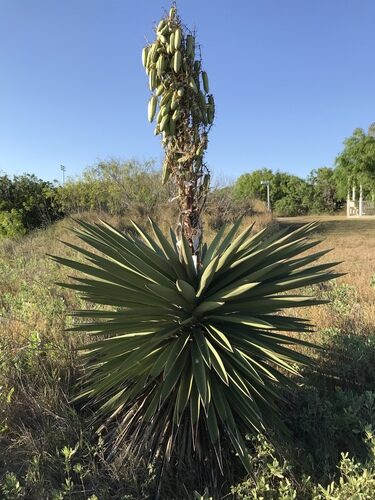
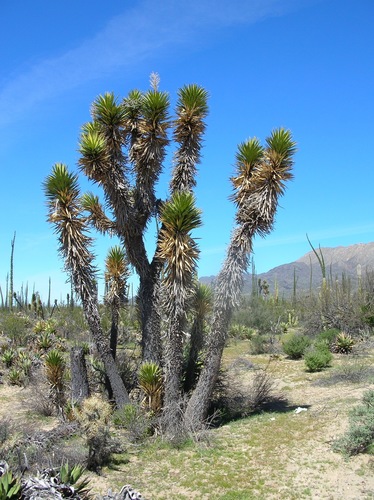
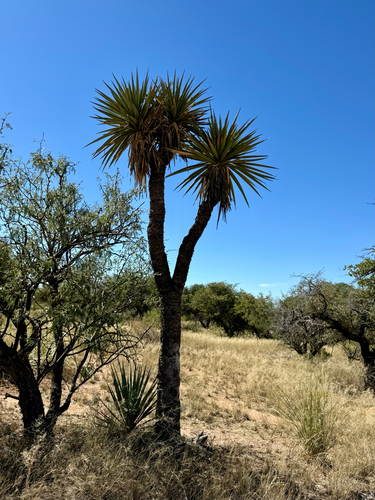
A robust tree. It has a single stem. The trunk is stout. It develops a large head of sword shaped leaves. These often have a purple colour. They are 1.8 m long and 12 cm wide. The flowers are creamy white. They are on 1 m long branched panicles. It has purple berries.
Edible Uses
The root can be baked, and the trunk pith is dried and steamed until soft, turning sweet and starchy — used to make porridge or a sweet drink. Both root and stems are rich in fructose, with yields comparing favourably with sugar beet (Beta vulgaris altissima). Young shoots are edible and serve as a cabbage substitute. The leaves are very fibrous even when young and are not recommended for eating. The fruit is also edible and measures about 6mm in diameter.
Medicinal Uses
None known.
Distribution
It is a warm temperate plant. It grows in wet forests. It grows in high rainfall cool mountainous regions in New Zealand. It needs a light to medium, well-drained soil. It can grow in a shaded position. It is resistant to frost but damaged by drought. It suits hardiness zones 9-10. Arboretum Tasmania.
Where It Grows
Australia, Britain, Europe, New Zealand*, Tasmania,
Cultivation
Plants are grown from seeds.
Propagation
Pre-soak seed for about 10 minutes in warm water, then sow in late winter to early spring in a warm greenhouse. Germination usually takes 1–3 months at 25°C, with a good overall germination rate. Prick seedlings into individual pots as soon as they are large enough to handle and grow on in the greenhouse through at least their first winter. Plant out in late spring after the last expected frosts, with some protection during the first winter outdoors. For stem cuttings, cut the main stem just below the head and saw into 5cm thick blocks, placing them 3cm deep in pure peat in a heated frame. Keep moist until rooting well, then pot individually and plant out after the last frosts. Suckers are best removed in early spring and planted directly in situ. Protect divisions from wind and cold and do not allow the soil to dry out until the plant is established. Divisions can also be potted up and grown on before planting out in summer.
Other Uses
The leaves contain saponins, though not in commercial quantities, and yield a strong fibre used for paper, twine, cloth, baskets, thatching, and rain capes, with whole leaves used directly in some applications. This species produces particularly strong rain capes. The midrib of the leaves provides a fine red-coloured strip well suited to plaiting. The fibre also makes a very strong rope that lasts longer in water than that of Phormium tenax.
Notes
There are 15-20 Cordyline species. Also put in the family Laxmanniaceae.
Also Known As
Blue dracaena, Mountain cabbage tree, Toi
References (11)
- Bodkin, F., 1991, Encyclopedia Botanica. Cornstalk publishing, p 281
- Cambie, R. C. & Ferguson, L. R., 2003, Potential functional foods in the traditional Maori diet. Mutation Research/Fundamental and Molecular Mechanisms of Mutagenesis. Volumes 523–524, February–March 2003, Pages 109-117
- Cundall, P., (ed.), 2004, Gardening Australia: flora: the gardener's bible. ABC Books. p 412
- Etherington, K., & Imwold, D., (Eds), 2001, Botanica's Trees & Shrubs. The illustrated A-Z of over 8500 trees and shrubs. Random House, Australia. p 226
- Crowe, A., 1997, A Field Guide to the Native Edible Plants of New Zealand. Penguin. p 17
Show all 11 references Hide references
- Harter, J.(Ed.), 1988, Plants. 2400 copyright free illustrations. Dover p 9.3
- Hedrick, U.P., 1919, (Ed.), Sturtevant's edible plants of the world. p 217
- Nom. bot. ed. 2, 1:419. 1840
- Plants for a Future database, The Field, Penpol, Lostwithiel, Cornwall, PL22 0NG, UK. http://www.scs.leeds.ac.uk/pfaf/
- Salmon, J.T., 1989, The Native Trees of New Zealand. Heinmann Reid p 350
- Skinner, G. & Brown, 1981, C., Simply Living. A gatherer's guide to New Zealand's fields, forests and shores. Reed. p 6