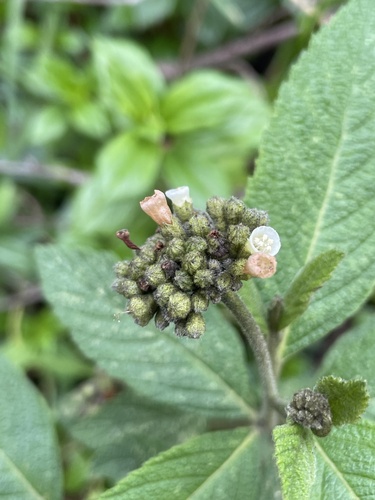
Cordia sebestena
L.
Scarlet Cordia
iNaturalist· cc-by-nc
(c) elprofer, some rights reserved (CC BY-NC)
iNaturalist· cc-by-nc
(c) UNIRSE nestor e. Diaz ,Rozett, some rights reserved (CC BY-NC)
iNaturalist· cc-by-nc
(c) jbliz, some rights reserved (CC BY-NC)
Summary
Source: WikipediaCordia sebestena is a shrubby tree in the family Cordiaceae, native to the American tropics. It ranges from southern Florida in the United States and the Bahamas, southwards throughout Central America and the Greater Antilles. Common names have included siricote or kopté (Mayan) in 19th Century northern Yucatán, scarlet cordia in Jamaica, and Geiger tree (after Key West wrecker John Geiger) in Florida.
Description
An evergreen shrub. It can lose its leaves. It grows up to 10 m high. The leaves are oval and the base is sometimes heart shaped. They are 10-20 cm long. There are teeth on the edge near the tip. The flowers are deep red or orange. They are funnel shaped. The lobes spread out. The fruit are large and creamy white. They are fleshy and 2.5 cm across.
Edible Uses
The ripe fruits can be eaten raw, boiled, or used in pickles and jams. The bark and flowers are used to make a sugary syrup.
Traditional Uses
The ripe fruit can be eaten raw. They are also boiled or used in pickles. They are used for jams. The bark and flowers are used to make a sugary syrup.
Medicinal Uses
The fruit is emollient. It is used in the treatment of fevers. The leaves are emollient. They are used in the treatment of bronchitis, coughs, fevesr and influenza. The plant has been used as a remedy for intestinal and stomach complaints, and also for bronchial affections. A syrup prepared from the bark, flowers and fruit is a local remedy for affections of the chest.
Distribution
A tropical plant. It grows in tropical America. It is very salt tolerant. It needs sandy, well drained soil. It needs full sun. It cannot tolerate cold temperatures. It is damaged by frost. It can tolerate drought. It suits hardiness zones 11-12.
Where It Grows
Antigua and Barbuda, Asia, Australia, Bahamas, Barbados, Belize, Bermuda, Burkina Faso, Caribbean, Central America, Colombia, Cook Islands, Cuba, Dominican Republic, East Africa, Fiji, Guam, Guatemala, Haiti, Hawaii, India, Indochina, Indonesia, Jamaica, Mexico, Micronesia, North America, Pacific, Pakistan, Palau, Puerto Rico, Saudi Arabia, SE Asia, South America, Tanzania, Thailand, Tuvalu, United Arab Emirates, UAE, USA, Venezuela, Vietnam, Virgin Is., West Indies*,
Cultivation
It can be grown from seed or cuttings. It can also be grown by air-layering.
Propagation
Seed - very slow to germinate, the process can be sped up if the seed is scarified by lightly abrading the seedcoat to allow easier ingress of water. Cuttings Layering.
Other Uses
The large, 18cm long, stiff, dark green leaves are rough and hairy, feeling much like sandpaper. Several species in this genus have leaves that are used like sandpaper for polishing surfaces. It would be worth trying this species. The heart wood is dark brown; the thick band of sapwood is a light brown or yellow. The wood is close-grained, fine-textured with a satiny appearance, hard and heavy. It is used locally for cabinet work, carpentry and construction.
Production
It is very slow growing. Flowers are fruit are produced all year round.
Notes
There are about 300 Cordia species.
Synonyms
Also Known As
Al-mukhiat, Anaconda, Broadleaf Cordia, Geiger Tree, Joaquin, Kanava palagi, Kelau, Kou-haole, Lolu, Siricote blanco, Vomitel amarillo
References (33)
- Altschul, S.V.R., 1973, Drugs and Foods from Little-known Plants. Notes in Harvard University Herbaria. Harvard Univ. Press. Massachusetts. no. 3537
- Barwick, M., 2004, Tropical and Subtropical Trees. A Worldwide Encyclopedic Guide. Thames and Hudson p 133
- Bodkin, F., 1991, Encyclopedia Botanica. Cornstalk publishing, p 280
- Ekman Herbarium records Haiti
- Elevitch, C.R.(ed.), 2006, Traditional Trees of the Pacific Islands: Their Culture, Environment and Use. Permanent Agriculture Resources, Holualoa, Hawaii. p 305
Show all 33 references Hide references
- Engel, D.H., & Phummai, S., 2000, A Field Guide to Tropical Plants of Asia. Timber Press. p 31
- Facciola, S., 1998, Cornucopia 2: a Source Book of Edible Plants. Kampong Publications, p 93
- Flora of Pakistan. www.eFloras.org
- Grandtner, M. M. & Chevrette, J., 2013, Dictionary of Trees, Volume 2: South America: Nomenclature, Taxonomy and Ecology. Academic Press p 162
- Hedrick, U.P., 1919, (Ed.), Sturtevant's edible plants of the world. p 217
- Karim, F. M. & Dakheel, A, J., 2006, Salt-tolerant plants of the United Arab Emirates. 2006. International Center for Biosaline Agriculture, Dubai, UAE.
- Kermath, B. M., et al, 2014, Food Plants in the Americas: A survey of the domesticated, cultivated and wild plants used for Human food in North, Central and South America and the Caribbean. On line draft. p 263
- Khan, D. & Shaukat, S.S., 2006, The Fruits of Pakistan: Diversity, Distribution, Trends of Production and Use. Int. J. Biol. Biotech., 3(3):463-499
- Little, E. L., et al, 1974, Trees of Puerto Rico and the Virgin Islands. USDA Handbook 449. Forestry Service. p 848
- Llamas, K.A., 2003, Tropical Flowering Plants. Timber Press. p 148
- Lyle, S., 2006, Discovering fruit and nuts. Land Links. p 153
- Martin, F. W., et al, 1987, Perennial Edible Fruits of the Tropics. USDA Handbook 642 p 93
- Mbuya, L.P., Msanga, H.P., Ruffo, C.K., Birnie, A & Tengnas, B., 1994, Useful Trees and Shrubs for Tanzania. Regional Soil Conservation Unit. Technical Handbook No 6. p 206
- Menninger, E.A., 1977, Edible Nuts of the World. Horticultural Books. Florida p 116
- Plants of Haiti Smithsonian Institute http://botany.si.edu/antilles/West Indies
- Roa, J. A. G. & Boada, D. S. G., 2018, Fundación para el Fortalecimiento de la Fruticultura y Plantas Alimenticias no Convencionales en Colombia.
- Russell, T., Cutler, C., & Walters, M., 2005, The Illustrated Encyclopedia of Trees of the Americas. Lorenz Books. p 243
- Segura, S. et al, 2018, The edible fruit species in Mexico. Genet Resour Crop Evol (2018) 65:1767–1793
- Smith, A.C., 1991, Flora Vitiensis Nova, Lawaii, Kuai, Hawaii, Volume 5 p 153
- Smith, N., Mori, S.A., et al, 2004, Flowering Plants of the Neotropics. Princeton. p 62
- Sp. pl. 1:190. 1753
- Staples, G.W. and Herbst, D.R., 2005, A tropical Garden Flora. Bishop Museum Press, Honolulu, Hawaii. p 198 (Drawing)
- Sukarya, D. G., (Ed.) 2013, 3,500 Plant Species of the Botanic Gardens of Indonesia. LIPI p 209
- Thaman, R. R, 2016, The flora of Tuvalu. Atoll Research Bulletin No. 611. Smithsonian Institute p 72
- Walter, A. & Sam C., 2002, Fruits of Oceania. ACIAR Monograph No. 85. Canberra. p 151
- Young, J., (Ed.), 2001, Botanica's Pocket Trees and Shrubs. Random House. p 266
- http://cookislands.bishopmuseum.org
- www.desert-tropicals.com