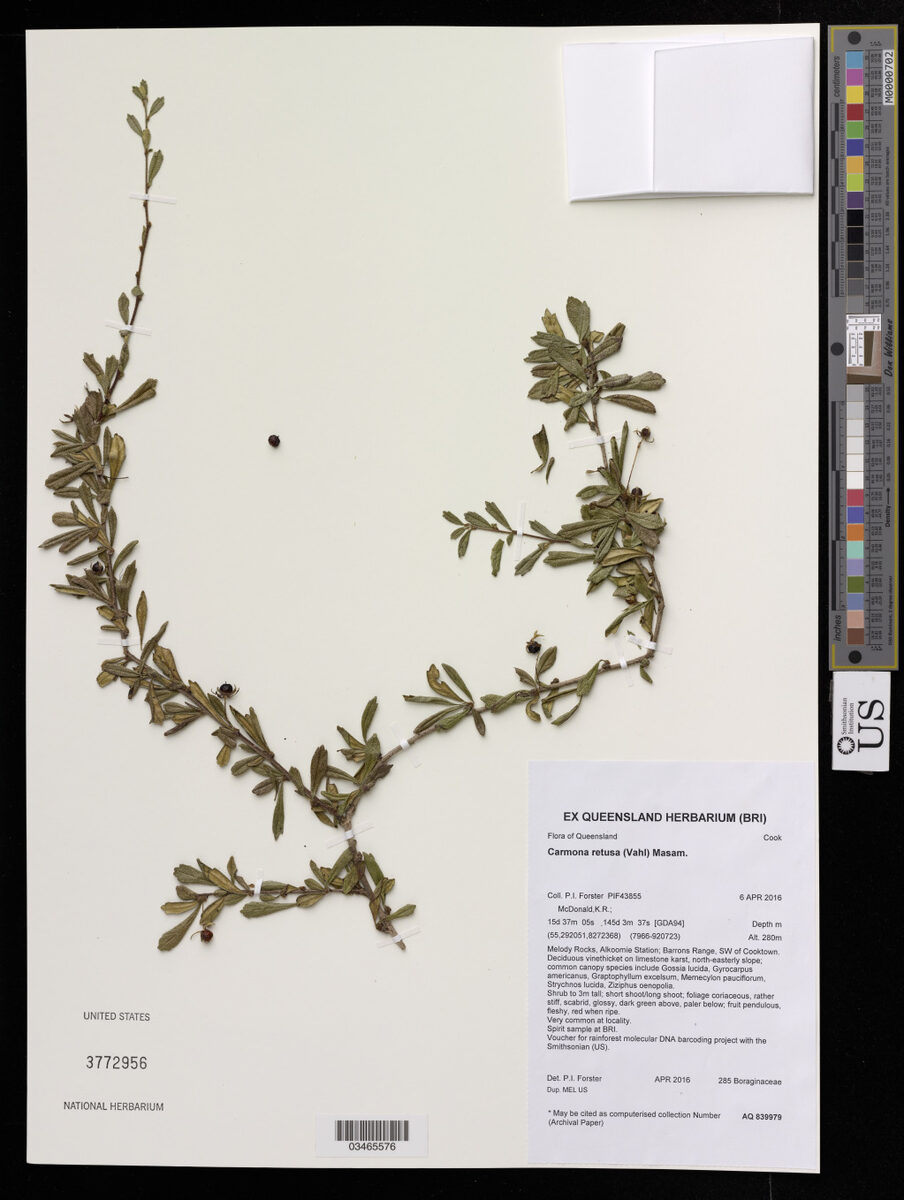
Cordia ovalis
R. Br. ex DC.
Sandpaper tree, Snot berry
iNaturalist· cc-by-nc
(c) Benjamin Morris, some rights reserved (CC BY-NC)
iNaturalist· cc-by-nc
(c) Benjamin Morris, some rights reserved (CC BY-NC)
iNaturalist· cc-by-nc
(c) Benjamin Morris, some rights reserved (CC BY-NC)
Description
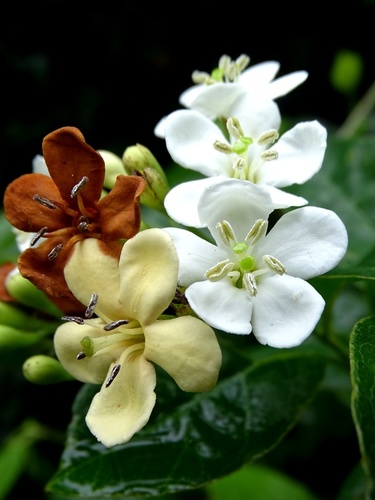
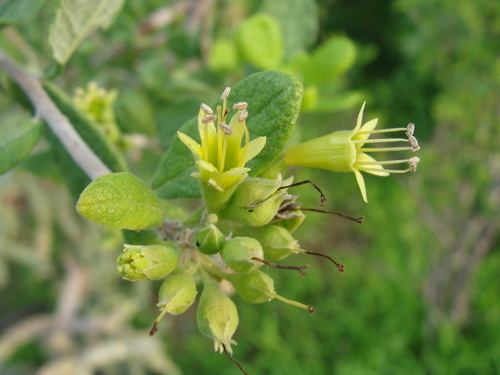
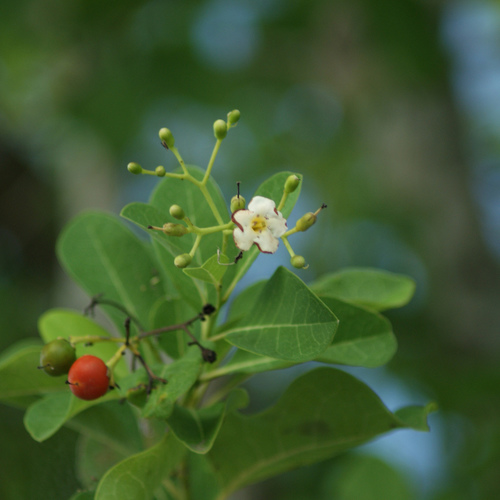
A shrub or small bushy tree. It grows 4-7 m high. The bark is pale grey. It is smooth but can be somewhat flaky. The leaves are oval or almost round. They are 5-8 cm long by 4-6 cm wide. They are leathery and deep green. They are harsh to touch. There are soft yellow hairs underneath. The base is rounded and the edges can be slightly scalloped. The leaf stalk is 1-2 cm long. The flowers are yellow. They occur in dense clusters at the ends of branches. The fruit is oval and fleshy. It is up to 2 cm long. They are orange-red when mature. They have a sharp point. They have a cup at the base and this has toothed edges. There is one seed inside a jelly-like pulp.
Edible Uses
The fruits are eaten raw, particularly by children.
Traditional Uses
The fruit are eaten raw.
This uses section is brief — help expand it
Distribution
A tropical plant. It grows at low altitudes in hot woodland. Often they are on dry rocky hillsides.
Where It Grows
Africa, Angola, Botswana, Central Africa, East Africa, Ethiopia, Kenya, Middle East, Oman, Somalia, South Africa, Southern Africa, Uganda, Zambia, Zimbabwe,
Production
A fruit weighs about 1 g.
Other Information
The fruit are eaten especially by children.
Notes
There are about 300 Cordia species.
Nutrition
| Part | Moisture | kJ | kcal | Protein | Vit A | Vit C | Iron | Zinc |
|---|---|---|---|---|---|---|---|---|
| Fruit | 67.2 | — | — | 10.6 | — | — | — | — |
Synonyms
Also Known As
Esegesege, Luketa, Madheed, Madheera hoffee, Mareer-girgir, Se'eki
References (17)
- Asfaw, Z. and Tadesse, M., 2001, Prospects for Sustainable Use and Development of Wild Food Plants in Ethiopia. Economic Botany, Vol. 55, No. 1, pp. 47-62
- Balemie, K., & Kebebew, F., 2006, Ethnobotanical study of wild edible plants in Derashe and Kucha Districts, South Ethiopia. Journal of Ethnobiology and Ethnomedicine.
- Fox, F. W. & Young, M. E. N., 1982, Food from the Veld. Delta Books. p 133
- Gemedo-Dalle, T., et al, 2005, Plant Biodiversity and Ethnobotany of Borana Pastoralists in Southern Oromia, Ethiopia. Economic Botany 59(1) pp. 43-65
- Goode, P., 1989, Edible Plants of Uganda. FAO p 30
Show all 17 references Hide references
- Grivetti, L. E., 1980, Agricultural development: present and potential role of edible wild plants. Part 2: Sub-Saharan Africa, Report to the Department of State Agency for International Development. p 71
- Ichikawa, M., 1980, The Utilization of Wild Food Plants by the Suiei Dorobo in Northern Kenya. J. Anthrop. Soc. Nippon. 88(1): 25-48
- Jardin, C., 1970, List of Foods Used In Africa, FAO Nutrition Information Document Series No 2.p 130
- Lulekal, E., et al, 2011, Wild edible plants in Ethiopia: a review on their potential to combat food insecurity. Afrika Focus - Vol. 24, No 2. pp 71-121
- Mengistu, F. & Hager, H., 2008, Wild Edible Fruit Species Cultural Domain, Informant Species Competence and Preference in Three Districts of Amhara Region, Ethiopia. Ethnobotany Research & Applications 6:487-502
- Miller, A. G., Morris, M. & Stuart-Smith, S., 1988, Plants of Dhofar. The Southern Region of Oman, Traditional, Economic and Medicinal Uses. Sultanate of Oman. p 64
- Palgrave, K.C., 1996, Trees of Southern Africa. Struik Publishers. p 801
- Roodt, V., 1998, Trees & Shrubs of the Okavango Delta. Medicinal Uses and Nutritional value. The Shell Field Guide Series: Part 1. Shell Botswana. p 193
- Ruiters-Welcome, A. K., 2019, Food plants of southern Africa. Ph.D. thesis. Univ. of Johannesburg p 38
- Schmidt, E., Lotter, M., & McCleland, W., 2007, Trees and shrubs of Mpumalanga and Kruger National Park. Jacana Media p 570
- Welcome, A. K. & Van Wyk, B.-E., 2019, An inventory and analysis of the food plants of southern Africa. South African Journal of Botany 122 (2019) 136–179
- Wilson, A. L. & Downs, C. T., 2012, Fruit nutritional composition and non-nutritive traits of indigenous South African tree species. South African Journal of Botany. 78:30-36