Actinidia polygama
(Siebold & Zucc.) Maxim.
Silver vine, Matatabi
iNaturalist· cc-by-nc
(c) V.S. Volkotrub, some rights reserved (CC BY-NC), uploaded by V.S. Volkotrub
iNaturalist· cc-by-nc
(c) Chuangzao, some rights reserved (CC BY-NC), uploaded by Chuangzao
iNaturalist· cc-by-nc
(c) onidiras-iNaturalist, some rights reserved (CC BY-NC), uploaded by onidiras-iNaturalist
Summary
Source: WikipediaActinidia polygama (also known as silver vine, matatabi and cat powder) is a species of kiwifruit in the family Actinidiaceae. It grows in the mountainous areas of Korea, Japan and China at elevations between 500 and 1,900 metres (1,600 and 6,200 ft).
Description
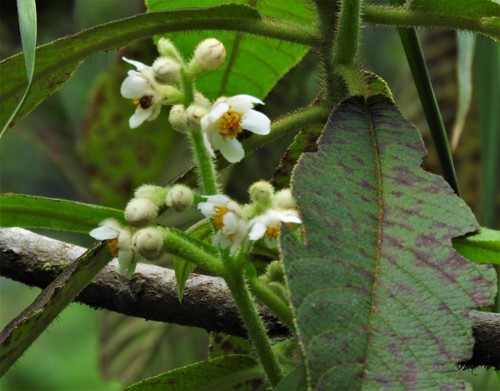
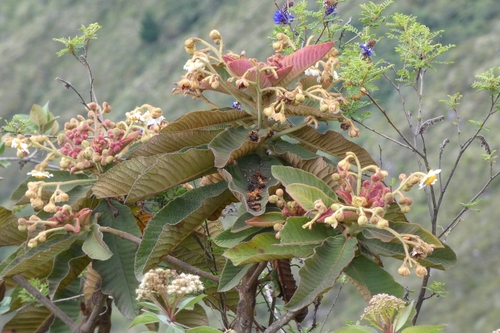
A climber. It grows up to 2.4 m long and spreads 2.4 m wide. The leaves are pale silver or gold. They are 15 cm long. The leaves are tapered. The flowers are white with yellow anthers. The fruit are 3 cm across.
Edible Uses
The fruit can be eaten raw or cooked, though it is not very palatable and is typically eaten salted. Some cultivars produce better-flavoured fruit. The ovoid fruits are orange and hairless when fully ripe, growing up to 3cm across, and contain up to 5 times the vitamin C of blackcurrants. Small seeds are present but soft enough to eat with the flesh. The leaves can be eaten raw or cooked, and may also be roasted and blended with tea.
Medicinal Uses
The leaves are both hallucinogenic and sedative. They contain compounds that are highly attractive to cats, making them particularly useful as a sedative for lions and similar animals in zoo settings. Consumed in large quantities, the leaves can produce a mild hallucinatory effect. Polygamol, derived from the fruits, is used as a heart tonic. A dry decoction is used in the treatment of colic and rheumatism.
Distribution
It is a temperate plant. It grows naturally in woodlands and hedges in mountains throughout Japan. They are hardy to -30°C when dormant. They are damaged by frost when young. It suits hardiness zones 4-9. In Sichuan and Yunnan.
Where It Grows
Asia, Australia, China, Japan, Korea, Manchuria, Russia,
Propagation
Sow seed in spring in a greenhouse. Best results come from 3 months of stratification — either sow in a cold frame as soon as the seed is ripe in November, or as soon as it is received. Fresh seed germinates in 2–3 months at 10°c; stored seed may take longer. Once seedlings are large enough to handle, prick them out into individual pots and grow on in light shade in the greenhouse for at least their first winter. When plants reach 30cm or more, plant out into permanent positions in late spring or early summer, after the last expected frosts. Most seedlings will be male. Seedlings are prone to damping off and must be kept well ventilated. Take softwood cuttings in spring as soon as material is ready, half-ripe cuttings in July/August, or ripe wood cuttings in October/November — all in a frame. Half-ripe cuttings have a very high success rate.
Other Uses
None known.
Other Information
The fruit are considered a delicacy in Japan.
Notes
There are 40-60 Actinidia species. The Actinidiaceae are a mainly tropical family.
Synonyms
Also Known As
Gaedarae, Gezaomihoutao
References (20)
- Arora, R. K., 2014, Diversity in Underutilized Plant Species - An Asia-Pacific Perspective. Bioversity International. p 34, 55
- Biocyclopedia Edible Plant Species. biocyclopedia.org
- Bircher, A. G. & Bircher, W. H., 2000, Encyclopedia of Fruit Trees and Edible Flowering Plants in Egypt and the Subtropics. AUC Press. p 9
- Brickell, C. (Ed.), 1999, The Royal Horticultural Society A-Z Encyclopedia of Garden Plants. Convent Garden Books. p 76
- Chen, B. & Qiu, Z., Consumer's Attitudes towards Edible Wild Plants, Ishikawa Prefecture, Japan. p 22 www.hindawi.com/journals/ijfr/aip/872413.pdf
Show all 20 references Hide references
- Cundall, P., (ed.), 2004, Gardening Australia: flora: the gardener's bible. ABC Books. p 96
- Facciola, S., 1998, Cornucopia 2: a Source Book of Edible Plants. Kampong Publications. p 2
- Flowerdew, B., 2000, Complete Fruit Book. Kyle Cathie Ltd., London. p 134
- Hedrick, U.P., 1919, (Ed.), Sturtevant's edible plants of the world. p 25
- Hu, Shiu-ying, 2005, Food Plants of China. The Chinese University Press. p 552
- Hwang, HS, et al, 2014, Distribution characteristics of plant in the Ungseokbong Mountain, Gyeongsangnam-do, Korea. Journal of Asia-Pacific Biodiversity. 7(2014) e164-e178
- Kang, Y., et al, 2012, Wild food plants and wild edible fungi in two valleys on the Qinling Mountains (Shaanxi, central China) Journal of Ethnobiology and Ethnomedicine; 9:26
- Lamberton, K (Ed.), 2004, The Australian gardening encyclodepia. Murdoch Books, NSW Australia. p 144
- Lyle, S., 2006, Discovering fruit and nuts. Land Links. p 47
- Mem. Acad. Imp. Sci. St.-Petersbourg Divers Savans 9:64. 1859 (Prim. fl. amur.)
- Morton, J. F., 1987, Fruits of Warm Climates. Wipf & Stock Publishers p 299
- Ong, H. G., et al, 2015, Ethnobotany of the wild edible plants gathered in Ulleung Island, South Korea. Genet Resourc crop Evol. Springer
- Plants for a Future database, The Field, Penpol, Lostwithiel, Cornwall, PL22 0NG, UK. http://www.scs.leeds.ac.uk/pfaf/
- Williams, D., 2017, Ainu Ethnobiology. Contributions in Ethnobiology. Society of Ethnobiology. p 121
- Zeven, A. C. & de West, J. M. J., 1982, Dictionary of cultivated plants and their regions of diversity. Wageningen. p 32