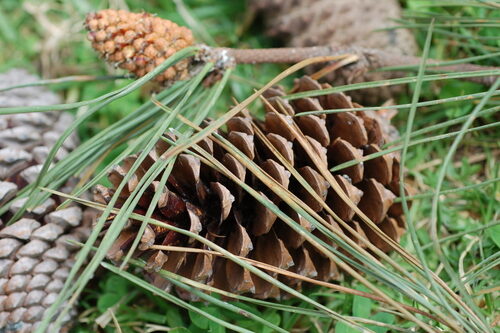
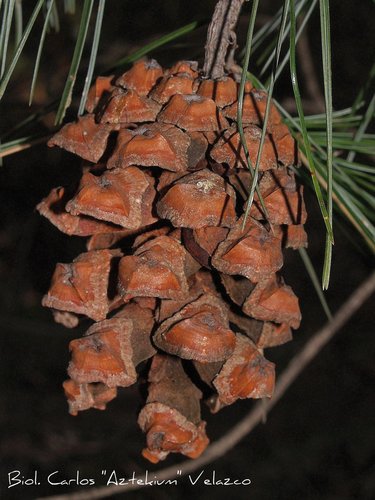
Pinus merkusii
Jungh. & de Vriese
Merkus pine
iNaturalist· cc-by-sa
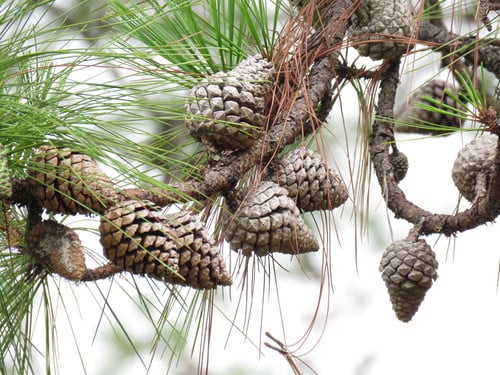
(c) mohd fahmi on Flickr, some rights reserved (CC BY-SA)
iNaturalist· cc-by-sa
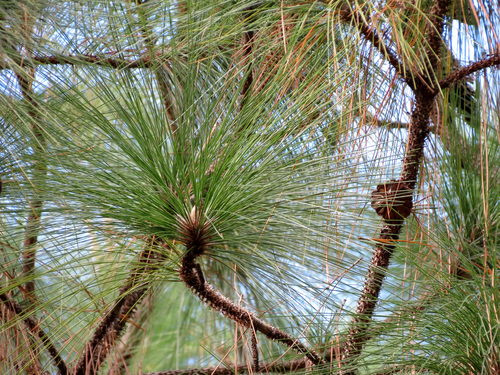
(c) mohd fahmi on Flickr, some rights reserved (CC BY-SA)
Summary
Source: WikipediaPinus merkusii, the Merkus pine or Sumatran pine, is a pine native to parts of southeast Asia, and the only one that occurs naturally south of the equator.
Description
A large evergreen tree reaching 50m tall by 30m wide, growing at a fast rate. Hardy to UK zone 10. Wind-pollinated with no specific information on self-fertility. Tolerates light sandy, medium loamy, and heavy clay soils; prefers well-drained conditions and grows in mildly acidic, neutral, or very acidic pH. Requires full sun and tolerates drought and moist soils.
Edible Uses
A vanillin flavouring is obtained as a by-product of resins released from the pulpwood. The seeds of all pine species are more or less edible; some are large and make very tasty, nutritious foods eaten in quantity, while others are less desirable due to a strongly resinous or bitter flavour, or are simply too small to be worth the effort. No specific information is available on the quality of this species' seeds, though they are noted as being rather small — the dark brown seeds are 6–7mm long, a measurement that includes the shell.
Traditional Uses
The tender layer of the stem just beneath the bark is eaten.
This uses section is brief — help expand it
Medicinal Uses
Turpentine drawn from the resin of pine trees is antiseptic, diuretic, rubefacient, and vermifuge. Taken internally, it is a valuable remedy for kidney and bladder complaints, and is used both internally and as a rub or steam bath for rheumatic conditions. It benefits the respiratory system and is useful against mucous membrane diseases, coughs, colds, influenza, and TB. Applied externally, it is a beneficial treatment for skin complaints, wounds, sores, burns, and boils, in the form of liniment plasters, poultices, herbal steam baths, and inhalers.
Known Hazards
The wood, sawdust and resins from various species of pine can cause dermatitis in sensitive people.
Distribution
It is a temperate plant.
Where It Grows
Asia, India, Indonesia, Myanmar, Northeastern India, Philippines,
Cultivation
It grows in areas where the mean annual rainfall is in the range 1,000 - 2,800mm, occasionally to 3,500mm, and the mean annual temperature is 21 - 28°c with a mean maximum temperature of the hottest month of 24 - 32°c and a mean minimum temperature of the coldest month of 18 - 24°c. Pines grow naturally in South-East Asia only in strongly seasonal environments. A strongly light-demanding species. Tolerant of a wide range of soils, including dry sandy soils, gravely soils, red tropical loams (latosols), clay soils, alluvial soils and acid ultisols on sandstone which are often poorly drained. It is often found on poor quality, acid soils. Prefers a pH in the range 4.5 - 5.5, tolerating 4 - 6.5. Established plants are drought tolerant. The plant is very wind tolerant. Young plants are quite slow-growing for their first five years, but later grow more rapidly. Harvesting of the resin can start about 15 years after being planted out. Trees can yield 3 - 4 kilos of resin a year, with some reports claiming that older trees can yield up to 30 - 60 kilos of crude gum a year. Old trees can yield 30 - 60 kg of crude gum per year, producing 20 - 40 kg of pure resin and 7 - 14 kg of turpentine per year. In plantations, trees reach sexual maturity when about 20 years old. They bear cones every year, although seed production varies. In plantations, the first thinning is usually carried out in the 9th or 10th year, and about every 5 years thereafter. Rotation cycles of 30 years are needed for optimal timber production. For the production of pulpwood, a cutting cycle of 15 years is usually practised. Mycorrhizae are required for successful growth and to allow seedlings to survive in more adverse sites. The prolonged 'grass stage' often present in young trees means increased weeding requirements when compared to P. Caribaea, P. Oocarpa and P. Kesiya. This is the southernmost occurring pine of all pines, and the only one whose natural distribution extends into the southern hemisphere. Merkus pines of the Asian mainland and the Philippines differ slightly from those of Sumatra: the seedlings have a 'grass stage', the needles are slightly longer, the cones are less cylindrical, and the seeds nearly twice as heavy.
Propagation
No pre-treatment is required, though soaking seed overnight in cold water before sowing can speed germination. Seeds germinate in 8–21 days, with a germination rate of 40–60% expected. Nursery bed seedlings are typically 20–25cm tall and ready for field planting after about 8 months. Natural regeneration requires relatively large amounts of sunlight at ground level. For cone collection, only those that have just changed colour from green to brown should be gathered, then air dried. Pine seeds can generally be stored for several years if kept dry, cold, and in an airtight container, but seeds of this species have a notably short viability — those from Sumatra can be stored dry for only 1–2 years, and those from continental Asia for an even shorter period. Propagation by tissue culture is possible using suspensor, root tissue, and hypocotyl segments from 2-week-old seedlings, all of which readily yield callus when cultured on a Murashige and Skoog mineral formulation supplemented with naphthalene acetic acid (0.25–0.65 ppm) and benzylamino purine (1.0–2.0 ppm).
Other Uses
A good-quality oleoresin is collected from this species, often on a plantation scale. The tree is a high resin yielder and commercial tapping is commonly practised. The resin is used in paints, medicines, printing, and the perfumery industry. The resin-rich wood is also used as torches. The heartwood is yellowish to orange-brown with dark red veins and numerous resin canals, clearly separated from a 2–5cm wide band of whitish to creamy-white sapwood. The texture is moderately coarse with a straight grain; the surface is lustrous when freshly cut but dulls with age, with a resinous odour and faint resinous taste. The wood is moderately heavy, soft to moderately hard, and seasons quickly with little risk of checking or distortion; once dry it is moderately stable. It saws easily and works to a good finish, though resins may clog cutters. Reports on durability conflict — some describe the wood as fairly durable and resistant to soil rot, others as non-durable and liable to termite attack. It serves as a general-purpose softwood for light construction, joinery, window and door frames, flooring, furniture, matches, chopsticks, paper pulp, pit props, transmission poles, ship and boat building, vehicle construction, and containers. The wood is also used as fuel and for making charcoal. The needles release a substance called terpene when washed by rain, which inhibits germination of some plants including wheat. This species is also a pioneer, naturally colonising areas following disturbances such as fire, and is used in the rehabilitation of degraded land due to its tolerance of fire and poor soils. It has been successfully intercropped with Irish potatoes and used to shade out alang-alang grass.
Other Information
It is commonly used. It is cultivated.
Synonyms
Also Known As
Hro-sheng
References (3)
- Tsering, J., et al, 2017, Ethnobotanical appraisal on wild edible plants used by the Monpa community of Arunchal Pradesh. Indian Journal of Traditional Knowledge. Vol 16(4), October 2017, pp 626-637
- World Checklist of Useful Plant Species 2020. Royal Botanic Gardens, Kew
- Zeven, A. C. & de West, J. M. J., 1982, Dictionary of cultivated plants and their regions of diversity. Wageningen. p 61