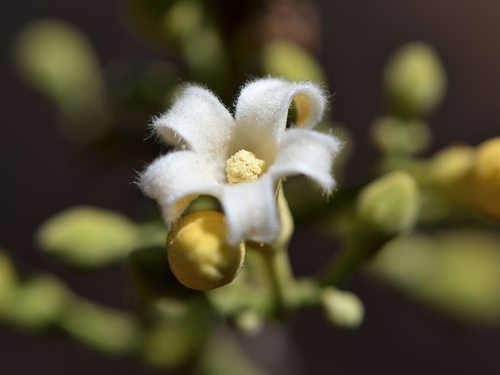
Cola verticillata
(Schum. et Thonn.) Stapf ex A. Chev.
Slippery kola
gbif· cc-by-nc-sa
MBG
gbif· cc-by-nc-sa
MBG
gbif· cc-by-nc-sa
MBG
Summary
Source: WikipediaCola verticillata is a species of tree in the genus Cola, of the family Malvaceae, native to the forests of tropical Africa. Common names include owe cola, slippery cola and mucilage cola. It was first described by the Danish botanist Peter Thonning as Sterculia verticillata, and was given its current name of Cola verticillata by the Austrian botanist Otto Stapf and the French botanist Auguste Chevalier.
Description
A medium sized tree. It grows up to 24 m high. The trunk is straight. They bark is brown with cracks along it. The small branches have a waxy coating. The leaves are simple and usually in rings of 4. The leaves are 10-25 cm long and 3.5-9 cm wide. They are sword shaped and taper to the tip. They are leathery and dark green. The flowers are arranged in rings. They are in the axils of leaves and are hairy. The fruit are made up of 5 cells. These are nearly at right angles to the stem. They are green or brown and shiny. They are 20 cm long by 9 cm wide. There are 6-8 seeds. These are covered with a white skin.
Edible Uses
The timber of Cola verticillata is hard and white; in southern Nigeria it is used to make fetish images. The trees are sometimes planted in villages, the nuts, which contain significant amounts of caffeine, being gathered from the wild when ripe and used to make a drink.
Distribution
It is a tropical plant. It grows in lowland rain-forest near streams. In Nigeria it is recorded at 1,440 m above sea level.
Where It Grows
Africa, Benin, Cabinda, Cameroon, Central Africa, Congo, Côte d'Ivoire, Ghana, Ivory Coast, Liberia, Nigeria, Togo, West Africa,
Notes
Also put in the family Sterculiaceae.
Also Known As
Abidoo, Goh, Owé cola, Owe kola, Senbiel, Woba
References (16)
- Brown, D., 2002, The Royal Horticultural Society encyclopedia of Herbs and their uses. DK Books. p 175
- Burkill, H. M., 1985, The useful plants of west tropical Africa, Vol. 5. Kew.
- Chapman, J. D. & Chapman, H. M., 2001, The Forest Flora of Taraba and Andamawa States, Nigeria. WWF & University of Canterbury. p 205
- Hawthorne, W.& Marshall, C., 2013, Nimba Western Area Iron Ore Concentrator Mining Project Environmental and Social Impact Assessment. AcelorMittel Liberia. p 461
- Jardin, C., 1970, List of Foods Used In Africa, FAO Nutrition Information Document Series No 2.p 33
Show all 16 references Hide references
- Keay, R.W.J., 1989, Trees of Nigeria. Clarendon Press, Oxford. p 135
- Les Vegetaux utiles de l'Afrique tropicale francais 6:136, t. 7, fig. 3. 1911 (Kolatiers)
- Menninger, E.A., 1977, Edible Nuts of the World. Horticultural Books. Florida p 41
- Purseglove, J.W., 1968, Tropical Crops Dicotyledons, Longmans. p
- USDA, ARS, National Genetic Resources Program. Germplasm Resources Information Network - (GRIN). [Online Database] National Germplasm Resources Laboratory, Beltsville, Maryland. Available: www.ars-grin.gov/cgi-bin/npgs/html/econ.pl (10 April 2000)
- van Wyk, B., 2005, Food Plants of the World. An illustrated guide. Timber press. p 149
- Vickery, M.L. and Vickery, B., 1979, Plant Products of Tropical Africa, Macmillan. p 90
- Vivien, J., & Faure, J.J., 1996, Fruitiers Sauvages d'Afrique. Especes du Cameroun. CTA p 346
- Wickens, G.E., 1995, Edible Nuts. FAO Non-wood forest products. FAO, Rome. p155
- Wiersema, J. H. & Leon, B., 2013, World Economic Plants. A Standard Reference CRC Press. 2nd Ed. p 190
- World Checklist of Useful Plant Species 2020. Royal Botanic Gardens, Kew