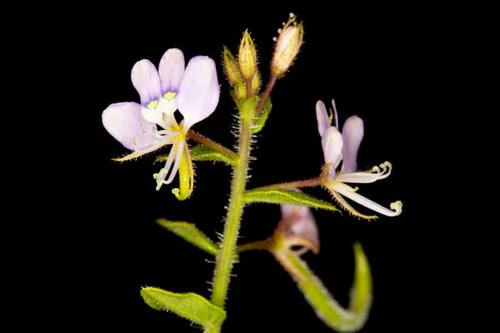
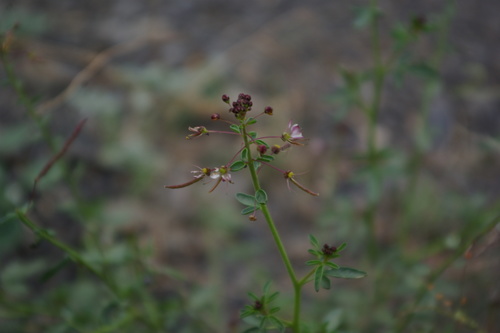
Cleome rutidosperma
DC.
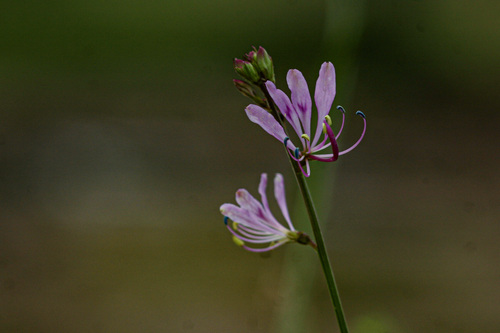
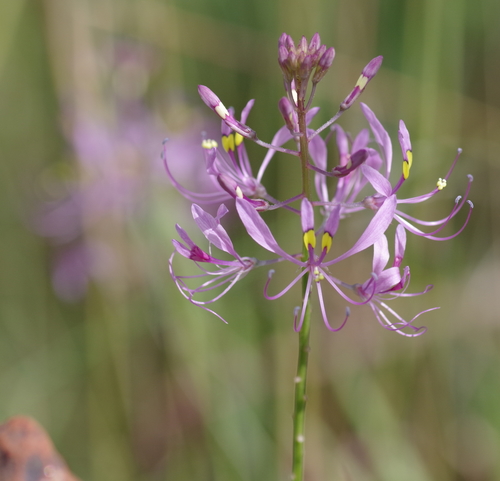
Fringed spiderplant
iNaturalist· cc0
no rights reserved, uploaded by 葉子
iNaturalist· cc-by-nc
(c) jediyam, some rights reserved (CC BY-NC)
Summary
Source: WikipediaCleome rutidosperma, commonly known as fringed spider flower or purple cleome, is a species of flowering plant in the genus Cleome of the family Cleomaceae, native to tropical Africa. This species is an invasive weed throughout most lowland wet tropical areas of Asia and Australia. It is a very common weed of lawns.
Description
An annual herb. It grows 50 cm tall. It branches from the base. The stems have fine hairs. The leaves are alternate and have 3 leaflets. The leaf stalks is 7 cm long. The leaflets are 1-6 cm long by 1-2.5 cm wide.
Edible Uses
The leaves are collected and cooked as a vegetable or added to soup, though they have a bitter taste. It is cultivated in some places as a vegetable of local importance.
Traditional Uses
The leaves are collected and cooked as a vegetable or added to soup. They have a bitter taste.
This uses section is brief — help expand it
Medicinal Uses
It possibly has anti-cancer properties.
Distribution
A tropical plant. It grows at low altitudes in hot humid conditions. It grows up to 400 m above sea level. It grows in areas with a rainfall between 1,700-3,000 mm. In Yunnan.
Where It Grows
Africa*, Angola, Asia, Australia, Benin, Burkina Faso, Cameroon, Central Africa, Central African Republic, CAR, Central America, China, Congo DR, Côte d'Ivoire, Cuba, East Africa, Equatorial-Guinea, Gabon, Gambia, Ghana, Guiana, Guinea, Guinée, Guinea-Bissau, Haiti, Indochina, Indonesia, Ivory Coast, Jamaica, Laos, Liberia, Malaysia, Myanmar, Nauru, Nigeria, North America, Pacific, Philippines, Sao Tome and Principe, SE Asia, Senegal, Sierra Leone, Taiwan, Tanzania, Togo, Tuvalu, Uganda, Virgin Islands, West Africa, West Indies, West Timor, Zambia,
Cultivation
A plant of the wet, lowland tropics, growing in areas with a mean annual rainfall within the range 1,700 - 3,000mm. The plant has become a weed in many areas in the tropics, often spreading freely and becoming invasive. It spreads by seed, which is dispersed by water, in farm machinery, farm produce and often by ants
Other Information
It is cultivated in some places. It is a vegetable of local importance only.
Notes
There are about 150 Cleome species. Also put in the family Capparaceae and they may be changed to the Brassicaceae. It possibly has anti-cancer properties.
Nutrition
| Part | Moisture | kJ | kcal | Protein | Vit A | Vit C | Iron | Zinc |
|---|---|---|---|---|---|---|---|---|
| Leaves raw | 81 | 239 | 57 | 5.5 | — | — | 2.7 | — |
Synonyms
Also Known As
Bodji-bu-butsangi, Garseya, Inzi, Kabangasheshe, Kinaski ciile, Maman, Mu ala, Mushaaka kanamafuji, Nanjinda
References (26)
- Achigan-Dako, E, et al (Eds), 2009, Catalogue of Traditional Vegetables in Benin. International Foundation for Science.
- Altschul, S.V.R., 1973, Drugs and Foods from Little-known Plants. Notes in Harvard University Herbaria. Harvard Univ. Press. Massachusetts. no. 1350
- Belem, M., et al, 2017, Strategy of Conservation and Protection of Wild Edible Plants Diversity in Burkina Faso. ANADOLU 27 (2) 2017, 82- 90 (As Cleome ciliata)
- Burkill, H. M., 1985, The useful plants of west tropical Africa, Vol. 1. Kew.
- Busson, 1965, (As Cleome ciliata)
Show all 26 references Hide references
- Codjia, J. T. C., et al, 2003, Diversity and local valorisation of vegetal edible products in Benin. Cahiers Agricultures 12:1-12
- Dalziel, J. M., 1937, The Useful plants of west tropical Africa. Crown Agents for the Colonies London. (As Cleome ciliata)
- Dansi, A., et al, 2008, Traditional leafy vegetables and their use in the Benin Republic. Genet Resour Crop Evol (2008) 55:1239–1256
- Food Composition Tables for use in Africa FAO http://www.fao.org/infoods/directory No. 584
- Grubben, G. J. H. and Denton, O. A. (eds), 2004, Plant Resources of Tropical Africa 2. Vegetables. PROTA, Wageningen, Netherlands. p 197
- http://aflora.africa.kyoto-u.ac.jp
- Jansen, P.C.M., 2004. Cleome rutidosperma DC. [Internet] Record from Protabase. Grubben, G.J.H. & Denton, O.A. (Editors). PROTA (Plant Resources of Tropical Africa), Wageningen, Netherlands. < http://database.prota.org/search.htm>. Accessed 14 October 2009.
- Jardin, C., 1970, List of Foods Used In Africa, FAO Nutrition Information Document Series No 2.p 68
- Kongel. Danske Vidensk. Selsk. Naturvidensk. Math. Afh. 4:68. 1829 (As Cleome ciliata)
- Malaisse, F., 1997, Se nourrir en floret claire africaine. Approche ecologique et nutritionnelle. CTA., p 59
- Malaisse, F., 2010, How to live and survive in Zambezian open forest (Miombo Ecoregion). Les Presses Agronomiques de Gembloux.
- Martin, F.W. & Ruberte, R.M., 1979, Edible Leaves of the Tropics. Antillian College Press, Mayaguez, Puerto Rico. p 181 (Also as Cleome ciliata)
- Murakami, A. et al, 2014, Screening for the In Vitro Anti-tumor-promoting Activities of Edible Plants from Malaysia. Bioscience, Biotechnology, and Biochemistry, 64:1, 9-16.
- Peters, C. R., O'Brien, E. M., and Drummond, R.B., 1992, Edible Wild plants of Sub-saharan Africa. Kew. p 76 (As Cleome ciliata)
- Plants of Haiti Smithsonian Institute http://botany.si.edu
- Prodr. 1:241. 1824
- Raponda-Walker, A & Sillans, R., 1961, Les Plantes Utiles du Gabon. Editions Paul Lechevalier, Paris. p 117 (As Cleome ciliata)
- Thaman, R. R, 2016, The flora of Tuvalu. Atoll Research Bulletin No. 611. Smithsonian Institute p 75
- World Checklist of Useful Plant Species 2020. Royal Botanic Gardens, Kew
- Yamada, T., 1999, A report of the Ethnobotany of the Nyindu in the Eastern part of the former Zaire. African Study Monographs 20(1):1-72
- Zon, A.P.M. van der, Grubben, G.J.H., 1976, Les legumes-feuilles spontanes et cultives du Sud-Dahomey, Communication 65, Royal Tropical Institute, Amsterdam, p 48 (As Cleome ciliata)