Cleomella lutea
(Hook.)
Yellow spiderflower, Yellow bee plant
iNaturalist· cc-by
(c) Andrey Zharkikh, some rights reserved (CC BY)
iNaturalist· cc-by
(c) Andrey Zharkikh, some rights reserved (CC BY)
iNaturalist· cc-by-sa
(c) Matt Lavin, some rights reserved (CC BY-SA)
Summary
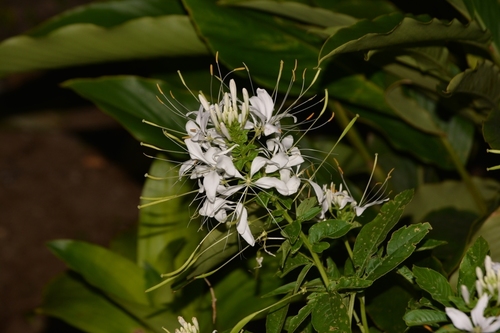
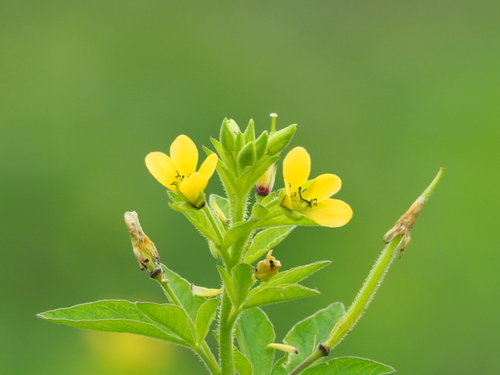
Source: WikipediaCleomella lutea is a species of flowering plant known by the common names yellow bee plant and yellow spiderflower. This annual wildflower is native to the western United States where it is most common in desert scrub and plateau habitats. It is a sprawling plant often exceeding 1 metre (3 feet) in height. The erect stem can be branched and has widely spaced leaves all the way along, each leaf made up of three to five leaflets, which are smaller closer to the top of the plant. Atop the stem is a showy inflorescence of many bright yellow flowers. Each flower has four narrow sepals and four oblong petals around a cluster of six long stamens tipped with knobby anthers. As the inflorescence lengthens at the top of the stem, flowers that have opened and been pollinated drop their petals and the ovary develops into a fruit. The fruits are capsules several centimeters long containing large seeds; these develop at the base of the inflorescence and hang on pedicels. A flowering plant may have blooming flowers at the top of the stem and ripening capsules dangling off the stem further down. Some Plateau Indian tribes drank an infusion from the branch and flowers of the yellow bee plant as a treatment for the common cold.
Description
An annual plant. It grows 30 cm high and spreads 50 cm wide. The stems are erect and slender. The leaves are compound. The flowers are yellow-orange. They are in groups at the top of the plant.
Edible Uses
The leaves are used as a potherb, and the seeds are ground into meal.
Traditional Uses
The leaves are used as a potherb. The seeds are ground into a meal.
This uses section is brief — help expand it
Distribution
It is a temperate plant. It is best in light, well-drained, rich soils. It needs a protected sunny position. It is resistant to frost but damaged by drought.
Where It Grows
Australia, Mexico, North America*, USA,
Cultivation
Plants are grown from seeds.
Notes
There are about 150 Cleome species. It was in the plant family Capparaceae.
Synonyms
Also Known As
Golden cleome
References (7)
- Bodkin, F., 1991, Encyclopedia Botanica. Cornstalk publishing, p 265 (As Cleome lutea)
- Fl. bor.-amer. 1:70, t. 25. 1830 (As Cleome lutea)
- http://www.stoller-eser.com/Flora/ethnobotany_table.htm (As Cleome lutea)
- Kermath, B. M., et al, 2014, Food Plants in the Americas: A survey of the domesticated, cultivated and wild plants used for Human food in North, Central and South America and the Caribbean. On line draft. p 242 (As Cleome lutea)
- MacMahon, J.A., 1990, Deserts. Audubon Society Nature Guides. Knopf. p 390 Plate 111 (As Cleome lutea)
Show all 7 references Hide references
- Plants for a Future database, The Field, Penpol, Lostwithiel, Cornwall, PL22 0NG, UK. http://www.scs.leeds.ac.uk/pfaf/ (As Cleome lutea)
- World Checklist of Useful Plant Species 2020. Royal Botanic Gardens, Kew