Citrus bergamia
L.
Bergamot
iNaturalist· cc0
no rights reserved
iNaturalist· cc0
no rights reserved
iNaturalist· cc0
no rights reserved
Description
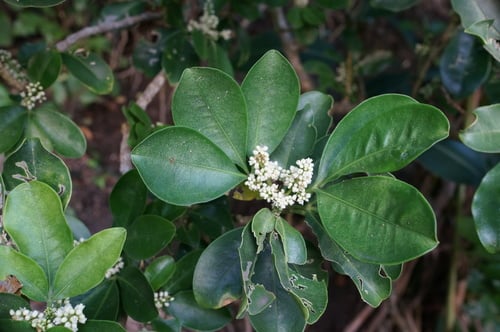
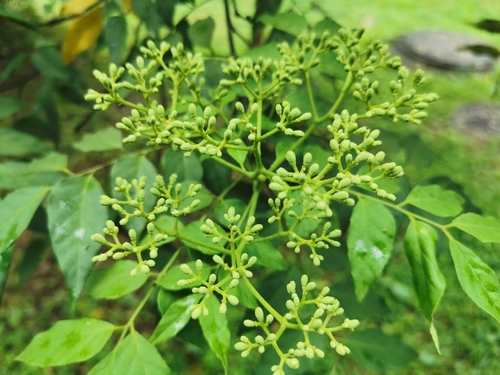
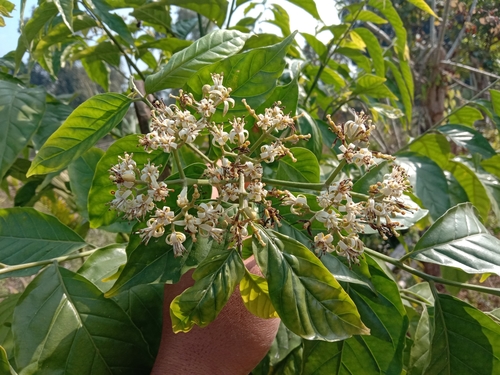
An evergreen tree. It grows 3-4 m tall. It can be 12 m tall with a trunk 25 cm across. It has irregular branches. The leaves are simple and alternate. They are large and oval. The blade is 12 cm long by 6 cm wide. The flowers are small and have a sweet fragrance. The fruit are pear shaped and 10 cm across.
Edible Uses
The aromatic oil from the peel is used to flavor Earl Grey tea, candy, baked goods, chewing gum, and desserts. The very acid fruit are sometimes used for vinegar or lime juice. The flowers are used for making orange flower water.
Traditional Uses
The oil from the peel is used in Earl Grey Tea. It is also used to flavour candy, baked goods, chewing gum and desserts. The very acid fruit are sometimes used for vinegar or lime juice. The flowers are used for making orange flower water.
Medicinal Uses
Bergamot is a bitter, aromatic herb that relieves tension, relaxes spasms and improves digestion. Neroli essential oil, which is obtained from the flowers, is stimulant and, reputedly, aphrodisiac. Bergamot oil, which is obtained from the peel of the fruit, is more sedative and healing. Orange flower water is taken internally to treat colic, especially in babies. Bergamot oil is used externally in douches and baths to treat vaginal infections. Both neroli oil and bergamot oil are used in aromatherapy for stress-related complaints and skin conditions.
Known Hazards
Bergamot essential oil contains bergapten which may cause skin irritation and photosensitivity and is thus a danger in sunscreen products. Bergamot oil NS (non-sensitizing) has been developed to overcome this risk; terpeneless grades produced by vacuum distilling whole oil can also be used.
Distribution
It is a subtropical plant. It grows best in full sun. It does not do well with either very wet or very dry soils. It needs a temperature above 7°C. It suits hardiness zones 9-11.
Where It Grows
Africa, Asia, Australia, Cuba, Europe, France, Italy, Madagascar, Mediterranean, Mexico, Morocco, North Africa, Turkey, Türkiye, West Indies,
Cultivation
Plants can be grown by seeds, layering or cuttings.
Propagation
The seed is best sown in containers as soon as it is ripe, after thoroughly rinsing it. Sow stored seed in containers as soon as possible]. Germination usually takes place within 2 - 3 weeks at 13°c. Seedlings are liable to damp off so they must be watered with care and kept well ventilated. The seed is usually polyembryonic, two or more seedlings arise from each seed and they are genetically identical to the parent but they do not usually carry any virus that might be present in the parent plant. When large enough to handle, prick the seedlings out into individual pots and grow them on until they are 10cm or more tall before planting out into their permanent positions. Cuttings of half-ripe wood, July/August in a frame. This species grows easily from cuttings. Layering in October.
Other Uses
Bergamot is mainly grown for the essential oil present in the peel of its fruit (bergamot oil). Bergamot oil is an important component of toilet water 'eau-de-Cologne', which was first developed around 1675 in Cologne (Germany) by the Italian immigrant Gian Paolo Feminis. His relatives further developed the industry and brought it to several other cities. As a result several formulae of eau-de-Cologne were developed, all characterized by bergamot oil. Later, bergamot oil became a constituent of high quality perfumes and of men's perfumes, such as aftershaves. The oil is further used in skin care products (bronzers), soaps, lotions and creams. A different essential oil is obtained from the leaves and branches (bergamot petitgrain oil), but is only produced to order. Neroli oil, obtained from the flowers, is used in perfumery.
Production
The fruit is used for oil. It takes 200 kg of fruit to produce 1 kg of oil.
Other Information
It is cultivated.
Notes
There are 20 Citrus species. Several hybrids have been formed.
Synonyms
Also Known As
Bargamaoty, Bergamet, Bergamota
References (18)
- Bodkin, F., 1991, Encyclopedia Botanica. Cornstalk publishing, p 261
- Brouk, B., 1975, Plants Consumed by Man. Academic Press, London. p 189
- Brown, D., 2002, The Royal Horticultural Society encyclopedia of Herbs and their uses. DK Books. p 172
- Etherington, K., & Imwold, D., (Eds), 2001, Botanica's Trees & Shrubs. The illustrated A-Z of over 8500 trees and shrubs. Random House, Australia. p 214
- Facciola, S., 1998, Cornucopia 2: a Source Book of Edible Plants. Kampong Publications, p 215
Show all 18 references Hide references
- Hist. nat. orangers 1:111, t. 53-56. 1819
- Kiple, K.F. & Ornelas, K.C., (eds), 2000, The Cambridge World History of Food. CUP p 1731
- Lyle, S., 2006, Discovering fruit and nuts. Land Links. p 142
- Miguel, E., et al, 1989, A checklist of the cultivated plants of Cuba. Kulturpflanze 37. 1989, 211-357
- Morton,
- PROSEA handbook Volume 13 Spices. p 275
- Risso & Poit.
- Segura, S., et al, 2018, The edible fruit species in Mexico. Genet Resour Crop Evol (2018) 65:1767–1793
- Small, E., 2009, Top 100 Food Plants. The world's most important culinary crops. NRC Research Press. p 390
- Tanaka,
- Wiersema, J. H. & Leon, B., 2013, World Economic Plants. A Standard Reference CRC Press. 2nd Ed. p 179
- www.worldagroforestrycentre.org/treedb/
- Zeven, A. C. & de West, J. M. J., 1982, Dictionary of cultivated plants and their regions of diversity. Wageningen. p 118