Cissus quadrangularis
L.
Edible stemmed vine
iNaturalist· cc-by-nc
(c) karel, some rights reserved (CC BY-NC)
iNaturalist· cc-by-nc-sa
(c) World Agroforestry, some rights reserved (CC BY-NC-SA)
iNaturalist· cc-by-sa
(c) M Kriek, some rights reserved (CC BY-SA), uploaded by M Kriek
Summary
Source: WikipediaCissus quadrangularis is a perennial plant of the grape family. It is commonly known as veldt grape, winged treebine or adamant creeper. The species is native to tropical Asia, the Arabian Peninsula and much of Africa.
Description
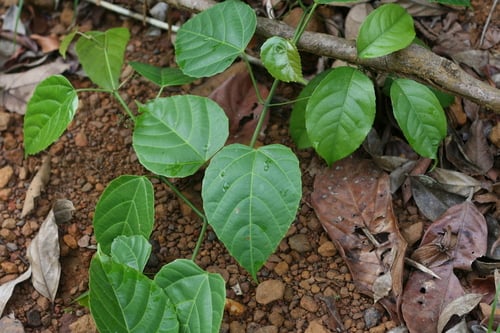
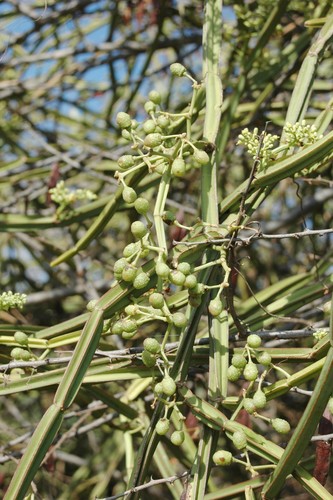
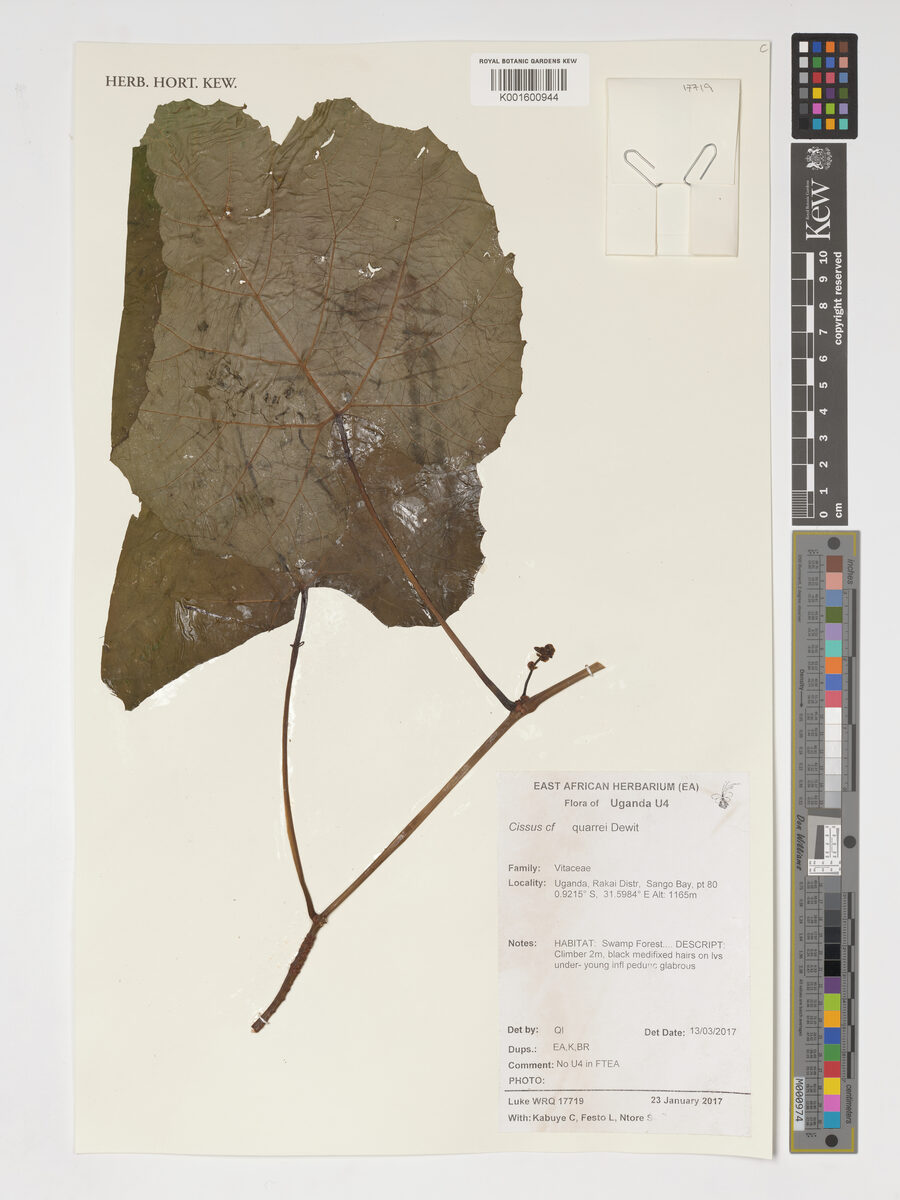
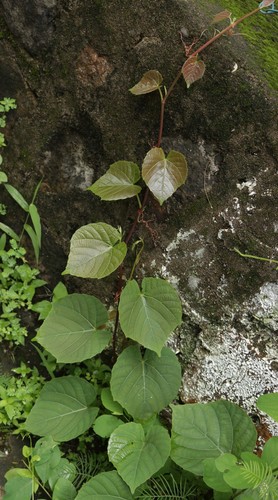
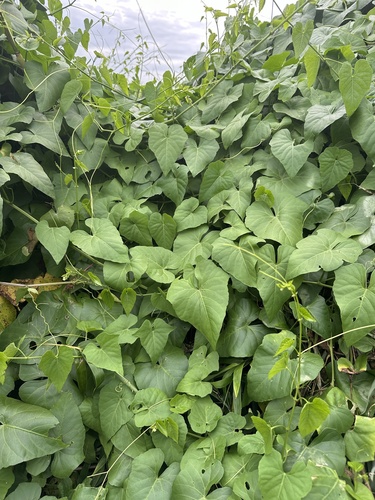
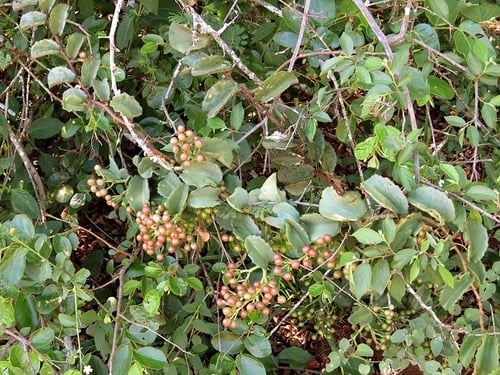
A climber with a fleshy four angled stem. It grows to 3 m long. It can be 10 m long. Leaves only occur on young shoots and the rest of the plant is leafless. The plant has tendrils by which it attaches to objects. These are opposite the leaves. The inner branches are thinner with a wavy edge, and these are constricted at the nodes. The leaves occur at the nodes. The leaves are simple, rounded and have teeth around the edges. Sometimes the leaves have 3 lobes. Leaves can be 20 cm long. The flowers are arranged in clusters. They are small and green or yellow. These clusters can be 5 cm long. The fruit is red to black and round. It can be 10 mm across.
Edible Uses
Young green stems are cooked, usually fried or curried. The leaves and young shoots are used in the preparation of poppadoms and curries. The fruit is edible. The ash of the plant is used as a substitute for baking powder.
Traditional Uses
Young leaves and shoots are used in curries. They are also used in the preparation of papadams. Fresh stem pieces are pickled. The stems can be stored for 10 days. The fruit are eaten. The seeds are used for cooking oil. The ash of the plant is used as a substitute for baking powder.
Medicinal Uses
An infusion of the plant is antifungal and anthelmintic. The pulped stem is given in the treatment of asthma, used as an alterative in cases of amenorrhoea, and given in the treatment of haemorrhoids. The leaves or young stems are analgesic and speed the rate of healing; they are crushed and applied as a poultice to ease pain from broken bones, for the maturation of boils, to treat wounds and burns, to ease rheumatic joint pain, and as a treatment for saddle sores on horses. Powdered dry roots are used for treating indigestion. The powdered root is considered a specific treatment for fractured bones.
Distribution
A tropical plant. It occurs in the Ethiopian highlands. The minimum temperature is 15°C. In Thailand it occurs in forests and coastal regions. It grows in the hottest part of India. It grows in hot arid places. It grows between sea level and 1,950 m above sea level. It grows in woodland and savannah. It can grow in arid places. It suits hardiness zones 10-12.
Where It Grows
Africa, Angola, Arabia, Asia, Australia, Bangladesh, Benin, Botswana, Burkina Faso, Cambodia, Cameroon, Central Africa, Central African Republic, CAR, Chad, Congo, Côte d'Ivoire, East Africa, Egypt, Eritrea, Eswatini, Ethiopia, Gabon, Gambia, Guinea, Guinée, Guinea-Bissau, Hawaii, India, Indochina, Indonesia, Ivory Coast, Kenya, Laos, Madagascar, Malawi, Malaysia, Maldives, Mali, Middle East, Mozambique, Myanmar, Namibia, Nigeria, North Africa, Northeastern India, Pacific, Pakistan, Philippines, SE Asia, Senegal, Somalia, South Africa, Southern Africa, Sri Lanka, South Sudan, Sudan, Swaziland, Tanzania, Thailand, Uganda, USA, Vietnam, West Africa, Zambia, Zimbabwe,
Cultivation
A plant of drier to arid regions, mainly in the lowland tropics and frost-free subtropics, though it can also be found at elevations over 2,000 metres. The plant is intolerant of any frost. Succeeds in full sun to light shade. Succeeds in most soils but prefers a loam.
Propagation
Layers very easily. Also easily grown from stem cuttings.
Other Uses
The plant is sometimes grown to stabilize sand dunes and can be trained to form a hedge. The stems and roots yield a strong fibre.
Notes
It has a number of medicinal uses. There are about 200-350 Cissus species. There are about 75 species in tropical America.
Nutrition
| Part | Moisture | kJ | kcal | Protein | Vit A | Vit C | Iron | Zinc |
|---|---|---|---|---|---|---|---|---|
| Stems | — | 37 | 1.2 | — | — | 2.1 | — | — |
Synonyms
Also Known As
Ali'e, Arugani, Asthisanhara, Athuku bachali, Bohocenou, Chaudhari, Chodhari, Chophi, Choudhari, Daddori, Hadijod, Hadjod, Hadjodi, Hadjora, Haraslata, Harbhanga, Harjora, Harsankari, Harzora, Hasjora, Itachovani, Kaktus manjat, Kan kaw, Kand-vel, Kandra, Karsankari, Kashikafa, Khandvel, Kiritti, Lidzambiso, Mabope, Mafumo, Mangaroli, Mangaroli, Mhais-vel, Murunjurunju, Muvengahonye, Nalleru, Naralai, Nofon, Nullerootigch, Patah tulang, Perandai keerai, Pirandai, Purundei codie, Renja, Renjam Itachovani, Repich-ingthun, Sam-roi-taw, San chakat, Shazaung-let-set, Sihlonhlwane, Suncaro, Umhlafutu, Vajravalli, Vedhari, Veldt-grape, Winged treebine
References (67)
- Achigan-Dako, E, et al (Eds), 2009, Catalogue of Traditional Vegetables in Benin. International Foundation for Science.
- Ambasta, S.P. (Ed.), 2000, The Useful Plants of India. CSIR India. p 127
- Andersohn, G., 1983, Cacti and Succulents. EP Publishing. p 298
- Ara, R. I. T., 2015, Leafy Vegetables in Bangladesh. Photon eBooks. p 102
- Arinathan, V., et al, 2007, Wild edibles used by Palliyars of the western Ghats, Tamil Nadu. Indian Journal of Traditional Knowledge. 6(1) pp 163-168
Show all 67 references Hide references
- Bahru, T., et al, 2013, Wild Edible Plants: Sustainable Use and Management by Indigenous Communities in and the Buffer Area of Awah National Park, Ethiopia. Ethiop. J. Sci., 36(2): 93-108
- Baro, D., Baruah, S. and Borthukar, S. K. 2015, Documentation on wild vegetables of Baksa district, BTAD (Assam). Scholars Research Library. Archives of Applied Science Research, 2015, 7 (9):19-2
- Bongers, F. et al (Eds), Forest Climbing Plants of West Africa: Diversity, Ecology and Management. CABI
- Bonou, A., et al, 2013, Valeur economique des Produits Forestiers Non Ligneux (PFNL) au Benin. Editions Universitaires Europeennes p 92
- Brickell, C. (Ed.), 1999, The Royal Horticultural Society A-Z Encyclopedia of Garden Plants. Convent Garden Books. p 270
- Burkill, I.H., 1966, A Dictionary of the Economic Products of the Malay Peninsula. Ministry of Agriculture and Cooperatives, Kuala Lumpur, Malaysia. Vol 2 (I-Z) p 2287 (As Vitis quadrangularis)
- Chandrakumar, P., et al, 2015, Ethnobotanical studies of wild edible plants of Gond, Halba and Kawar tribes of Salekasa Taluka, Gondia District, Maharashtra State, India. International Research Journal of Pharmacy 6(8)
- Chowdery, T., et al, 2014, Wild edible plants of Uttar Dinajpur District, West Bengal. Life Science Leaflets. 47:pp 20-36 http://lifesciencesleaflets.ning.com
- Chowdhury, M. & Mukherjee, R., 2012, Wild Edible Plants Consumed by Local Communities of Maldah of West Bengal, India. Indian J.Sci.Res.3(2) : 163-170
- Cundall, P., (ed.), 2004, Gardening Australia: flora: the gardener's bible. ABC Books. p 380
- Dalziel, J. M., 1937, The Useful plants of west tropical Africa. Crown Agents for the Colonies London.
- Diarra, N. et al, 2016, Etude ethnobotanique des plantes alimentaires utilisées en période de soudure dans les régions Sud du Mali. Int. J. Biol. Chem. Sci. 10(1): 184-197
- Dobriyal, M. J. R. & Dobriyal, R., 2014, Non Wood Forest Produce an Option for Ethnic Food and Nutritional Security in India. Int. J. of Usuf. Mngt. 15(1):17-37
- Dutta, U., 2012, Wild Vegetables collected by the local communities from the Churang reserve of BTD, Assam. International Journal of Science and Advanced Technology. Vol. 2(4) p 119
- Facciola, S., 1998, Cornucopia 2: a Source Book of Edible Plants. Kampong Publications, p 245
- FAO, 1988, Traditional Food Plants, FAO Food and Nutrition Paper 42. FAO Rome p 184
- Fowler, D. G., 2007, Zambian Plants: Their Vernacular Names and Uses. Kew. p 63
- Gallagher, D. E., 2010, Farming beyond the escarpment: Society, Environment, and Mobility in Precolonial Southeastern Burkina Faso. PhD University of Michigan.
- Hedrick, U.P., 1919, (Ed.), Sturtevant's edible plants of the world. p 685 (Vitis quandrangularis)
- Hossain, U. & Rahman, A., 2018, Study and quantitative analysis of wild vegetable floral diversity available in Barisal district, Bangladesh. Asian J. Med. Biol. Res. 2018, 4 (4), 362-371
- Jadhav, R., et al, 2015, Forest Foods of Northern Western Ghats: Mode of Consumption, Nutrition and Availability. Asian Agri-History Vol. 19, No. 4: 293-317
- Jardin, C., 1970, List of Foods Used In Africa, FAO Nutrition Information Document Series No 2.p 67, 128
- Kar, A., & Borthakur, S. K., 2008, Wild vegetables of Karbi - Anglong district, Assam, Natural Product Radiance, Vol. 7(5), pp 448-460
- Karthi, Sathya, & Salome, 2014, Uncultivated Edible Greens from Small Millet Farms Tamil Nadu India. IDRC (As Vitis quadrangularis)
- Kohila, A. & Kensa, V. M., 2019, Survey of Wild Edible Plants of Dhanakarkulam Panchayath, Tirunelveli District, Tamil Nadu, India. Kong. Res. J. 6(2): 20-27, 2019
- Kumar, R. & Saikia, P., 2020, Wild edible plants of Jharkhand and their utilitarian perspectives. Indian Journal of Traditional Knowledge Vol 19 (2), April 2020, pp 237-250
- Kumbhojkar, M.S. & Vartak, V.D., 1988, Ethnobotanical Studies on Wild Edible Grapes from Sacred Groves in Western Maharashtra. J. Econ. Tax. Bot. Vol. 12 No. 2 pp 257-263
- Long, C., 2005, Swaziland's Flora - siSwati names and Uses http://www.sntc.org.sz/flora/
- Martin, F.W. & Ruberte, R.M., 1979, Edible Leaves of the Tropics. Antillian College Press, Mayaguez, Puerto Rico. p 225
- Martin, F.W. & Ruberte, R.M., 1979, Edible Leaves of the Tropics. Antillian College Press, Mayaguez, Puerto Rico. p 174 (As Vitis quadrangularis)
- McMakin, P.D., 2000, Flowering Plants of Thailand. A Field Guide. White Lotus. p 63
- Miller, A. G., Morris, M. & Stuart-Smith, S., 1988, Plants of Dhofar. The Southern Region of Oman, Traditional, Economic and Medicinal Uses. Sultanate of Oman. p 284
- Mohan, V. R. & Kalidass, C., 2010, Nutritional and Antinutritional Evaluation of some Unconventional Wild Edible Plants. Tropical and Subtropical Agroecosystems, 12 (2010): 495- 506
- Mutie, F. M., et al, 2023, Important Medicinal and Food Taxa (Orders and Families) in Kenya, Based on Three Quantitative Approaches. Plants 2023, 12, 1145
- Patiri, B. & Borah, A., 2007, Wild Edible Plants of Assam. Geethaki Publishers. p 27
- Peters, C. R., O'Brien, E. M., and Drummond, R.B., 1992, Edible Wild plants of Sub-saharan Africa. Kew. p 201
- PROSEA (Plant Resources of South East Asia) handbook, Volume 8, 1993, Vegetables
- Ramachandran, V. S., 2007, Wild edible plants of the Anamalais, Coimbatore district, western Ghats, Tamil Nadu. Indian Journal or Traditional Knowledge. 6(1) pp 173-176
- Rao, M. L. S., et al, 2014, Indigenous Plant Foods which are commonly consumed by the tribal communities in Dumbriguda Area of Visakhapatnam District, Andhra Pradesh, India. Biolife. Vol 2, Issue 3
- Raponda-Walker, A & Sillans, R., 1961, Les Plantes Utiles du Gabon. Editions Paul Lechevalier, Paris. p 55
- Rasingam, L., 2012, Ethnobotanical studies on the wild edible plants of Irula tribes of Pillur Valley, Coimbatore district, Tamil Nadu, India. Asian Pacific Journal of Tropical Biomedicine. (2012) S1493-S1497
- Royal Botanic Gardens, Kew (1999). Survey of Economic Plants for Arid and Semi-Arid Lands (SEPASAL) database. Published on the Internet; http://www.rbgkew.org.uk/ceb/sepasal/internet [Accessed 13th June 2011]
- Samy, J., Sugumaran, M., Lee, K. L. W., 2009, Herbs of Malaysia, Marshall Cavendish. p 80
- Sarvalingam, A., et al, 2014, Wild edible plant resources used by the Irulas of the Maruthamalai Hills, Southern Western Ghats, Coimbatore, Tamil Nadu. Indian Journal of Natural Products and Resources 5(2):198-201
- Seidemann J., 2005, World Spice Plants. Economic Usage, Botany, Taxonomy. Springer. p 105
- Shah, G.L. et al, 1981, An account of the Ethnobotany of Saurashtra in Gujarat State (India). J. Econ. Tax. Bot. Vol 2 pp 173-182
- SHORTT,
- Singh, H.B., Arora R.K.,1978, Wild edible Plants of India. Indian Council of Agricultural Research, New Delhi. p 21
- Staples, G.W. and Herbst, D.R., 2005, A tropical Garden Flora. Bishop Museum Press, Honolulu, Hawaii. p 573
- Sujanapal, P., & Sankaran, K. V., 2016, Common Plants of Maldives. FAO & Kerala FRI, p 80
- Sukarya, D. G., (Ed.) 2013, 3,500 Plant Species of the Botanic Gardens of Indonesia. LIPI p 911, 989 (Also as Vitis quadrangularis)
- Swaziland's Flora Database http://www.sntc.org.sz/flora
- Syst. nat. ed. 12, 2:124; Mant. pl. 1:39 ("quadrangulus"). 1767
- Tamil herbs, 2007, Edible Plants of the Tropical Dry Evergreen Forest.
- Tanaka,
- Tredgold, M.H., 1986, Food Plants of Zimbabwe. Mambo Press. p 3
- USDA, ARS, National Genetic Resources Program. Germplasm Resources Information Network - (GRIN). [Online Database] National Germplasm Resources Laboratory, Beltsville, Maryland. Available: www.ars-grin.gov/cgi-bin/npgs/html/econ.pl (10 April 2000)
- von Katja Rembold, 2011, Conservation status of the vascular plants in East African rain forests. Dissertation Universitat Koblenz-Landau p 160
- WATT, (As Vitis quadrangularis)
- Wiersema, J. H. & Leon, B., 2013, World Economic Plants. A Standard Reference CRC Press. 2nd Ed. p 177
- World Checklist of Useful Plant Species 2020. Royal Botanic Gardens, Kew
- www.zimbabweflora.co.zw 2011