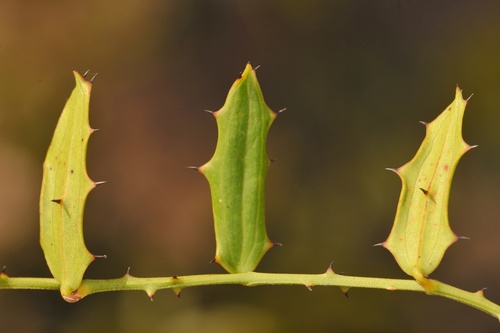
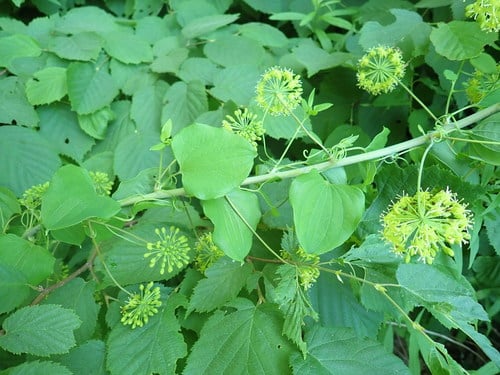
Smilax aristolochiifolia
Mill.
Mexican sarsaparilla
iNaturalist· cc-by-nc
(c) Victor Quintero F., some rights reserved (CC BY-NC), uploaded by Victor Quintero F.
iNaturalist· cc-by-nc
(c) Victor Quintero F., some rights reserved (CC BY-NC)
Summary
Source: WikipediaSmilax aristolochiifolia, also known as gray sarsaparilla, Mexican sarsaparilla, or sarsaparilla, is a species in the genus Smilax and the family Smilacaceae, native to Mexico and Central America. It is widely used as traditional medicine to treat many symptoms.
Description
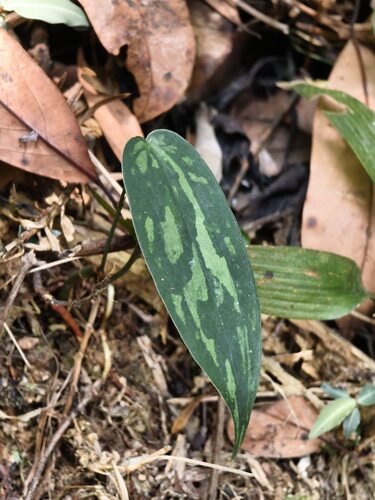
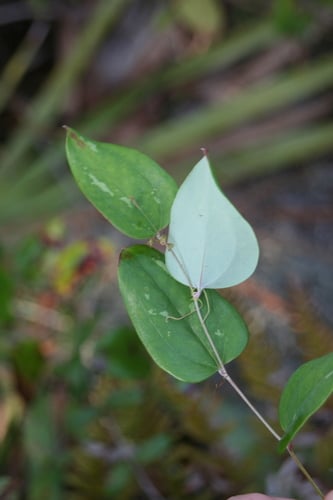
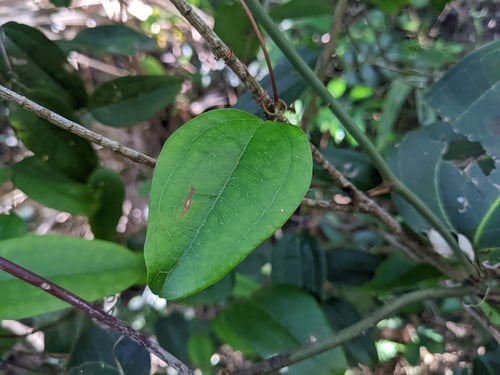
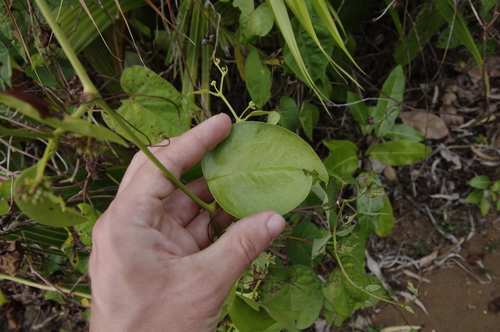
A climbing vine. It has tendrils. It grows 4-5 m long. The roots can be 2-2.5 m long. The leaves are papery and arranged alternately. The leaves are 10-30 cm wide. The flowers are small and green. The fruit are small red berries with 2-3 seeds.
Edible Uses
Root extracts are used to flavour soft drinks, ice cream, confectionery and bakery products. The root itself is bitter with a liquorice-like taste.
Traditional Uses
The root is used to make a drink. The roots are used for sarsaparilla flavouring. It is used commercially for flavouring root beers, baked goods, ice cream candy and drinks.
Medicinal Uses
Mexican sarsaparilla, derived from the roots and rhizome, is a sweet, acrid, alterative herb that reduces inflammation, controls itching, improves digestion and elimination, and is antiseptic. This is one of three species — the others being S. febrifuga and S. regelii — that gained a high reputation in the 17th century as cure-alls and were widely imported into Europe until early in the 20th century, when their rather overrated reputation had waned somewhat. The plants do have genuine medicinal benefits: their roots contain steroidal saponins that are effective in treating many cases of psoriasis, and they also have hormonal effects that may improve fertility in women with ovarian dysfunction. The rhizomes are alterative, digestive and febrifuge. A decoction is used in the treatment of fevers, digestive disorders, kidney troubles and gonorrhoea, and is also applied against scrophula, skin diseases and rheumatism.
Distribution
It is a tropical plant. It grows in warm and swampy areas. It grows between 850-1,760 m above sea level.
Where It Grows
Belize, Central America, Costa Rica, El Salvador, Guatemala, Mexico, North America, USA,
Cultivation
Not known
Propagation
Seed.
Other Uses
Other Uses: None known Special Uses
Other Information
One of the main sources of sarsaparilla.
Synonyms
Also Known As
Enredadera de monte, Gray sarsaparilla, Veracruz sarsaparilla, Zarzaparilla
References (10)
- Facciola, S., 1998, Cornucopia 2: a Source Book of Edible Plants. Kampong Publications, p 231 (As Smilax medica)
- Heywood, V.H., Brummitt, R.K., Culham, A., and Seberg, O., 2007, Flowering Plant Families of the World. Royal Botanical Gardens, Kew. p 401 (Family)
- Kermath, B. M., et al, 2014, Food Plants in the Americas: A survey of the domesticated, cultivated and wild plants used for Human food in North, Central and South America and the Caribbean. On line draft. p 809
- Kiple, K.F. & Ornelas, K.C., (eds), 2000, The Cambridge World History of Food. CUP p 1781 (As Smilax medica)
- Linnaea 6:47. 1831 (As Smilax medica)
Show all 10 references Hide references
- Morton, (As Smilax medica)
- Pascual-Mendoza, S. et al, 2021, Traditional knowledge of edible plants in an indigenous community in the Sierra Norte of Oaxaca, Mexico. Plant Biosystems - An International Journal Dealing with all Aspects of Plant Biology
- Piedra-Malagón, E. M., et al, 2022, Edible native plants of the Gulf of Mexico Province. Biodiversity Data Journal 10: e80565 p 30
- Wiersema, J. H. & Leon, B., 2013, World Economic Plants. A Standard Reference CRC Press. 2nd Ed. p 640
- World Checklist of Useful Plant Species 2020. Royal Botanic Gardens, Kew