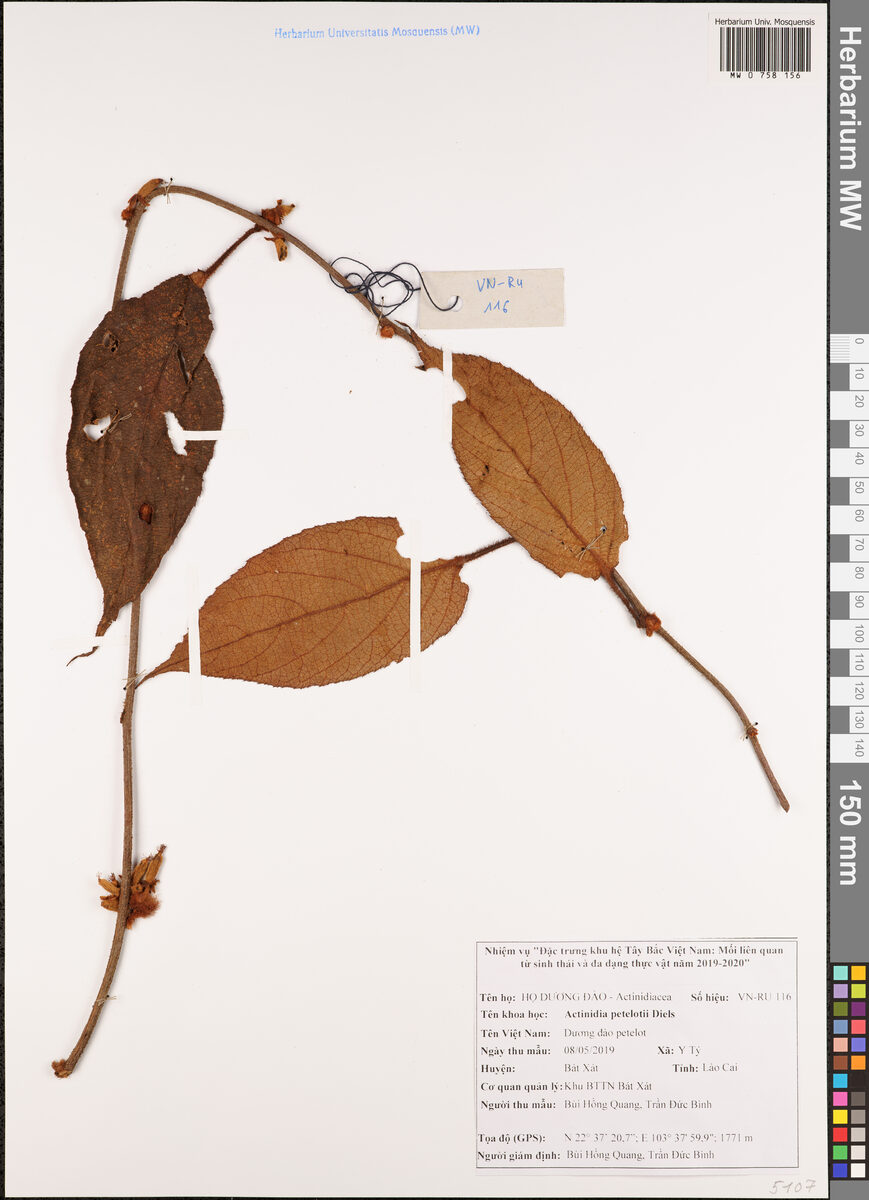
Actinidia callosa
Lindl.
Kokuwa
iNaturalist· cc-by-nc
(c) Kinmatsu Lin, some rights reserved (CC BY-NC), uploaded by Kinmatsu Lin
iNaturalist· cc-by-sa
(c) fagushayata, some rights reserved (CC BY-SA)
Summary
Source: WikipediaActinidia callosa, the Himalayan kiwi vine, is a species of flowering plant in the Chinese gooseberry family Actinidiaceae. A deciduous climber reaching 30 m (98 ft), it is found in a wide variety of habitats at elevations from 400 to 2,600 m (1,300 to 8,500 ft). Cultivated for its fruit, there is considerable doubt that it is a good species given vagrancies in the distributions of its varieties and its variable chromosome numbers.
Description
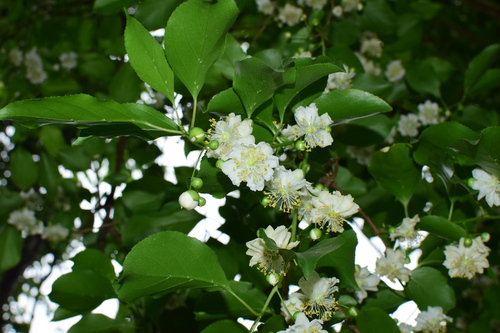
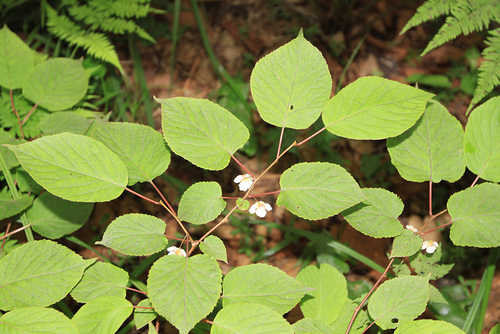
A climber to 9 m long. The stems can be 10 cm across. The leaves are stalked. The leaves are 8-15 cm long and oval and pointed. Male and female flowers occur on separate plants. The flowers are 1.5-2.5 cm across. There are five rounded petals that are overlapping. Flowers are white. The fruit is a green berry. Fruit are 1.8-2.2 cm long and have many small seeds.
Edible Uses
The fruit can be eaten raw or cooked and has a delicate, acid flavour. It can also be dried for later use. Fruits are grayish-green when fully ripe and range from 18–50mm in length. They contain a number of small seeds, which are soft enough to eat along with the flesh.
Traditional Uses
The ripe fruit are eaten raw or cooked. They are also used for jam. They are acid. They are also dried and used in pastries.
This uses section is brief — help expand it
Medicinal Uses
None known
Distribution
A tropical and subtropical plant. It grows in W. China and the Himalayas in forests and shrubby areas up to 3000 metres altitude. In Nepal they grow at 1300-3000 m altitude. In Sichuan and Yunnan.
Where It Grows
Asia, Bhutan, Cambodia, Caucasus, China, Georgia, Himalayas, India, Indochina, Japan, Malaysia, Manchuria, Myanmar, Nepal, Northeastern India, SE Asia, Sikkim, Taiwan, Thailand, Vietnam,
Cultivation
Male and female plants must be grown if seed is required. Plants can be grown from seed. Fresh seed germinates in 2 - 3 months at 10°C and stored seed can take longer. Seedlings should be transplanted out when 30 cm tall and after the last frosts. (Most seedlings are male.) Plants can be grown from cuttings.
Propagation
Sow seed in spring in a greenhouse. Three months of stratification is recommended — either sow fresh seed in a cold frame as soon as it ripens in November, or stratify stored seed before spring sowing. Fresh seed germinates in 2–3 months at 10°C; stored seed may take longer. Once seedlings are large enough to handle, prick them out into individual pots and grow on in light shade in the greenhouse for at least their first winter. Plant out into permanent positions in late spring or early summer when plants are 30cm or more tall, after the last expected frosts. Note that most seedlings are male. Seedlings are prone to damping off and must be kept well ventilated. Softwood cuttings can be taken as soon as they are ready in spring, in a frame. Half-ripe cuttings can be taken in July/August in a frame, with a very high success rate. Ripe wood cuttings can be taken in October/November in a frame.
Other Uses
The wood of this plant is porous.
Production
In India plants flower and fruit April to August.
Notes
There are 40-60 Actinidia species. The Actinidiaceae are a mainly tropical family.
Synonyms
Also Known As
Khasi-mei-soh-khan, Kiwi, Locu, Mei-jaior, Mei-soh-khan, Red-spotted kiwifruit, Tekphal, Theki phal, Thum-mrep
References (29)
- Arora, R. K., 2014, Diversity in Underutilized Plant Species - An Asia-Pacific Perspective. Bioversity International. p 55
- Badwar, R. R., & Fernandez, R. R., 2011, Edible Wild Plants of the Himachal Pradesh State by IHBT, Himalayas, Daya Publishing House,. Delhi, India
- Bajracharya, D., 1980, Nutritive Values of Nepalese Edible Wild Fruits. Z. Lebensm. Unters. Forsch. 171: 363-366
- Bircher, A. G. & Bircher, W. H., 2000, Encyclopedia of Fruit Trees and Edible Flowering Plants in Egypt and the Subtropics. AUC Press. p 9
- Bussman, R. W., et al, 2016, A comparative ethnobotany of Khevsureti, Samtskhe-Javakheti, Tusheti, Svaneti, and Racha-Lechkhumi, Republic of Georgia (Sakartvelo), Caucasus. Journal of Ethnobiology and Ethnomedicine (2016) 12:43
Show all 29 references Hide references
- Bussman, R. W. et al, 2017, Ethnobotany of Samtskhe-Javakheti, Sakartvelo (Republic of Georgia), Caucasus. Indian Journal of Traditional Knowledge Vol. 16(1) pp 7-24
- Bussman, R. W., et al, 2021, Unity in diversity—food plants and fungi of Sakartvelo (Republic of Georgia), Caucasus. Journal of Ethnobiology and Ethnomedicine (2021) 17:72 p 4
- Chase, P. & Singh, O. P., 2016, Bioresources of Nagaland: A Case of Wild 4 Edible Fruits in Khonoma Village Forest. in J. Purkayastha (ed.), Bioprospecting of Indigenous Bioresources of North-East India.
- Dangol, D. R. et al, 2017, Wild Edible Plants in Nepal. Proceedings of 2nd National Workshop on CUAOGR, 2017.
- Dobriyal, M. J. R. & Dobriyal, R., 2014, Non Wood Forest Produce an Option for Ethnic Food and Nutritional Security in India. Int. J. of Usuf. Mngt. 15(1):17-37
- Facciola, S., 1998, Cornucopia 2: a Source Book of Edible Plants. Kampong Publications. p 2
- Flora Malesiana Vol 13 p 37
- Gautim, R. S., et al, 2020, Wild Edible Fruits of Nepal. Int. J. Appl. Sci. Biotechnol. Vol 8(3): 289-304
- Gautam, R. S., et al, 2022, Ethnobotanical Review of Wild Edible Plants of Nepal. Journal of Natural History Museum Volume 32, 2021-22 p 100
- Hedrick, U.P., 1919, (Ed.), Sturtevant's edible plants of the world. p 24
- Intr. nat. syst. bot. ed. 2. 439. 1836
- Jeeva, S., 2009,Horticultural potential of wild edible fruits used by the Khasi tribes of Meghalaya. Journal or Horticulture and Forestry Vol. 1(9) pp. 182-192
- Manandhar, N.P., 2002, Plants and People of Nepal. Timber Press. Portland, Oregon. p 71
- Pham-Hoang Ho, 1999, An Illustrated Flora of Vietnam. Nha Xuat Ban Tre. p 408
- Plants for a Future database, The Field, Penpol, Lostwithiel, Cornwall, PL22 0NG, UK. http://www.scs.leeds.ac.uk/pfaf/
- Polunin, O., & Stainton, A., 2006, Flowers of the Himalaya, Oxford India Paperbacks. p 59
- Sawian, J. T., et al, 2007, Wild edible plants of Meghalaya, North-east India. Natural Product Radiance Vol. 6(5): p 413
- Singh, H.B., Arora R.K.,1978, Wild edible Plants of India. Indian Council of Agricultural Research, New Delhi. p 40
- Sundriyal, M., et al, 1998, Wild edibles and other useful plants from the Sikkim Himalaya, India. Oecologia Montana 7:43-54
- Sundrayal, M., et al, 2004, Dietary Use of Wild Plant Resources in the Sikkim Himalaya, India. Economic Botany 58(4) pp 626-638
- Tsering, J., et al, 2017, Ethnobotanical appraisal on wild edible plants used by the Monpa community of Arunchal Pradesh. Indian Journal of Traditional Knowledge. Vol 16(4), October 2017, pp 626-637
- Usher, G., 1974, A Dictionary of Plants Used by Man. Constable. p 20
- Wild edible plants of Himachal Pradesh
- World Checklist of Useful Plant Species 2020. Royal Botanic Gardens, Kew