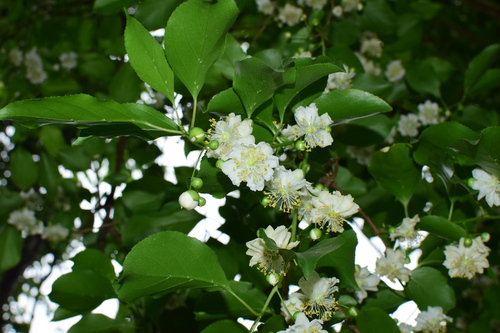
Actinidia kolomikta
(Maxim. & Rupr.) Maxim.
Arctic Beauty, Kolomikta
iNaturalist· cc-by-nc
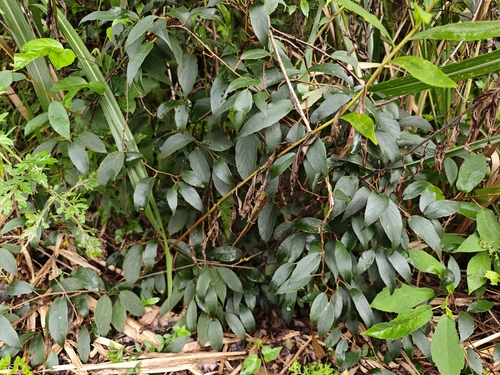
(c) 空猫 T. N, some rights reserved (CC BY-NC), uploaded by 空猫 T. N
iNaturalist· cc-by-nc
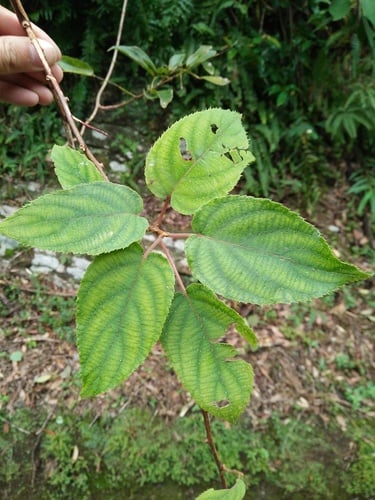
(c) V.S. Volkotrub, some rights reserved (CC BY-NC), uploaded by V.S. Volkotrub
iNaturalist· cc-by-nc
(c) V.S. Volkotrub, some rights reserved (CC BY-NC), uploaded by V.S. Volkotrub
Summary
Source: WikipediaActinidia kolomikta, the kolomikta, miyamatatabi, super-hardy kiwi, or variegated-leaf hardy kiwi, is a species of flowering plant in the family Actinidiaceae, native to temperate mixed forests of the Russian Far East, Korea, Japan and China (Eastern Asiatic Region).
Description
A vine which looses its leaves during the year. It climbs to a height of 4-6 m. The stems are slender, woody and branching. The leaves are oval and taper towards the point. The leaves are 15 cm long and when young they have a purple tinge. They become green and blotched with cream and pink. The flowers are white. They have a sweet smell. They are shaped like a cup and 1 cm across. They occur on groups of 3. Male and female flowers occur separately on separate plants. The fruit are yellow. They are egg shaped berries 2 cm long. They are smooth. The fruit are edible.
Edible Uses
The fruit can be eaten raw, cooked, or dried for later use. Sweet and agreeable in flavour, it contains up to 5 times the vitamin C of blackcurrants — one report puts the vitamin C content at 1520mg per 100g of fruit. The ovoid fruit is hairless and pale orange when fully ripe, reaching up to 25mm in diameter. It contains a number of small seeds, which are soft enough to eat along with the fruit. Young leaves can be cooked and used as a potherb or added to soups.
Traditional Uses
The ripe fruit are eaten fresh. They are also dried or preserved with salt.
This uses section is brief — help expand it
Medicinal Uses
The fruit is notably high in vitamin C.
Distribution
A plant native of China and Japan. It grows naturally in coniferous woodlands and hedges in mountains throughout Japan. It prefers cool well drained soils. It suits a sunny position. It is frost resistant but damaged by drought. It suits hardiness zones 4-9. It grows in Sichuan and Yunnan. Arboretum Tasmania.
Where It Grows
Asia, Australia, Canada, China, Europe, Korea, Japan, Lithuania, North America, Russia, Slovenia, Tasmania,
Cultivation
The plant is grown by cuttings.
Propagation
Sow seed in spring in a greenhouse. Best results come from giving the seed 3 months of stratification — either sow in a cold frame as soon as it is ripe in November, or as soon as it is received. Fresh seed germinates in 2–3 months at 10°C; stored seed may take longer. Once seedlings are large enough to handle, prick them out into individual pots and grow on in light shade in the greenhouse for at least their first winter. When plants reach 30cm or more, plant out into permanent positions in late spring or early summer, after the last expected frosts. Note that most seedlings are male. Seedlings are prone to damping off and must be kept well ventilated. Softwood cuttings can be taken as soon as they are ready in spring in a frame. Half-ripe cuttings taken in July/August in a frame give a very high success rate. Ripe wood cuttings can also be taken in October/November in a frame.
Other Uses
None known
Production
It produces fruit in 3 years.
Other Information
It is a cultivated plant.
Notes
The unripe fruit have amino acids important for health. It is rich in Vitamin C. There are 40-60 Actinidia species. The Actinidiaceae are a mainly tropical family.
Synonyms
Also Known As
Aktinidija, Kishmish, Manchurian gooseberry, Miyama-mata-tabi
References (24)
- Arora, R. K., 2014, Diversity in Underutilized Plant Species - An Asia-Pacific Perspective. Bioversity International. p 56
- Bircher, A. G. & Bircher, W. H., 2000, Encyclopedia of Fruit Trees and Edible Flowering Plants in Egypt and the Subtropics. AUC Press. p 9
- Bodkin, F., 1991, Encyclopedia Botanica. Cornstalk publishing, p 47
- Brickell, C. (Ed.), 1999, The Royal Horticultural Society A-Z Encyclopedia of Garden Plants. Convent Garden Books. p 76
- Crandall, C & Crandall, B., 1996, Flowering Fruiting and Foliage vines. Sterling. p 88
Show all 24 references Hide references
- Cundall, P., (ed.), 2004, Gardening Australia: flora: the gardener's bible. ABC Books. p 96
- Facciola, S., 1998, Cornucopia 2: a Source Book of Edible Plants. Kampong Publications. p 2
- Flowerdew, B., 2000, Complete Fruit Book. Kyle Cathie Ltd., London. p 134
- Gouldstone, S., 1983, Growing your own Food-bearing Plants in Australia. Macmillan p 98
- Hu, Shiu-ying, 2005, Food Plants of China. The Chinese University Press. p 551
- John, L., & Stevenson, V., 1979, The Complete Book of Fruit. Angus & Robertson p 111
- Joyce, D., 1998, The Garden Plant Selector. Ryland, Peters and Small. p 176
- Lamberton, K (Ed.), 2004, The Australian gardening encyclodepia. Murdoch Books, NSW Australia. p 144
- Luo, B., et al, 2019, Wild edible plants collected by Hani from terraced rice paddy agroecosystem in Honghe Prefecture, Yunnan, China. Journal of Ethnobiology and Ethnomedicine 15:56
- Lyle, S., 2006, Discovering fruit and nuts. Land Links. p 47
- Mem. Acad. Imp. Sci. St.-Petersbourg Divers Savans 9:63. 1859 (Prim. fl. amur.)
- Morton, J. F., 1987, Fruits of Warm Climates. Wipf & Stock Publishers p 299
- Plants for a Future database, The Field, Penpol, Lostwithiel, Cornwall, PL22 0NG, UK. http://www.scs.leeds.ac.uk/pfaf/
- Ryan, S., 2008, Dicksonia. Rare Plants Manual. Hyland House. p 73
- USDA, ARS, National Genetic Resources Program. Germplasm Resources Information Network - (GRIN). [Online Database] National Germplasm Resources Laboratory, Beltsville, Maryland. Available: www.ars-grin.gov/cgi-bin/npgs/html/econ.pl (10 April 2000)
- Wang, J. et al, 2013, A Study on the Utilization of Wild Plants for Food in Liangshan Yi Autonomous Prefecture. Plant Diversity and Resources. 35(4): 416-471
- Wang, J., et al, 2020, An ethnobotanical survey of wild edible plants used by the Yi people of Liangshan Prefecture, Sichuan Province, China. Journal of Ethnobiology and Ethnomedicine 16:10
- Wiersema, J. H. & Leon, B., 2013, World Economic Plants. A Standard Reference CRC Press. 2nd Ed. p 16
- World Checklist of Useful Plant Species 2020. Royal Botanic Gardens, Kew