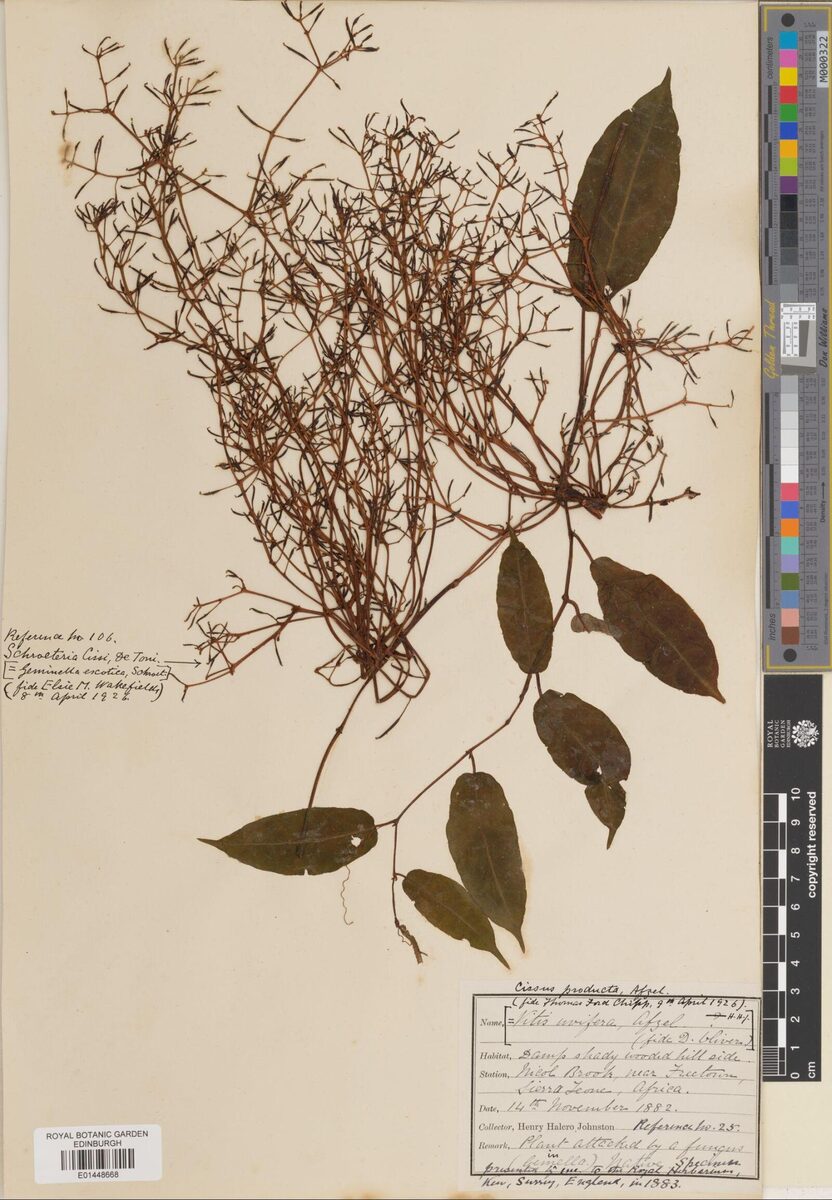
Cissus adnata
(Wall.) Roxb.
Endeavour River Vine
iNaturalist· cc-by
(c) Siddarth Machado, some rights reserved (CC BY), uploaded by Siddarth Machado
iNaturalist· cc-by
(c) Siddarth Machado, some rights reserved (CC BY), uploaded by Siddarth Machado
iNaturalist· cc-by
(c) Siddarth Machado, some rights reserved (CC BY), uploaded by Siddarth Machado
Summary
Source: WikipediaCissus adnata is a woody vine species in the genus Cissus found in Asia and Australia. Pallidol is a resveratrol dimer found in C. pallida.
Description
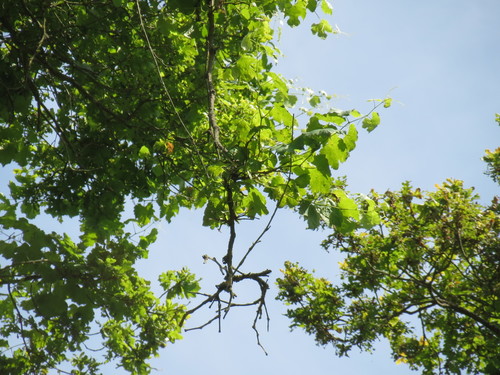
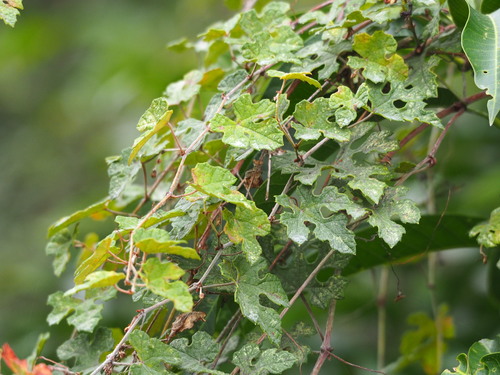
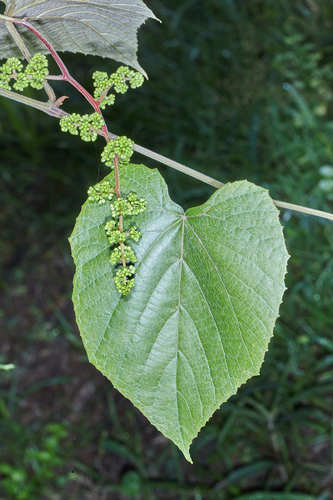
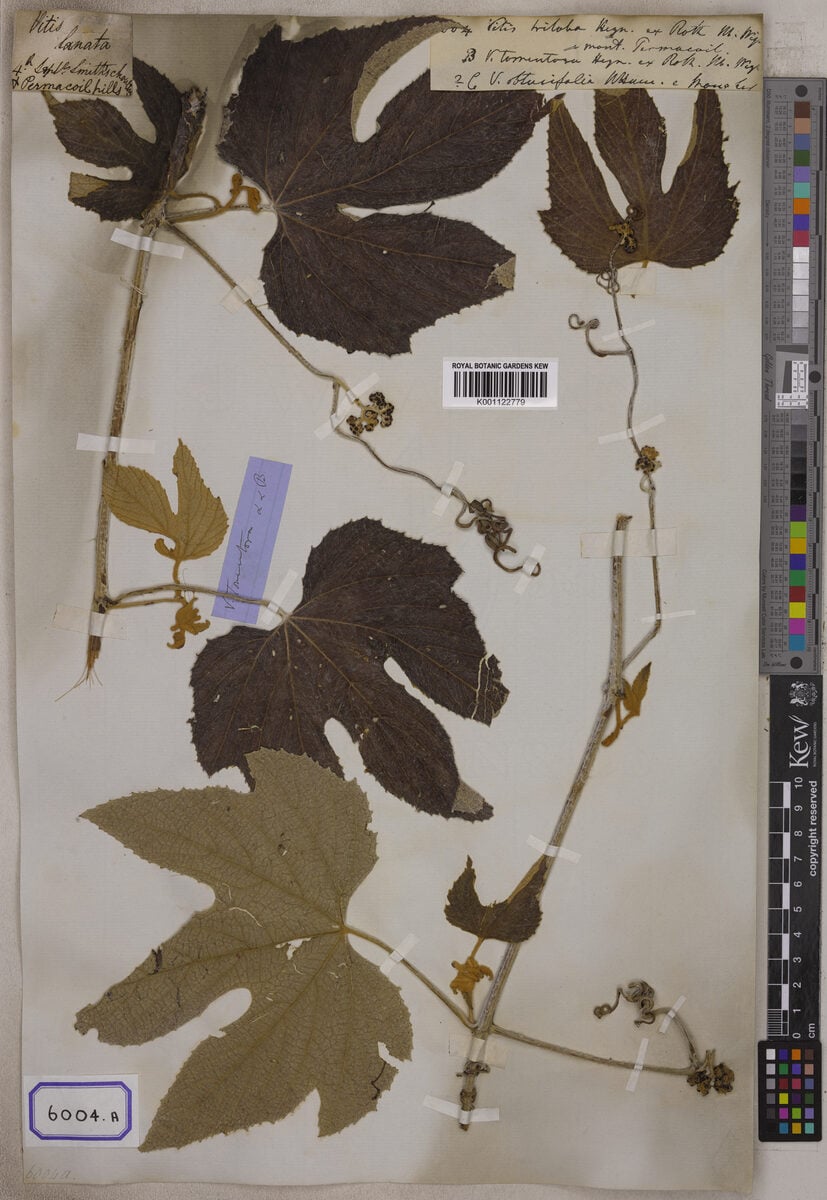
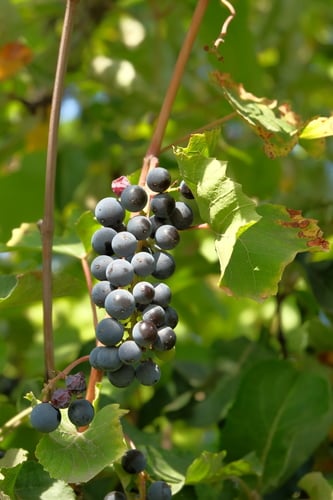
A woody creeper or vine that keeps growing from year to year. It will climb to 5-15 m high and spread to 4 m across. The stem is slender and woody. It climbs by tendrils which attach to objects. It usually loses all its leaves during the dry season. Young shoots are covered with brown hairs. The leaves are dull green and 6-12 cm long by 4-8 cm wide. They are broad and round or heart shaped. They have saw like teeth along the edge. The veins in the leaf are easy to see. The flowers are in small dense heads. They are green or cream and 2 mm wide. The flower bunches are produced in the axils of leaves near the ends of branches. The fruit are green berries which become black when ripe. They are 6-8 mm long. They resemble grapes. The are edible, but not attractive. They contain one seed which is round and 4-6 mm across.
Edible Uses
The fruit are edible but leathery with an unpleasant taste. The leaves are cooked and eaten, and sometimes the fibrous root is cooked and eaten.
Traditional Uses
CAUTION: Some people consider the fruit toxic. The fruit are edible but are leathery and have an unpleasant taste. Sometimes the fibrous root is cooked and eaten. The leaves are cooked and eaten.
Medicinal Uses
The root is alterative, diuretic and blood purifier. A cold infusion of the pounded root is taken as a treatment for cough. Applied externally, the powdered root is heated and used as a poultice on cuts and fractures. The juice from the stem is taken as a treatment for cough and diarrhoea. Externally the leaves are applied as a poultice for the maturation of boils.
Known Hazards
Some people consider the fruit toxic.
Distribution
It is a tropical plant. It grows most commonly on medium to heavy, moist soils. It suits a shaded and protected position. It is drought and frost tender. It grows along stream banks in open forest. In Sikkim it grows between 300-1,000 m above sea level. In Yunnan.
Where It Grows
Asia, Australia, Bangladesh, Cambodia, China, Himalayas, India, Indochina, Laos, Malaysia, Myanmar, Nepal, Northeastern India, Pacific, Papua New Guinea, PNG, SE Asia, Sikkim, Sri Lanka, Thailand, Vietnam,
Cultivation
Plants are grown from seed or cuttings. The plant regrows each year from the rootstock.
Other Uses
The stem is commonly used for cordage.
Production
In India plants flower and fruit from November to January.
Notes
There are about 200-350 Cissus species. There are about 75 species in tropical America.
Synonyms
Also Known As
Alianga-lata, Bodlarnari, Charchare, Gudamatige, Gudmatige, Kokkitayaralu, Kolezan, Kongouyen, Kung chen-rik, Nadena, Native grape, Pani-lara
References (26)
- Ambasta, S.P. (Ed.), 2000, The Useful Plants of India. CSIR India. p 126
- Bandyopadhyay, S. et al, 2009, Wild edible plants of Koch Bihar district, West Bengal. Natural Products Radiance 8(1) 64-72
- BARC, 2016, State of Biodiversity for Food and Agriculture in Bangladesh. Bangladesh Agricultural Research Council.
- Bodkin, F., 1991, Encyclopedia Botanica. Cornstalk publishing, p 258
- Bindon, P., 1996, Useful Bush Plants. Western Australian Museum. p 80.
Show all 26 references Hide references
- Cherikoff V. & Isaacs, J., The Bush Food Handbook. How to gather, grow, process and cook Australian Wild Foods. Ti Tree Press, Australia p 198
- Devi, O. S., et al, 2021, Wild edible plants associated with the people of Thoubal Khunou village and its migrated villagers. Int. J. Adv. Res. Biol. Sci. 8(9): 72-90
- Dobriyal, M. J. R. & Dobriyal, R., 2014, Non Wood Forest Produce an Option for Ethnic Food and Nutritional Security in India. Int. J. of Usuf. Mngt. 15(1):17-37
- Elliot, W.R., & Jones, D.L., 1984, Encyclopedia of Australian Plants suitable for cultivation. Vol 3. Lothian. p 39
- Hedrick, U.P., 1919, (Ed.), Sturtevant's edible plants of the world. p 680 (As Vitis adnata)
- Jadhav, R., et al, 2015, Forest Foods of Northern Western Ghats: Mode of Consumption, Nutrition and Availability. Asian Agri-History Vol. 19, No. 4: 293-317
- Jones, D.L. & Gray, B., 1977, Australian Climbing Plants. Reed. p 89
- Jones D, L, 1986, Ornamental Rainforest Plants in Australia, Reed Books, p 285
- Kumbhojkar, M.S. & Vartak, V.D., 1988, Ethnobotanical Studies on Wild Edible Grapes from Sacred Groves in Western Maharashtra. J. Econ. Tax. Bot. Vol. 12 No. 2 pp 257-263
- Lazarides, M. & Hince, B., 1993, Handbook of Economic Plants of Australia, CSIRO. p 60
- Manandhar, N.P., 2002, Plants and People of Nepal. Timber Press. Portland, Oregon. p 155
- Paczkowska, G . & Chapman, A.R., 2000, The Western Australian Flora. A Descriptive Catalogue. Western Australian Herbarium. p 568
- Peekel, P.G., 1984, (Translation E.E.Henty), Flora of the Bismarck Archipelago for Naturalists, Division of Botany, Lae, PNG. p 346, 344
- Savita, et al, 2006, Studies on wild edible plants of ethnic people in east Sikkim. Asian J. of Bio Sci. (2006) Vol. 1 No. 2 : 117-125
- Singh, H.B., Arora R.K.,1978, Wild edible Plants of India. Indian Council of Agricultural Research, New Delhi. p 21
- Sundriyal, M., et al, 1998, Wild edibles and other useful plants from the Sikkim Himalaya, India. Oecologia Montana 7:43-54
- Sundriyal, M., et al, 2004, Dietary Use of Wild Plant Resources in the Sikkim Himalaya, India. Economic Botany 58(4) pp 626-638
- Townsend, K., 1994, Across the Top. Gardening with Australian Plants in the tropics. Society for Growing Australian Plants, Townsville Branch Inc. p 132
- Wheeler, J.R.(ed.), 1992, Flora of the Kimberley Region. CALM, Western Australian Herbarium, p 636
- Wightman, G. M. & Andrews, M.R., 1989, Plants of Northern Territory Monsoon Vine Forests (Vol 1). Conservation Commission of Northern Territory. p 118
- Wild edible plants of Himachal Pradesh