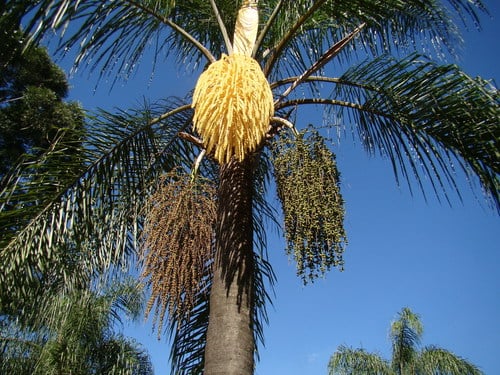
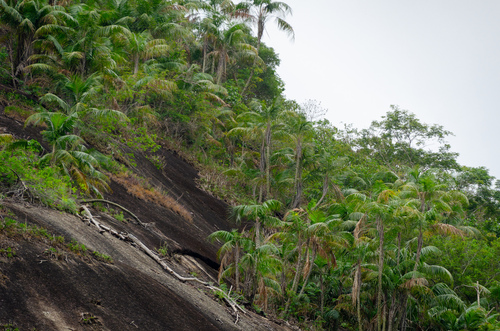
Bactris simplicifrons
Mart.
Turtle paripi
iNaturalist· cc-by-nc
(c) Matthew Cock, some rights reserved (CC BY-NC), uploaded by Matthew Cock
iNaturalist· cc-by-nc
(c) Matthew Cock, some rights reserved (CC BY-NC), uploaded by Matthew Cock
iNaturalist· cc-by-nc
(c) Matthew Cock, some rights reserved (CC BY-NC), uploaded by Matthew Cock
Summary
Source: WikipediaBactris simplicifrons is a small (0.5–2 m tall, 0.3–1 cm in diameter) palm which is found in Trinidad and Tobago, Guyana, Suriname, French Guiana, Brazil, Colombia, Ecuador, Peru and Bolivia. Unlike most other species of Bactris, B. simplicifrons is usually non-spiny, or only spiny along the leaf margins. It also tends to have simple, rather than compound leaves.
Description
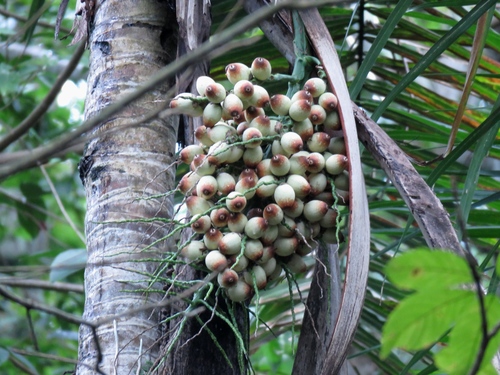
A palm It forms clusters and grows 2 m tall. The fruit are greenish yellow and turn red. They are round and 8 mm across.
This description is brief — help expand it
Edible Uses
The fruit, palm heart, and cabbage (palm bud) are eaten.
Distribution
It is a tropical plant. It grows in forests.
Where It Grows
Amazon, Colombia, Ecuador, Guianas, Guyana, Peru, South America,
Cultivation
Grows best in a warm, sheltered, moist position.
Other Uses
The leaves are used for thatching. The leaves are valued for their durability. These leaves are even sometimes taken off old houses to be reused in the construction of a new house, especially if the new living area does not supply these palms.
Other Information
The fruit are mostly eaten by children.
Synonyms
Also Known As
Boyegontiwe, Hikuri paripia, Parapi-balli, Marajazinha, Wayamu paripiri
References (6)
- Kermath, B. M., et al, 2014, Food Plants in the Americas: A survey of the domesticated, cultivated and wild plants used for Human food in North, Central and South America and the Caribbean. On line draft. p 117
- Kew Plants of the World onLine
- Marcia, M. J., et al, 2011, Palm Uses in Northwestern South America: A Quantitative Review. Bot. Rev. (2011) 77:462-570
- Roa, J. A. G. & Boada, D. S. G., 2018, Fundación para el Fortalecimiento de la Fruticultura y Plantas Alimenticias no Convencionales en Colombia.
- Torre, de la L., et al, 2008, Enciclopedia de las Plantas Útiles del Ecuador. Herbario QCA. Pontificia Universidad Católica del Ecuador. p 198
Show all 6 references Hide references
- van Andel, T., 2000, Useful plants of Guyana. Non-timber forest products of the North-West District of Guyana. Part 2. A Field Guide. Tropenbos-Guyana Programme. p 298