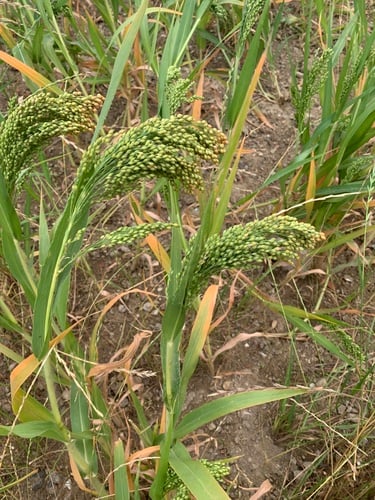
Gigantochloa wrayi
Gamble
gbif· cc0
President and Fellows of Harvard College
gbif· cc0
President and Fellows of Harvard College
gbif· cc0
President and Fellows of Harvard College
Description
A bamboo. It grows 10 m tall. The stems are 2-7 cm across. The culm sheaths are 27 cm long with dark hairs when young. The leaf blade is 40 cm long by 6 cm wide.
Edible Uses
The shoots are eaten.
Distribution
It is a tropical plant.
Where It Grows
Asia, Indochina, Malaysia, Myanmar, SE Asia, Thailand,
Cultivation
The plant establishes naturally on poor clayey soils but does not produce as large culms as when it grows on alluvial soils. Nevertheless in many wasteland areas it can establish as whole stands, mixed with secondary-forest trees and also with Gigantochloa scortechinii and sometimes Schizostachyum grande Ridley. In such dense stands, its leaf litter accumulates on the ground and appears to prevent effective establishment of other plants. Bamboos have an interesting method of growth. Each plant produces a number of new stems annually - these stems grow to their maximum height in their first year of growth, subsequent growth in the stem being limited to the production of new side branches and leaves. In the case of some mature tropical species the new stem could be as much as 30 metres tall, with daily increases in height of 30cm or more during their peak growth time. This makes them some of the fastest-growing species in the world. Bamboos in general are usually monocarpic, living for many years before flowering, then flowering and seeding profusely for a period of 1 - 3 years before usually dying. Bamboos in general are usually monocarpic, living for many years before flowering, then flowering and seeding profusely for a period of 1 - 3 years before usually dying. This pattern can vary - sometimes flowering is sporadic, with plants flowering annually and not dying; at other times it is gregarious with all the plants in a specific species coming into flower at the same time. Flowering in this species is sporadic, occurring on one to several culms in a clump, which can continue to show new vegetative growth during and after such flowering.
Other Uses
This species occurs sympatrically with Gigantochloa scortechinii, and its culms are of comparable quality and used in the same way, e.g. to prepare incensed prayer sticks used by the Chinese community, vegetable baskets, poultry cages and handicrafts. In rural areas in Peninsular Malaysia and southern Sumatra they are used when needed for fences, poles, roughly plaited house walls and other household items.
Also Known As
Buloh beti
References (1)
- Azmy, H. M. & Appanah. S., Bamboo resources conservation and utilization in Malaysia. www.bioversityinternational.org