Rhododendron moulmainense
Hook.
Wikipedia· cc-by-sa
Wikimedia Commons - Rhododendron_moulmainense_3.jpg
iNaturalist· cc-by-nc
(c) nigelkwokch, some rights reserved (CC BY-NC)
iNaturalist· cc-by-nc
(c) nigelkwokch, some rights reserved (CC BY-NC)
Summary
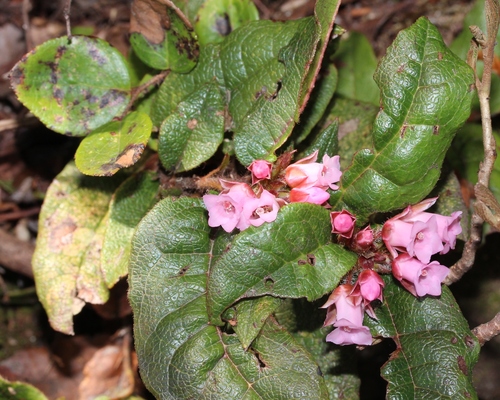
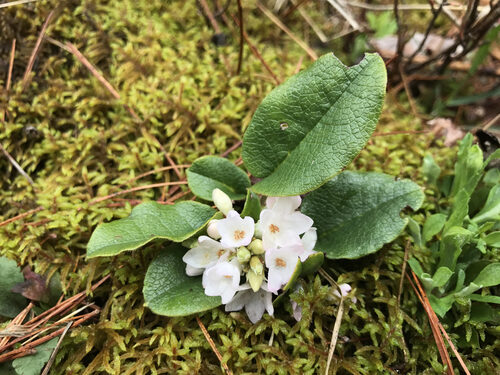
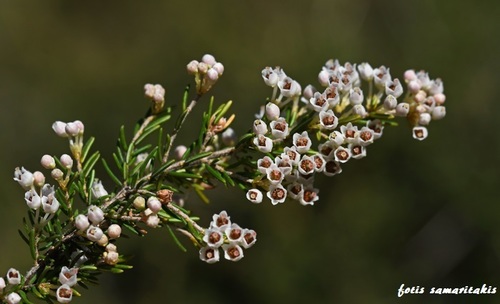
Source: WikipediaRhododendron moulmainense, Westland's rhododendron, is a species of Rhododendron native to southern China (Fujian, Guangdong, Guangxi, Guizhou, Hong Kong, Hunan, Yunnan), Myanmar, Malaysia, Thailand, and Vietnam. It is an evergreen shrub or small tree 3–8 m (9.8–26.2 ft) tall. The leaves are 4–13 cm long, elliptical and leathery. Every leaf has a curving margin rolling backward toward the underside. The flowers are fragrant, borne on top of the branches, in umbels and in groups of two to four. The petals are white or pink, with the inner parts spotted orange. The flowering period is from March to April. The fruit is a cylindrical, 2.5–5 cm long capsule, 6-angled along its length, bearing numerous small seeds. The fruiting period is from May to June. The common name "Westland's rhododendron" honours A. B. Westland, the first Superintendent of the Botanic Gardens, Hong Kong. In Hong Kong, where it occurs on Ma On Shan, Pat Sin Leng, Wu Kau Tang, and Lantau Island, it is a protected species under Forestry Regulations Cap. 96A. This plant is widespread in its native habitat. However, in temperate climates it requires some protection, as it does not tolerate freezing temperatures.
Description
A shrub or small tree. It grows 3-15 m tall. The bark is grey brown and does not peel. The leaves are oblong to sword shaped and 5-12 cm long by 3-5 cm wide. The base is wedge shaped and the edges curl under. The flowers are in groups of 2 or 3 towards the end of branches. They are funnel shaped and white with a yellow blotch.
Edible Uses
The flowers are edible.
Distribution
It is a tropical plant. It grows in open forests between 700-1,500 m above sea level in southern China. In Yunnan.
Where It Grows
Asia, China, India, Indochina, Indonesia, Malaysia, Myanmar, Northeastern India, SE Asia, Thailand, Vietnam,
Synonyms
Also Known As
Doquyen moulmain, Zalat-pyu
References (1)
- Liu, Yi-tao, & Long, Chun-Lin, 2002, Studies on Edible Flowers Consumed by Ethnic Groups in Yunnan. Acta Botanica Yunnanica. 24(1):41-56