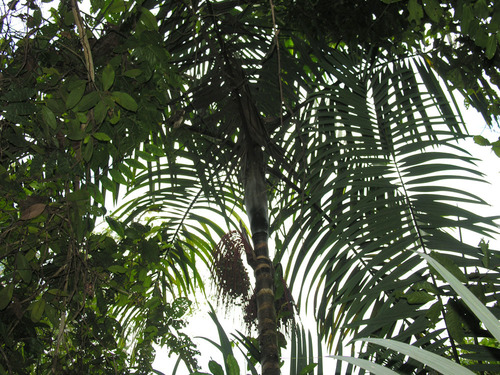
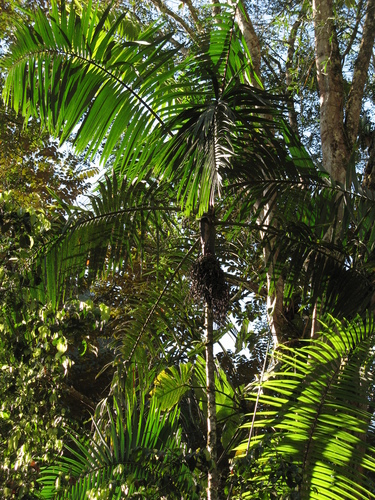
Areca hutchinsoniana
Becc.
Bunga
Wikipedia· cc-by-sa
Wikimedia Commons - Areca_hutchinsoniana.jpg
gbif· cc0
President and Fellows of Harvard College
Summary
Source: WikipediaAreca hutchinsoniana is a species of flowering plant in the family Arecaceae. It is found only on the island of Mindanao in the Philippines.
Description
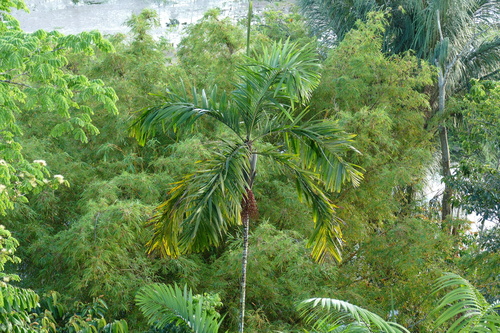
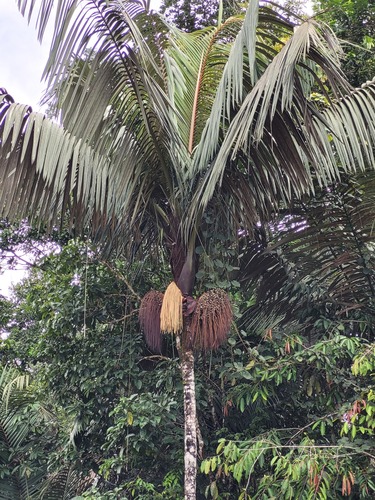
A palm with a single stem. It has a slender trunk. It grows 4-10 m tall and 15 cm thick. It has prominent pale rings on the trunk. The crown-shaft bulges a little. The fronds are dark green. There are leaflets along the stalk. The fruit are about 3 cm long. They are yellow when ripe.
Edible Uses
The nuts are occasionally used as a betel substitute. The palm heart (cabbage) is edible.
Traditional Uses
The nut is occasionally used as a betel substitute. The palm heart is edible.
This uses section is brief — help expand it
Medicinal Uses
The nuts are occasionally used as a betel substitute.
Distribution
A tropical plant. It grows in primary forests at low elevations. It grows in Mindanao. It is cold sensitive.
Where It Grows
Asia, Indonesia, Pacific, Philippines, SE Asia,
Cultivation
Plants can be grown from seeds.
Notes
There are 60 Areca species. They are tropical.
Synonyms
Also Known As
Pinang bunga
References (5)
- Haynes, J., & McLaughlin, J., 2000, Edible palms and Their Uses. University of Florida Fact sheet MCDE-00-50-1 p 2
- Johnson, D.V., 1998, Tropical palms. Non-wood Forest products 10. FAO Rome. p 44
- Jones, D.L., 1994, Palms throughout the World. Smithtonian Institution, Washington. p 129
- Jones, D.L., 2000, Palms of Australia 3rd edition. Reed/New Holland. p 115
- Sukarya, D. G., (Ed.) 2013, 3,500 Plant Species of the Botanic Gardens of Indonesia. LIPI p 749