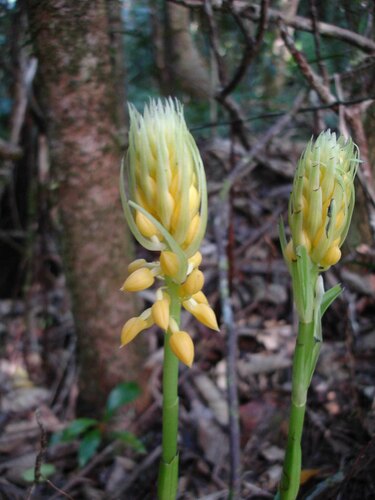
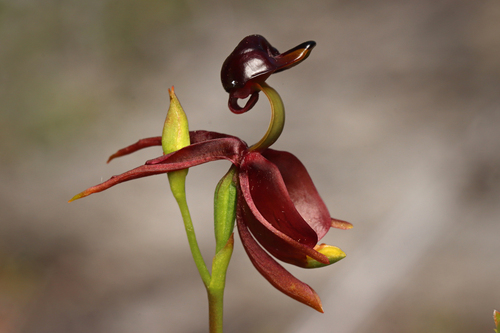
Nervilia concolor
(Blume) Schltr.
Water-root orchid
iNaturalist· cc0
no rights reserved, uploaded by S.MORE
iNaturalist· cc-by
(c) Roland Godon, some rights reserved (CC BY), uploaded by Roland Godon
iNaturalist· cc-by-nc
(c) K S Gopi Sundar, some rights reserved (CC BY-NC), uploaded by K S Gopi Sundar
Summary
Source: WikipediaNervilia concolor, commonly known as tall shield orchid, and to as Nervilia aragoana in Australia, is a small terrestrial orchid found in South Asia and Southeast Asia and in the northern regions of Australia. It has pale green, short-lived flowers with a cream-colored or yellowish labellum and a more or less circular leaf that emerges at the base of the flowering stem after flowering.
Description
An orchid. It has a fleshy round tuber. The leaves have stalks 15-20 cm long. The leaves are almost round or heart shaped and 15 cm across. The flowers are in groups on erect leafless stalks. These are 15-30 cm long.
Edible Uses
The juicy tuber is chewed to quench thirst and can also be burnt and eaten as a snack.
Traditional Uses
The juicy tuber is chewed to quench thirst. It is also burnt and taken as a snack.
This uses section is brief — help expand it
Medicinal Uses
The whole plant is bitter and acrid. It is considered to be antiinflammatory, antipyretic, antiseptic, cooling, diuretic, galactagogue, opthalmic and tonic. It stops bleeding. It is used to promote milk production and in the treatment of swellings, discharges, menorrhagia, mental instability, epilepsy, haemoptysis, colic, diarrhoea, vomiting, asthma, coughs, urinary complaints and weak kidneys. The pseudobulbs are used in the treatment of 'disturbances of cardiac function' in Thailand. A decoction of the leaves, known as 'ubat meroyan' was once considered an obligatory protective medicine after childbirth in parts of Malaya.
Distribution
It is a tropical plant.
Where It Grows
Asia, Guam, India, Indonesia, Micronesia, Pacific, Samoa, SE Asia, Yap,
Cultivation
Grows best in semi-shade.
Propagation
Seed - Division of the tubers.
Other Uses
The plant kills bugs. No more information.
Synonyms
Also Known As
Buru kisari, Maisa ulu, Seyaihagon, Tirimof, Tirimofon
References (5)
- Misra, R. C., et al, 2013, Genetic resources of wild tuberous food plants traditionally used in Similipal Biosphere Reserve, Odisha, India. Genetic Resources and Crop Evolution. Vol. 60 No. 2. Springer (As Nervilia aragoana)
- Nurfadilah, S., 2020, Utilization of orchids of Wallacea region and implication for conservation. IOP Conf. Series: Earth and Environmental Science 473 (2020) 012063 (As Nervilia aragoana)
- Pullaiah, Y., Krishnamurthy, K. V. & Bahadur, B., (Eds.), 2016, Ethnobotany of India, Volume 1: Eastern Ghats and Deccan. (As Nervilia aragoana)
- Stone, B., (As Nervilia aragoana)
- www.manoa.hawaii.edu/botany/plants of micronesia. (As Nervilia aragoana)