Chondrus crispus
(L.) Stackhouse
Carragheen, Irish Moss, Jelly moss, Sea moss
iNaturalist· cc-by-nc
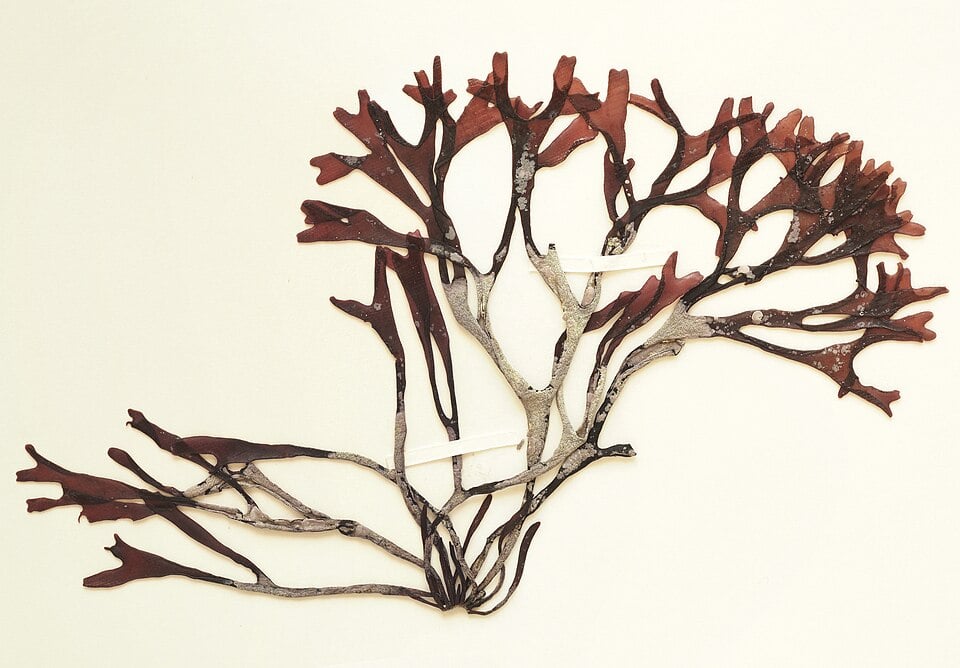
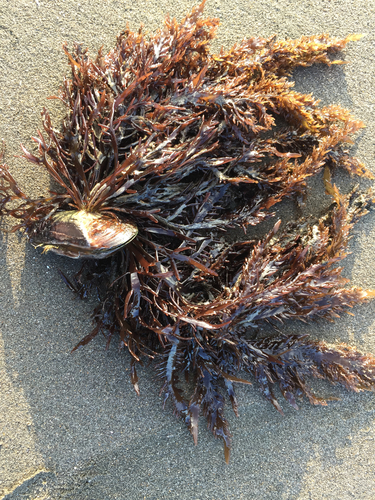
(c) Susan J. Hewitt, some rights reserved (CC BY-NC), uploaded by Susan J. Hewitt
iNaturalist· cc-by-nc
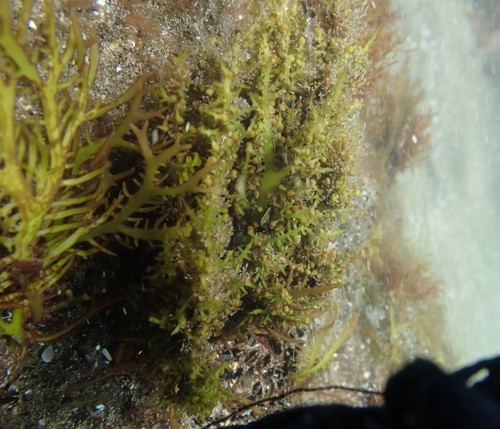
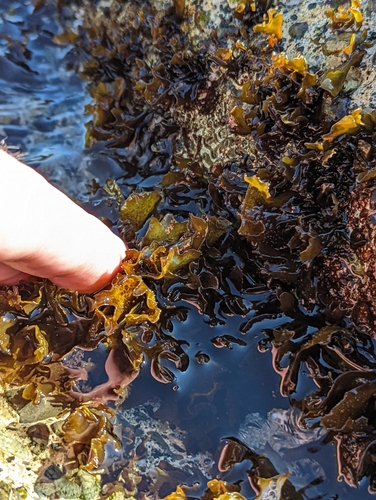
(c) Kate Mooney, some rights reserved (CC BY-NC), uploaded by Kate Mooney
iNaturalist· cc-by-nc
(c) Susan J. Hewitt, some rights reserved (CC BY-NC), uploaded by Susan J. Hewitt
Summary
Source: WikipediaChondrus crispus—commonly called Irish moss or carrageenan moss (Irish carraigín, "little rock")—is a species of red algae which grows abundantly along the rocky parts of the Atlantic coasts of Europe and North America. In its fresh condition it is soft and cartilaginous, varying in color from a greenish-yellow, through red, to a dark purple or purplish-brown. The principal constituent is a mucilaginous body, made of the polysaccharide carrageenan, which constitutes 55% of its dry weight. The organism also consists of nearly 10% dry weight protein and about 15% dry weight mineral matter, and is rich in iodine and sulfur. When softened in water it has a sea-like odour. Because of the abundant cell wall polysaccharides, it will form a jelly when boiled, containing from 20 to 100 times its weight of water.
Description
A red seaweed. It is 7-15 cm long and spreads 7-15 cm wide. It is red-purple to green. It has a disk shaped holdfast. It is narrow at the base and expands into branched fronds. These are often crimped along the edge.
Edible Uses
C. crispus is traditionally used fresh as a thickening agent in carrageen pudding, a milk-based dish eaten in Scotland and Ireland. Likewise, it is an industrial source of carrageenan commonly used as a thickener and stabilizer in milk products, such as ice cream and processed foods. In Europe, it is indicated as E407 or E407a. It may also be used as a thickener in calico printing and paper marbling, and for fining beer. Irish moss is frequently used with Mastocarpus stellatus (Gigartina mamillosa), Chondracanthus acicularis (G. acicularis), and other seaweeds, which are all commonly found growing together. Carrageenan may be extracted from tropical seaweeds of the genera Kappaphycus and Eucheuma.
Traditional Uses
It is a major source of carrageenan, a gum used for gelling and thickening and emulsifying foods. It is bleached and dried before use. It is used as a food and as an emulsifying and jelling agent for ice cream, cream cheese, yogurt, salad dressing, and gravies. It is used for thickening in soups and chowders.
Distribution
It is a temperate plant. It grows most commonly around Atlantic shores.
Where It Grows
Africa, Alaska, America, Angola, Antarctic, Atlantic, Britain, Canada, Cape Verde, Central Africa, Denmark, Europe, France, Germany, Ghana, Greece, Iceland, India, Ireland, Japan, Korea, Mauritania, Mediterranean, Netherlands, North America, North Sea, Norway, Portugal, Russia, Scandinavia, Spain, Sweden, USA, West Africa,
Cultivation
Plants are left intact along shores after harvesting to allow them to regrow.
Other Information
It is available in whole food shops. It is an important edible seaweed.
Notes
There are about 15 Chondrus species.
Nutrition
| Part | Moisture | kJ | kcal | Protein | Vit A | Vit C | Iron | Zinc |
|---|---|---|---|---|---|---|---|---|
| Seaweed | — | — | 26.4 | — | — | — | — | — |
Synonyms
Also Known As
Bejin gwenn, Pearl moss, Pioca
References (23)
- Ambasta, S.P. (Ed.), 2000, The Useful Plants of India. CSIR India. p 121
- Brouk, B., 1975, Plants Consumed by Man. Academic Press, London. p 256
- Brown, D., 2002, The Royal Horticultural Society encyclopedia of Herbs and their uses. DK Books. p 167
- Burkill, H. M., 1985, The useful plants of west tropical Africa, Vol. 5. Kew.
- Cherry, P., et al, 2019, Risks and benefits of consuming edible seaweeds. Nutrition ReviewsVR Vol. 77(5):307–329
Show all 23 references Hide references
- Facciola, S., 1998, Cornucopia 2: a Source Book of Edible Plants. Kampong Publications, p 258
- Hedrick, U.P., 1919, (Ed.), Sturtevant's edible plants of the world. p 187
- http://www.seavegetables.com
- Irving, M., 2009, The Forager Handbook, A Guide to the Edible Plants of Britain. Ebury Press p 369
- Kiple, K.F. & Ornelas, K.C., (eds), 2000, The Cambridge World History of Food. CUP p 1746
- Mabey, R., 1973, Food for Free. A Guide to the edible wild plants of Britain, Collins. p 116
- Michael, P., 2007, Edible Wild Plants and Herbs. Grub Street. London. p 48
- Pereira, L., 2011, A Review of the Nutrient Composition of Selected Edible Seaweeds. In Seaweed. Pomin V. H., (Ed.) Nova Science Publishers, Inc
- Rouxel, C. et al, 2001, Species identification by SDS-PAGE of red algae used as seafood or a food ingredient. Food Chemistry 74 (2001) 349–353
- Ruperez, P. et al, 2001, Dietary fibre and physicochemical properties of edible Spanish seaweeds. Eur. Food Res. Technol. 212: 349-354
- Small, E., 2009, Top 100 Food Plants. The world's most important culinary crops. NRC Research Press. p 482
- Surey-Gent, S. & Morris G., 1987, Seaweed. A User's Guide. Whirret Books. London. p 60, 133
- Svanberg, I., et al, 2012, Edible wild plant use in the Faroe Islands and Iceland. Acta Societatis Botanicorum Poloniae 81(4): 233-238
- Tozer, F., 2007, The Uses of Wild Plants. Green Man Publishing. p 66
- Tseng, C. K., 1947, Seaweed Resources of North America and Their Utilization. Economic Botany, Vol. 1, No. 1 pp. 69-97
- Van Ginneken, V. JT., et al, 2011, Polyunsaturated fatty acids in various macroalgal species from north Atlantic and tropical seas. Lipids in Health and Disease 10:104
- www.algaebase.org
- Zemke-White, W. L. & Ohno, M., 1999, World seaweed utilisation: An end-of-century summary. Journal of Applied Phycology 11: 369-376