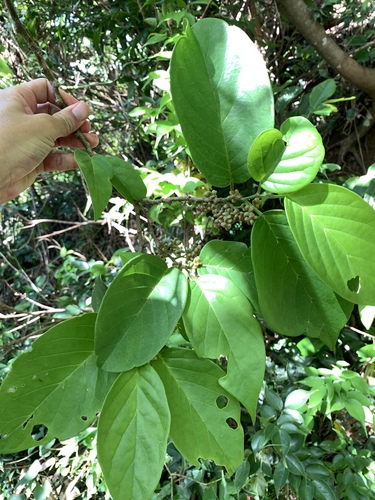
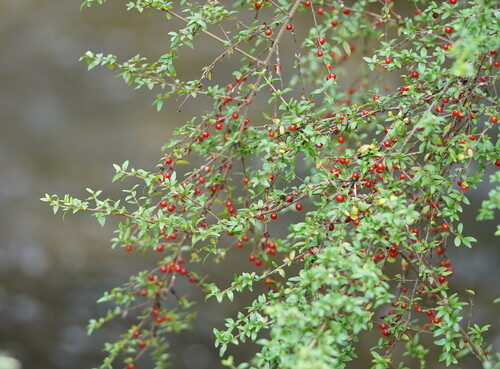
Aporosa octandra
(Buch.-Ham. ex D. Don) Vickery
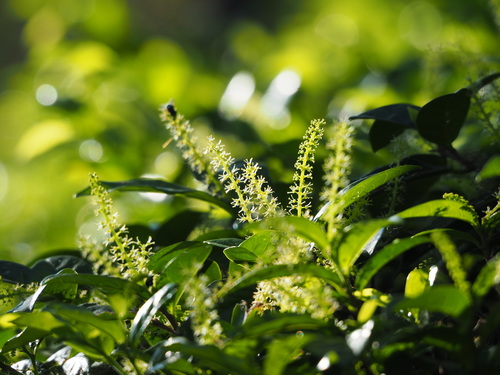
iNaturalist· cc-by-nc
(c) Eric Ching, some rights reserved (CC BY-NC), uploaded by Eric Ching
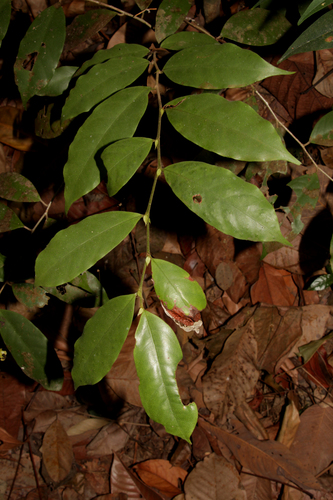
iNaturalist· cc-by-nc
(c) Jan Ho, some rights reserved (CC BY-NC), uploaded by Jan Ho
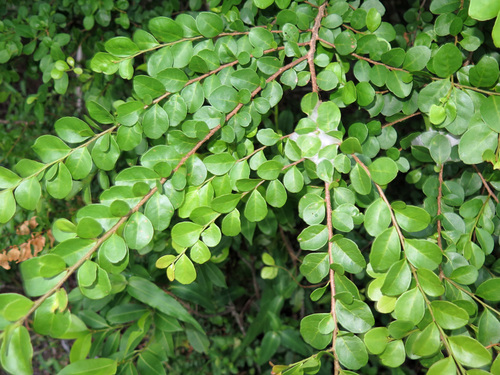
iNaturalist· cc-by-nc
(c) 桃子, some rights reserved (CC BY-NC), uploaded by 桃子
Summary
Source: WikipediaAporosa octandra is a species of plant in the family Phyllanthaceae found from Queensland and New Guinea to Indonesia, China and India. It is a highly variable plant with 4 named varieties. Its wood is used in construction and to make implements, its fruit is edible. The Karbi people of Assam use the plant for dyeing.
Description
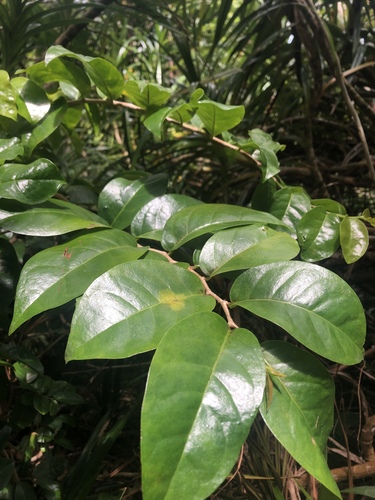
A shrub or tree. It grows 15 m tall. The trunk is 30 cm across. The bark is light brown and flaky with ridges along it. The bark is cracked into squares. The bark is red inside. It keeps its leaves throughout the year. The leaves are narrowly oval with short leaf stalks. They are 5-23 cm long by 2-8 cm wide. The base is rounded or wedge shaped and the edges can be wavy or have teeth. The flowers are very small and of separate sexes. The fruit are oval and 9-13 mm long by 6-10 mm wide and have a beak. There is usually one seed.
Edible Uses
The young leaves are boiled and eaten as a vegetable. The ripe yellow fruit are eaten raw. The bark is used to make a fermented drink.
Traditional Uses
The young leaves are boiled and eaten. The ripe yellow fruit are eaten raw. The bark is used to make a fermented drink.
This uses section is brief — help expand it
Medicinal Uses
The tree/shrub provides fodder for domesticated animals, timber for house construction (particularly house-posts), wood for fuel. The bark yields a red dye, while a decoction of the leaves is used to dye clothes black in northeast India. The fruits are edible. The bark is chewed as a kind of betel In India, the wood (called kokra or coco wood) is used, it is described as durable, hard and close-grained. It is used in construction, and for house-posts, rafters, rice pounders, and furniture. The Karbi people in Karbi Anglong district (Assam, India) use the twigs and leaves of what they call tamsir as a mordant when using black minerals to dye yarn black. The leaves are additionally used to prevent the yarn making contact with the dyeing vessel, which is held to make the yarn brittle. This latter use also occurs when dyeing with the lac insect Kerria lacca, to make pink yarn. There are many recorded uses of the species in traditional medicine in Asia, including in old Ayurvedic medical practices. In Cambodia the bark is a component of a folk-remedy to relieve tooth-ache, while the roots are used in another folk-medicine mixture to be used "against women diseases after delivery". In Mizoram it is recorded as treating many ailments. A. octandra var. malesiana has hard wood that is used for planks in houses, and for beams or furniture.
Distribution
It is a tropical and subtropical plant. In the Himalayas it grows up to 900 m above sea level.
Where It Grows
Asia, Bangladesh, Cambodia, China, Himalayas, India, Indochina, Laos, Myanmar, Nepal, Nicobar Islands, Northeastern India, Pakistan, SE Asia, Thailand,
Production
In southern India plants fruit February to May.
Notes
Also put in the family Euphorbiaceae.
Synonyms
Also Known As
Archal, Bara heloch, Barkaunli, Bor heloch, Chawntual, Chham chholja, Chhambolji, Chhamolja, Chipli khari, Garo khuta, Kahbhalai, Kam phnie ng, Khempasi, Khempasiba-phang, Khoidoi, Khokora, Kokra, Masania, Mossu, Pat kharolla, Samphere, Sawntuol, Sontul, Suantual, Tamsir-arong, Tamsir
References (18)
- Ambasta S.P. (Ed.), 2000, The Useful Plants of India. CSIR India. p 48 (As Aporosa dioica) (Also as Aporosa oblonga)
- Davis, S.D., Heywood, V.H., & Hamilton, A.C. (eds), 1994, Centres of plant Diversity. WWF. Vol 1 or 2. p 99 (As Aporosa oblonga)
- Gangte, H. E., et al, 2013, Wild Edible Plants used by the Zou Tribe in Manipur, India. International Journal of Scientific and Research Publications, Volume 3, Issue 5
- Gautim, R. S., et al, 2020, Wild Edible Fruits of Nepal. Int. J. Appl. Sci. Biotechnol. Vol 8(3): 289-304
- Guite, C., 2016, Study of wild edible plants associated with the Paite Tribe of Manipur, India. International Journal of Current Research. Vol. 8, Issue 11, pp. 40927-40932 (As Aporosa dioica)
Show all 18 references Hide references
- Hazarika, T. K., et al, 2012, Studies on wild fruits of Mizoram, India used as ethno-medicines. Genetic Resources and Crop Evolution. Published on line 03 February, 2012
- Kar, A., et al, 2013, Wild Edible Plant Resources used by the Mizos of Mizoram, India. Kathmandu University Journal of Science, Engineering and Technology. Vol. 9, No. 1, July, 2013, 106-126
- Karki, S., et al, 2017, Minor Fruits in Nepal: Utilization and Conservation Efforts. Proceedings of 2nd National Workshop on CUAPGR, 2017.
- Misra S. & Misra M., 2016, Ethnobotanical and Nutritional Evaluation of Some Edible Fruit Plants of Southern Odisha, India. International Journal of Advances in Agricultural Science and Technology, Vol.3 Issue.1, March- 2016, pg. 1-30
- Misra, S., 2020, Survey of edible plants for human consumption in south Odisha, India. Journal of Emerging Technologies and Innovative Research (JETIR) Vol. 7, Issue 12 p 278
- Pasha, M. K. & Uddin, S. B., 2019, Minor Edible Fruits of Bangladesh. Bangladesh J. Plant Taxon. 26(2): 299–313
- Patiri, B. & Borah, A., 2007, Wild Edible Plants of Assam. Geethaki Publishers. p 124 (As Aporusa octandra)
- Phon, P., 2000, Plants used in Cambodia. © Pauline Dy Phon, Phnom Penh, Cambodia. p 44 (As Aporosa dioica)
- Sarma, H., et al, 2010, Updated Estimates of Wild Edible and Threatened Plants of Assam: A Meta-analysis. International Journal of Botany 6(4): 414-423
- Singh, H.B., Arora R.K.,1978, Wild edible Plants of India. Indian Council of Agricultural Research, New Delhi. p 49
- Singh, B. et al, 2012, Wild edible plants used by Garo tribes of Nokrek Biosphere Reserve in Meghalaya, India. Indian Journal of Traditional Knowledge. 11(1) pp 166-171
- Singh, V. B., et al, (Ed.) Horticulture for Sustainable Income and Environmental Protection. Vol. 1 p 214 (As Aporosa dioica)
- Wild edible plants of Himachal Pradesh (As Aporosa dioica)