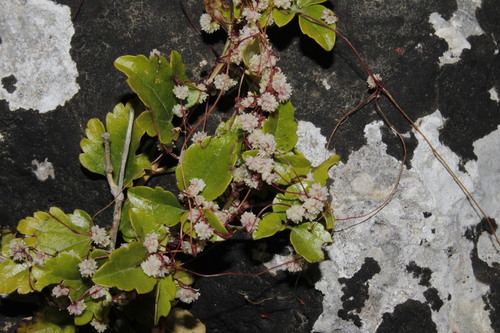
Merremia hederacea
(Burm.f.) Hall f.
iNaturalist· cc0
no rights reserved, uploaded by 葉子
iNaturalist· cc-by
(c) pbsg, some rights reserved (CC BY)
Summary
Source: WikipediaMerremia hederacea, the ivy woodrose, is a flowering vine of the family Convolvulaceae native to tropical and subtropical Old World to Pacific. M. hederacea has a wide range of distribution, found naturally in tropical and subtropical Old World, but introduced to Colombia, Cuba, Trinidad etc.
Description
A herb. It can be twining or lie along the ground. The stems form roots at the nodes. The leaves are heart shaped or oval and 2-8 cm long by 1-5 cm wide. They can have 3 lobes. The flowers can occur as few or many in a group.
Edible Uses
The seeds are eaten raw or roasted; the leaves are also edible.
Traditional Uses
The seeds are eaten raw and roasted.
This uses section is brief — help expand it
Medicinal Uses
A poultice of the leaves, combined with turmeric (Curcuma longa) and broken rice, is used to heal cracks in the hands and feet. The plant is used medicinally for treating acute tonsillitis.
Known Hazards
Although many species in this genus are toxic to grazing animals, this species is said to furnish wholesome grazing and animals can thrive even if it is their main food.
Distribution
It is a tropical plant. It grows in scrub and grassy roadsides between 100-800 m above sea level in southern China. In Yunnan.
Where It Grows
Africa, Asia, Australia, Burkina Faso, Cambodia, China, Himalayas, India, Indochina, Indonesia, Japan, Laos, Madagascar, Malaysia, Myanmar, Nepal, New Guinea, Pacific, Pakistan, Philippines, SE Asia, Sri Lanka, Taiwan, Thailand, Vietnam, West Africa, West Timor,
Cultivation
The plant is said to be invasive in some Pacific Islands, such as Guam and Tahiti.
Synonyms
Also Known As
Diwati
References (2)
- Hill, M. & Hallam, D., (eds), 1997, Na Hang Nature Reserve, Tat Ke Sector. Site description and conservation evaluation. Hanoi. p 76
- Setiya, A. V., et al, 2016, Exploration and documentation of some wild edible plants used by the aboriginals from Gadchiroli District (M.S.) India. International Advanced Research Journal in Science, Engineering and Technology. 3(7)