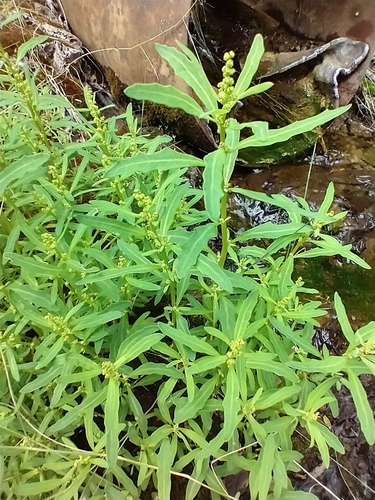
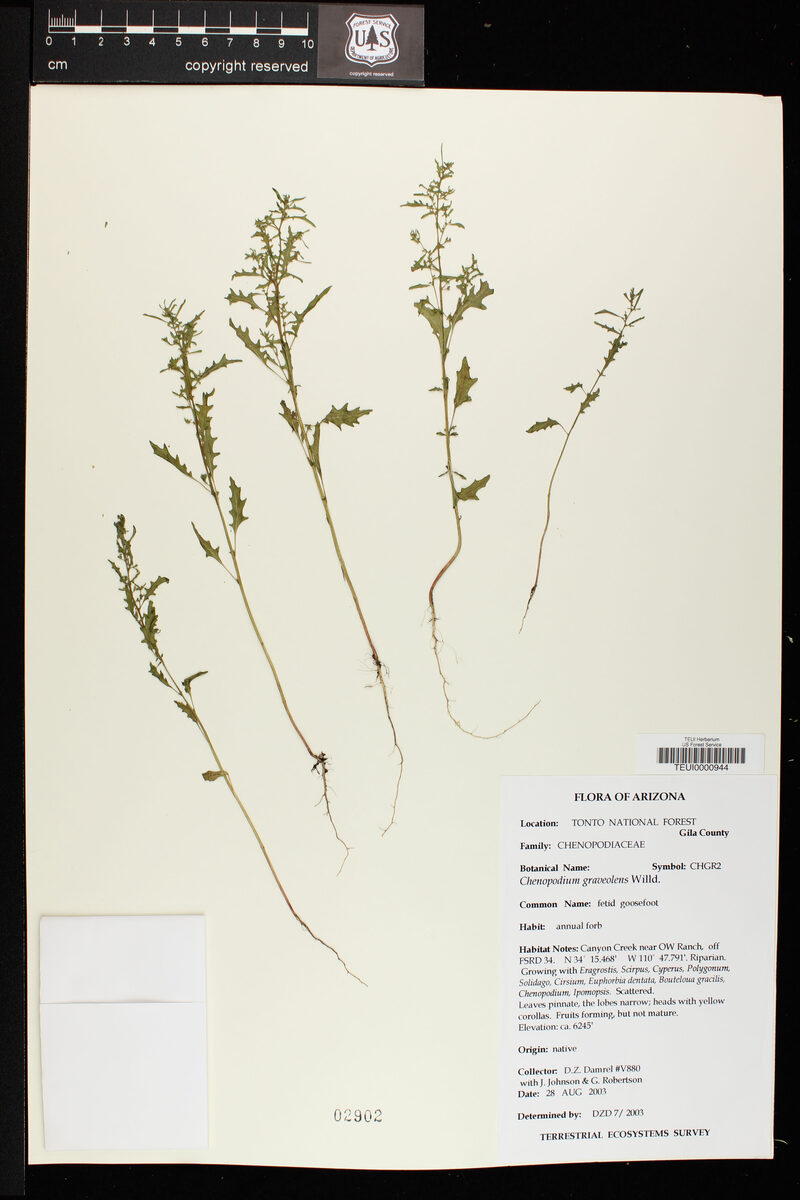
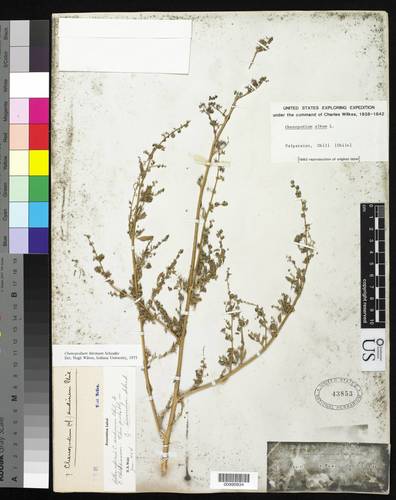
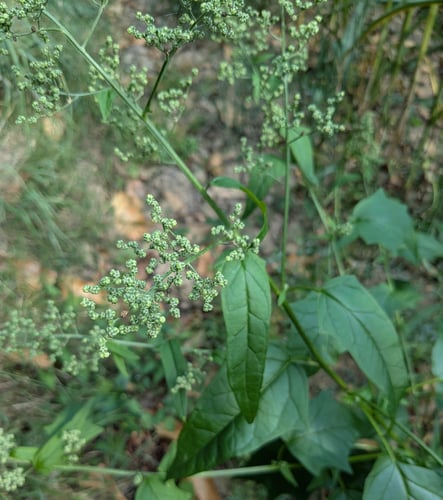
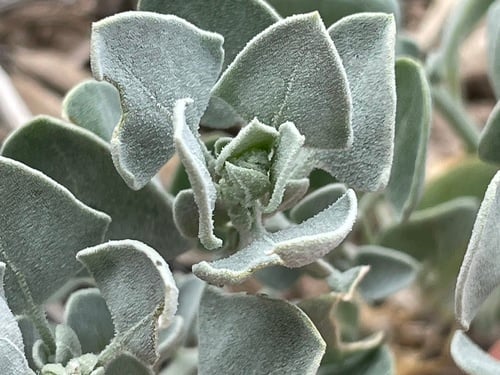
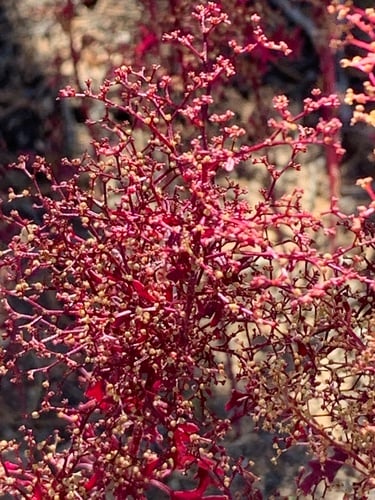
Chenopodium berlandieri var. bushianum
(Aellen) Cronquist
Bush's Goosefoot
gbif· cc-by-nc
Sam Gutekanst
gbif· cc-by-nc
Sam Gutekanst
gbif· cc-by-nc
Sam Gutekanst
Summary
Source: WikipediaChenopodium berlandieri, also known by the common names pitseed goosefoot, lamb's quarters (or lambsquarters), and huauzontle (Nahuatl), is an annual herbaceous plant in the family Amaranthaceae. The species is widespread in North America, where its range extends from Canada south to Michoacán, Mexico. It is found in every U.S. state except Hawaii. The fast-growing, upright plant can reach heights of more than 3 m. It can be differentiated from most of the other members of its large genus by its honeycomb-pitted seeds, and further separated by its serrated, evenly lobed (more or less) lower leaves. Although widely regarded as a weed, this species was once one of several plants cultivated by Native Americans in prehistoric North America as part of the Eastern Agricultural Complex. C. berlandieri was a domesticated pseudocereal crop, similar to the closely related quinoa C. quinoa. It continues to be cultivated in Mexico as a pseudocereal, as a leaf vegetable, and for its broccoli-like flowering shoots.
Description
A temperate herb of the Amaranthaceae family, one of approximately 100-150 Chenopodium species mostly found in temperate regions.
This description is brief — help expand it
Edible Uses
The leaves and seeds are edible.
Medicinal Uses
Chenopodium berlandieri is a prime candidate for additional research, especially its prospects for utility in the medicinal model. Long-term use of this plant makes little sense when judged in strict terms of subsistence. C. berlandieri shares some qualities with its medicinally useful relatives such as Chenopodium ambrosioides which is a widely known vermifuge and a potential food preservative. This makes its potential medicinal value a possibility. Its chemical constituents and possible medicinal properties have only been briefly examined in the anthropological and botanical literature. The useful substances in the leaves avoid the problems associated with the inefficiency of harvesting and processing the seeds. Tests for and analyses of bioactive chemical compounds would likely resolve questions about the use of Chenopodium berlandieri and the medicinal use may be evident in the concentration of these compounds.
Known Hazards
Chenopodium berlandieri has little presence in the current world food system, especially compared to other plants within its genus, such as Chenopodium quinoa or C. ambrosioides. This may be due to a recent Western bias against weedy plants, as well as a manifestation of colonial history which led to a disconnect from the local environment and indigenous knowledge. Today, the plant is still used as an edible herb and vegetable, primarily in Mexico. Edible parts of the plant include leaves, young shoots and seeds. Like other leafy greens, the leaves and shoots are eaten raw or cooked, though raw leaves are bitter as they contain chemical compounds produced by the plant for defense mechanisms. The plant can be processed through mechanical and chemical techniques. Mechanical processing techniques include winnowing to remove non-nutritive components, including possibly toasting the seeds during the winnowing process, followed by milling to de-husk the plant and separate the seeds. The seeds can then be ground down into smaller particles to make grits or bulgur, or ground further into flours to be combined with cereal flours to make breads or pancakes. The seeds contain saponins, though in small quantities, which are removed by soaking seeds in water overnight and rinsing thoroughly before further processing. Another method involves chemical processing, whereby gradual, controlled heating of the seeds detoxifies them, allowing nutrients to be bioavailable for digestion. People with gout, arthritis, rheumatism, kidney stones, or hyperacidity should use caution when consuming the plant, as it may aggravate their condition.
Distribution
It is a temperate plant.
Where It Grows
North America, USA,
Notes
There are about 100-150-250 Chenopodium species. They are mostly in temperate regions. Also put in the family Chenopodiaceae.
Synonyms
References (4)
- Hermandez Bermejo, J.E., and Leon, J. (Eds.), 1994, Neglected Crops. 1492 from a different perspective. FAO Plant Production and Protection Series No 26. FAO, Rome. p 12 (As Chenopodium bushianum)
- Kiple, K.F. & Ornelas, K.C., (eds), 2000, The Cambridge World History of Food. CUP p 1750 (As Chenopodium bushianum)
- Plants for a Future database, The Field, Penpol, Lostwithiel, Cornwall, PL22 0NG, UK. http://www.scs.leeds.ac.uk/pfaf/ (As Chenopodium bushianum)
- Repert. Spec. Nov. Regni Veg. 16:63. 1929 (As Chenopodium bushianum)