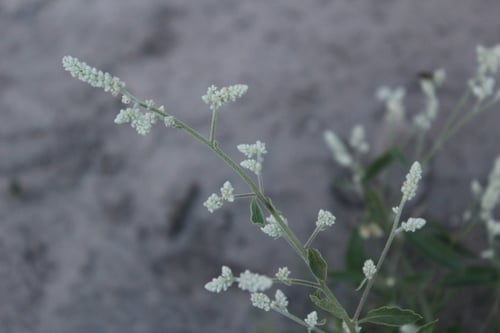
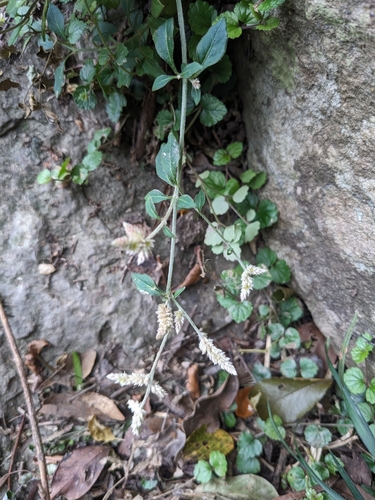
Enchylaena tomentosa
R. Br.
Barrier Saltbush, Ruby Saltbush, Berry Saltbush
iNaturalist· cc-by
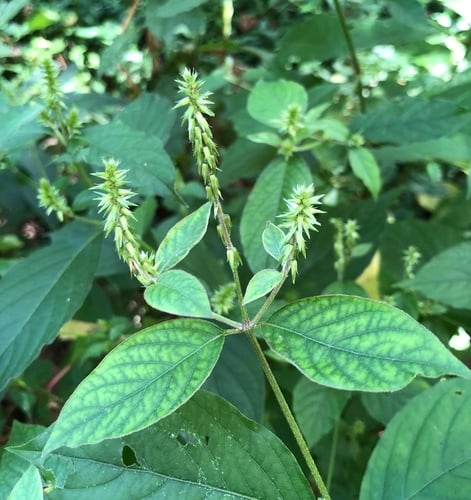
(c) Kym Nicolson, some rights reserved (CC BY), uploaded by Kym Nicolson
iNaturalist· cc-by-nc
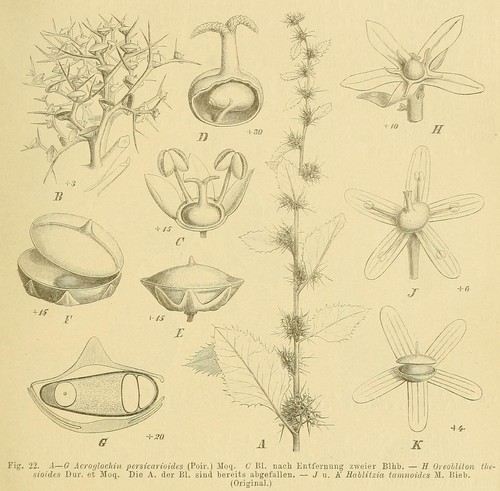
(c) Bernadette Lingham, some rights reserved (CC BY-NC), uploaded by Bernadette Lingham
iNaturalist· cc0
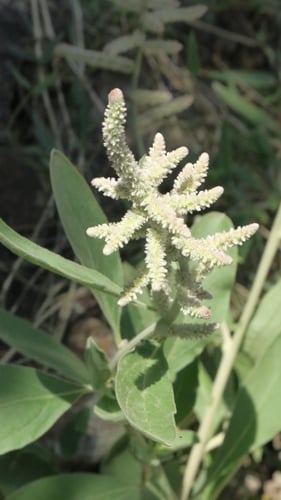
no rights reserved, uploaded by insiderelic
Summary
Source: WikipediaEnchylaena tomentosa commonly known as barrier saltbush or ruby saltbush,is a flowering plant in the family Amaranthaceae. It is a small shrub with greyish soft leaves, small flowers and fleshy berries.
Description
A small spreading shrub. It grows 0.3-1 m tall and spreads 0.5-1.5 m wide. The branches are slender and woody. They are hairy and straggling. The leaves are 0.8-2 cm long by 0.1-0.2 cm wide. They are thin and cylindrical. They are succulent and bluish-green. They are hairy. The flowers are small and occur singly in the axils of leaves. The fruit berries are 0.5 cm across. They change colour as they mature. Some varieties occur.
Edible Uses
The fruit is crisp, sweet, succulent, and salty-sweet in flavour. Very small at about 5mm in diameter, the fruits can also be soaked in water and the resulting liquid drunk like sweetened tea. Leaves are cooked like spinach, though they are rich in oxalates and should not be eaten in large quantities.
Traditional Uses
The young leaves can be cooked and used as a vegetable. The fruit are sweet and edible. They can also be dried and then soaked and eaten.
This uses section is brief — help expand it
Medicinal Uses
The plant is antiscorbutic.
Known Hazards
The leaves are rich in oxalic acid. Perfectly alright in small quantities, the leaves should not be eaten in large amounts since oxalic acid can bind up the body's supply of calcium leading to nutritional deficiency. It is oxalic acid that gives foods such as rhubarb their acid flavour. Cooking the leaves will greatly reduce the oxalic acid content. People with a tendency to rheumatism, arthritis, gout, kidney stones or hyperacidity should take especial caution if including this plant in their diet since it can aggravate their condition.
Distribution
A tropical to warm temperate plant. It grows in semi-desert and arid regions. It is on sandy or calcareous soils. They can grow on slightly salty coastal soils. It is drought and frost tolerant. It can grow in arid places.
Where It Grows
Australia*, Hawaii, Pacific,
Cultivation
We have very little information on this species and do not know if it will be hardy in Britain. It tolerates temperatures down to at least -7c in Australian gardens where it also resists salt spray. However, this cannot be translated directly to British gardens due to our cooler summers and longer, colder and wetter winters. It might be worthwhile trying it as a summer annual and seeing if it can overwinter. It probably requires a very well-drained soil and a sunny position. We have overwintered the plant in a cold greenhouse, though it suffered lots of die-back, so it will obviously have problems outdoors.
Propagation
Sow seed in spring in a greenhouse, barely covering it. Prick out seedlings as soon as large enough to handle and grow on under glass for at least their first winter, planting out after the last expected frosts with some protection for their first winter outdoors. The plant may also be grown as a summer annual by sowing in spring and planting out after the last expected frosts. Cuttings can also be used.
Other Uses
None known.
Other Information
It is eaten especially by children.
Notes
There are a few Enchylaena species. Also put in the family Chenopodiaceae.
Nutrition
| Part | Moisture | kJ | kcal | Protein | Vit A | Vit C | Iron | Zinc |
|---|---|---|---|---|---|---|---|---|
| Fruit | 65.1 | — | — | 5.7 | — | — | 3.8 | — |
Also Known As
Burra, Gurgudj, Iwati-wati, Mulili, Nyerilyi
References (43)
- Anon., 2003, Native Plants for the Fitzroy basin. Society for Growing Australian Plants Inc. (Rockhampton Branch) p 49
- Bindon, P., 1996, Useful Bush Plants. Western Australian Museum. p 111
- Bodkin, F., 1991, Encyclopedia Botanica. Cornstalk publishing, p 379
- Cancilla, D., 2018, Ethnobotanical and Ethnozoological Values Desktop Assessment - Eliwana Project. p 11
- Caton, J.M. & Hardwick, R. J., 2016, Field Guide to Useful Native Plants from Temperate Australia. Harbour Publishing House. p 60
Show all 43 references Hide references
- Cherikoff V. & Isaacs, J., The Bush Food Handbook. How to gather, grow, process and cook Australian Wild Foods. Ti Tree Press, Australia p 170, 189, 195
- Clarke, P. A., 2013, The Aboriginal Ethnobotany of the Adelaide Region, South Australia. Transactions of the Royal Society of South Australia. (2013), 137(1): 97-126
- Cribb, A.B. & J.W., 1976, Wild Food in Australia, Fontana. p 30, 106
- Dashorst, G.R.M., and Jessop, J.P., 1998, Plants of the Adelaide Plains & Hills. Botanic Gardens of Adelaide and State Herbarium. p 62
- De Angelis, D., 2005, Aboriginal Plant Use of the Greater Melbourne Area. La Trobe University Environment Collective
- Elliot, W.R., & Jones, D.L., 1984, Encyclopedia of Australian Plants suitable for cultivation. Vol 3. Lothian. p 399
- Facciola, S., 1998, Cornucopia 2: a Source Book of Edible Plants. Kampong Publications, p 77
- Flora of Australia, Volume 4, Phytolaccaceae to Chenopodiaceae, Australian Government Publishing Service, Canberra (1984) p 213
- Hall, N. et al, 1972, The Use of Trees and Shrubs in the Dry Country of Australia, AGPS, Canberra. p 289
- Hardwick, G., 2001, Economically Useful Plants for Northern Australia: Master Species List. Crusader eBooks.
- Hastings Advance Community College, 2017, Uses for Native Plants of the Mornington Peninsula. 86pp. p 41
- Hibbert, M., 2002, The Aussie Plant Finder 2002, Florilegium. p 92
- Hiddins, L., 1999, Explore Wild Australia with the Bush Tucker Man. Penguin Books/ABC Books. p 160
- Hunter, J. T. et al, Budjiti traditional use of plants on Naree Station. p 11
- Hunter, J., 2012, Vegetation and Floristics of Gilwarny and Wingadee Nature Reserves. A Report to the New South Wales National Parks and Wildlife Service p 116
- Hunter, J., 2015, Vegetation and flora of Naree and Yantabulla. A Draft Report to the Bush Heritage Australia
- Hunter, J.T., 2017, Is there a relationship between contemporary high Aboriginal plant resource locations and mapped vegetation communities? Cunninghamia 17:27-34. The Royal Botanic Garden Sydney. ISSN 2200 - 405X
- Lang, P. J., et al, 1986, Anangu Pitjantjatjara Lands Biological Survey. p 43
- Latz, P.K., 1996, Bushfires and Bushtucker: Aboriginal plant use in Central Australia. IAD Press Alice Springs p 166
- Lazarides, M. & Hince, B., 1993, Handbook of Economic Plants of Australia, CSIRO. p 90
- Lord, E.E., & Willis, J.H., 1999, Shrubs and Trees for Australian gardens. Lothian. p 162
- Low, T., 1991, Wild Food Plants of Australia. Australian Nature FieldGuide, Angus & Robertson. p 167
- Low, T., 1992, Bush Tucker. Australia’s Wild Food Harvest. Angus & Robertson. p 54, 70, 138
- Mallee Wildflower Committee, Flowers of the Mallee. p 73
- McKerney, M. & White, H., 2011, Bush Tucker, Boomerangs & Bandages. Border River-Gwyder Catchment Management Authority p 135
- Morley, B.D., & Toelken, H.R., (Eds), 1983, Flowering Plants in Australia. Rigby. p 82
- Paczkowska, G. & Chapman, A.R., 2000, The Western Australian Flora. A Descriptive Catalogue. Western Australian Herbarium. p 203
- Plants for a Future database, The Field, Penpol, Lostwithiel, Cornwall, PL22 0NG, UK. http://www.scs.leeds.ac.uk/pfaf/
- Ryan, M. (Ed.), 2003, Wild Plants of Greater Brisbane. Queensland Museum. p 45
- Smith, N. M., 1991, Ethnobotanical Field Notes from the Northern Territory, Australia, J. Adelaide Bot. Gard. 14(1): 1-65
- Spearrit, G., 2016, Plants of Irongate Conservation Park. Amaroo Environmental Education Centre.
- Urban, A., 1990, Wildflowers of Inland Australia. Portside editions. p 44
- Wheeler, J.R.(ed.), 1992, Flora of the Kimberley Region. CALM, Western Australian Herbarium, p 100
- Williams, K.A.W., 1999, Native Plants of Queensland Volume 4. Keith A.W. Williams North Ipswich, Australia. p 174
- Williams A. & Sides, T., 2008, Wiradjuri Plant Use in the Murrumbidgee Catchment. Murrumbidgee Catchment Management Authority. Wagga Wagga, p 60
- www.ceres.org.au/bushfoodcatalogue
- www.charlessturt.sa.gov.auwebdata/resources.files. Local_Coastal_Plants.pdf
- Zola, N., & Gott, B., 1992, Koorie Plants Koorie People. Koorie Heritage Trust. p 27