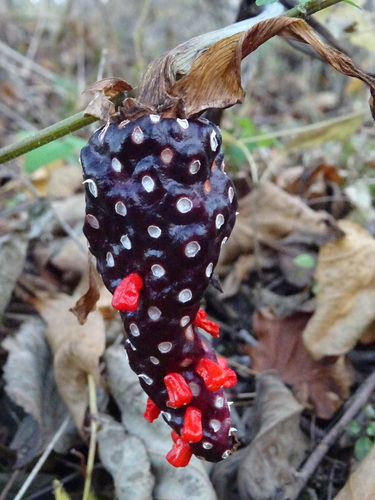
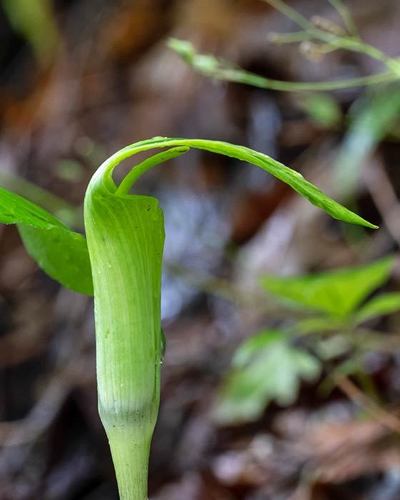
Pinellia pedatisecta
Schott
iNaturalist· cc-by-nc
(c) Guanning Liu, some rights reserved (CC BY-NC), uploaded by Guanning Liu
iNaturalist· cc-by-nc
(c) Adam, some rights reserved (CC BY-NC)
iNaturalist· cc-by-nc
(c) Adam, some rights reserved (CC BY-NC)
Summary
Source: WikipediaCorm-forming plant reaching 0.2 m tall and wide. Hardy to UK zone 6. Flowers July to August. Hermaphroditic. Tolerates light sandy, medium loamy, and heavy clay soils across mildly acidic to mildly alkaline pH ranges. Grows in semi-shade or full sun and prefers moist conditions.
Description
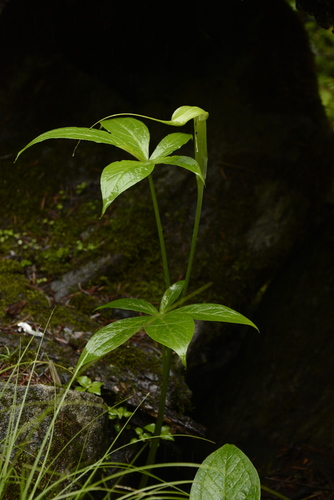
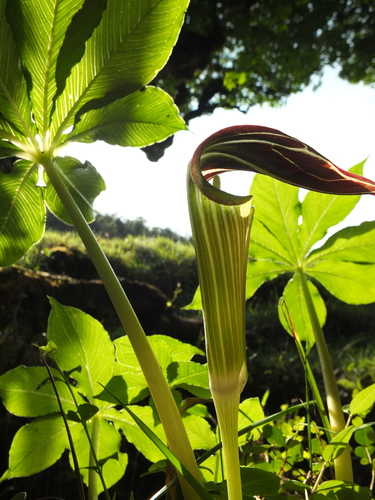
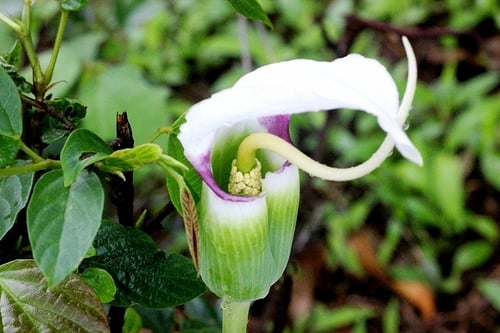
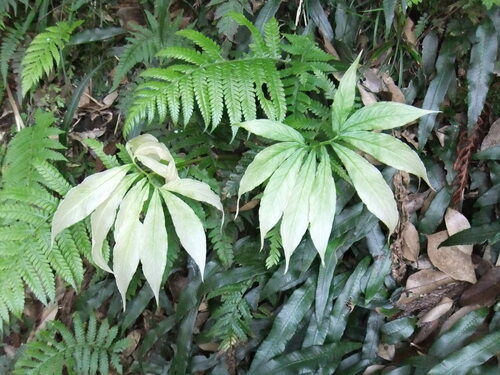
A herb. It keeps growing from year to year. It has tubers 4 cm across. There are 1-3 leaves. The leaf stalk is greenish and 20-70 cm across. It forms a sheath at the base. The leaves have 6-11 leaflets. These are sword shaped and wedge shaped at the base. The central leaflet is 15-18 cm long and later ones are smaller.
Edible Uses
No edible uses are known for this plant.
Traditional Uses
The young leaves are cooked in stir fries and eaten.
This uses section is brief — help expand it
Medicinal Uses
The poisonous tubers are used medicinally to treat enlargement of the lymph nodes and urinary tract infections. Notes from the closely related P. ternata almost certainly apply here as well. The root is antiemetic, antiphlogistic, expectorant, febrifuge, sialagogue, and styptic, and also strengthens the spleen. Modern research has confirmed this remedy is highly effective at controlling nausea and vomiting. It is also an ingredient in a Chinese prescription for removing gallstones without surgery — a procedure that typically causes severe nausea. Internally, the root is used to treat coughs with thin, watery phlegm and gastritis. The fresh root is extremely acrid and toxic; these properties are neutralized by drying or by soaking in tea or vinegar. The root is harvested in summer and dried for later use — it must never be used fresh. Plant extracts have demonstrated analgesic, antiemetic, anticancer, and sedative activity.
Known Hazards
Although we have no record of toxicity for this species, all parts of the plant probably contain calcium oxylate. This is toxic and if consumed makes the mouth and digestive tract feel as though hundreds of needles are being stuck into it. However, calcium oxylate is easily destroyed by thoroughly cooking or drying the plant.
Distribution
It is a temperate plant. It grows in forests and valleys and shaded areas below 1,000 m above sea level. It grows in Sichuan and Yunnan in China.
Where It Grows
Asia, China, Tibet,
Cultivation
Easily grown in a rich soil, it requires plenty of water in the growing season. Succeeds in full sun or partial shade. Plants can be naturalized in woodland. Plants produce bulbils in their leaf axils.
Propagation
Seed — no specific information is available for this species, but sowing in a cold frame as soon as seed is ripe is recommended, or in early spring if that is not possible. Prick seedlings out into individual pots once large enough to handle, and grow on in a greenhouse for at least the first winter. Plant out into permanent positions in late spring or early summer, after the last expected frosts. Division can be done as new growth begins in spring. Bulbils from the leaf axils can also be used.
Other Uses
No other uses are known for this plant.
Other Information
They are only occasionally eaten.
Synonyms
Also Known As
Hu zhang, Luoa
References (1)
- Ju, Y., et al, 2013, Eating from the wild: diversity of wild edible plants used by Tibetans in Shangri-la region, Yunnan, China, Journal of Ethnobiology and Ethno medicine 9:28