Cerastium fontanum subsp. triviale
(Spenn.) Jalas
Chickweed, Mouse ear chickweed
iNaturalist· cc-by-nc
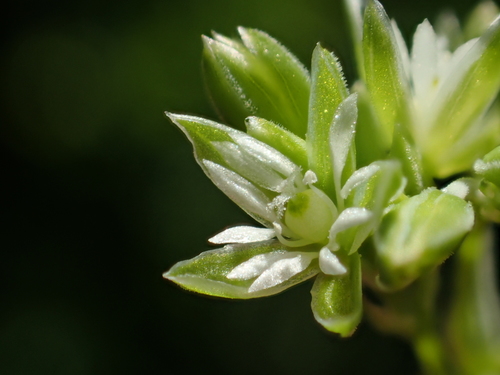
(c) Vladimir Bryukhov, some rights reserved (CC BY-NC), uploaded by Vladimir Bryukhov
iNaturalist· cc-by
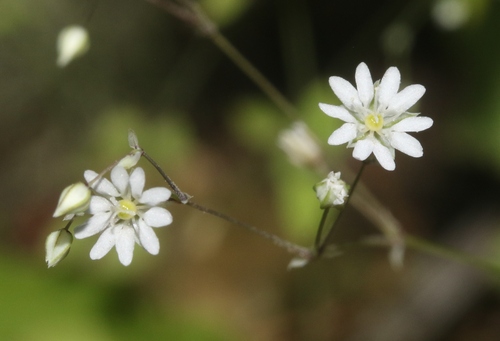
(c) Wolfgang Jauch, some rights reserved (CC BY)
iNaturalist· cc-by
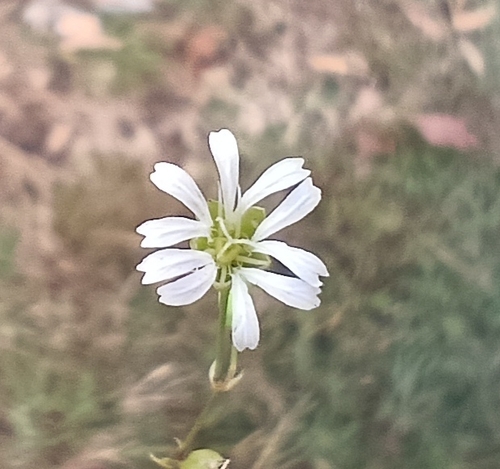
(c) Wolfgang Jauch, some rights reserved (CC BY)
Summary
Source: WikipediaCerastium fontanum, also called mouse-ear chickweed, common mouse-ear, or starweed, is a species of mat-forming perennial or, rarely, annual plant. It is native to Europe but introduced elsewhere. Its identifying characteristics are tear-shaped leaves growing opposite one another in a star pattern, hairy leaves, and small white flowers. Mouse-ear chickweed typically grows to 4"-8" tall and spreads horizontally along the ground via the formation of roots wherever the stem falls over and contacts the ground.
Description
A small herb. It usually lives for a few years. It grows 60 cm high. The stems can be branched or simple. They leaves are opposite. The leaves are 10-25 mm long by 3-9 mm wide. The flowers are small and white. They are in the axils of the upper leaves. The flowers are 1 cm across. The white petals are deeply notched. There is some confusion over Cerastium fontanum and the subsp.
Edible Uses
The leaves can be eaten in salads, soups, and stews. The stems and flowers can also be used in cooked dishes.
Traditional Uses
The leaves can be eaten in salads. They can also be used in soups and stews. The stems and flowers can be used in cooked dishes.
This uses section is brief — help expand it
Distribution
It grows in temperate places. It grows in forests, forest margins, mountain slopes, hilltop grasslands, fields, sandy soils, rock crevices, roadsides between 100–4300 m altitude in China. Tasmania Herbarium.
Where It Grows
Asia, Australia, China, Falklands, Hawaii, Himalayas, Japan, Korea, Macquarie Island, Nepal, Pacific, Pakistan, SE Asia, St Helena, Taiwan, Tasmania,
Notes
There are about 100 Cerastium species.
Synonyms
Also Known As
Xi quan juan er
References (12)
- Arch. Soc. Zool. Bot. Fenn. "Vanamo" 18:63. 1963 (As Cerastium fontanum subsp. triviale)
- Flora of Australia Volume 49, Oceanic Islands 1, Australian Government Publishing Service, Canberra. (1994) p 93 (As Cerastium fontanum subsp. triviale)
- Flora of Pakistan. www.eFlora.org (As Cerastium fontanum subsp. triviale)
- Hwang, HS, et al, 2014, Distribution characteristics of plant in the Ungseokbong Mountain, Gyeongsangnam-do, Korea. Journal of Asia-Pacific Biodiversity. 7(2014) e164-e178 (As Cerastium holosteoides var. hallaisanense (Nakai) Mizush)
- Hyde-Wyatt, B.H. & Morris D.I., 1975, Tasmanian Weed Handbook. Dept of Ag Tasmania. p 77 (As Cerastium fontanum subsp. triviale)
Show all 12 references Hide references
- Lu Dequan, Wu Zhengyi, Zhou Lihua, Chen Shilong; Michael G. Gilbert, Magnus Lidén, John McNeill, John K. Morton, Bengt Oxelman, Richard K. Rabeler, Mats Thulin, Nicholas J. Turland, Warren L. Wagner, CARYOPHYLLACEAE, Flora of China. (As Cerastium fontanum subsp. triviale)
- Paczkowska, G. & Chapman, A.R., 2000, The Western Australian Flora. A Descriptive Catalogue. Western Australian Herbarium. p 195 (As Cerastium fontanum subsp. triviale)
- Plants for a Future database, The Field, Penpol, Lostwithiel, Cornwall, PL22 0NG, UK. http://www.scs.leeds.ac.uk/pfaf/ (As Cerastium fontanum subsp. triviale)
- Tasmanian Herbarium Vascular Plants list p 18 (Cerastium fontanum subsp. vulgare)
- Upson, R., & Lewis R., 2014, Updated Vascular Plant Checklist and Atlas for the Falkland Islands. Falklands Conservation and Kew.
- Wild edible plants of Himachal Pradesh
- www.ediblewildfood.com (As Cerastium fontanum subsp. triviale)