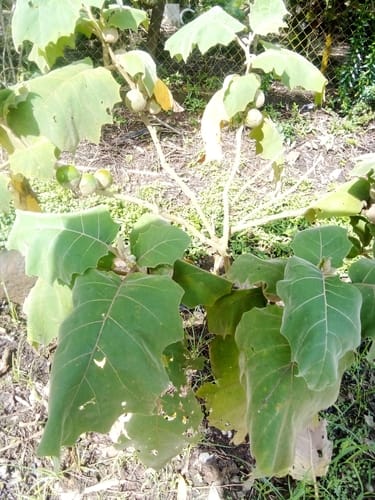
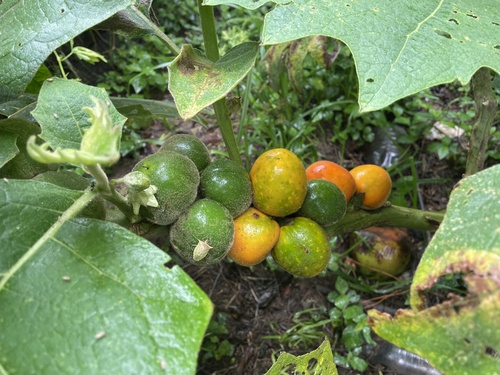
Solanum virginianum
L.
Thorny nightshade, Yellow-berried nightshade
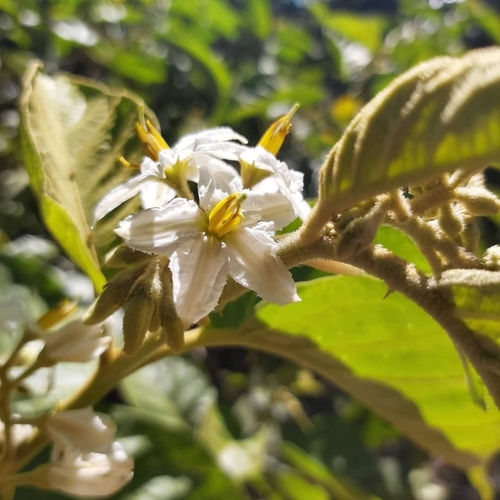
iNaturalist· cc-by-nc
(c) Curren Frasch, some rights reserved (CC BY-NC), uploaded by Curren Frasch
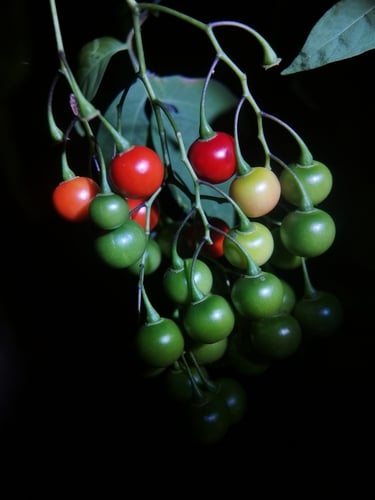
iNaturalist· cc-by
(c) Dr. Alexey Yakovlev, some rights reserved (CC BY), uploaded by Dr. Alexey Yakovlev
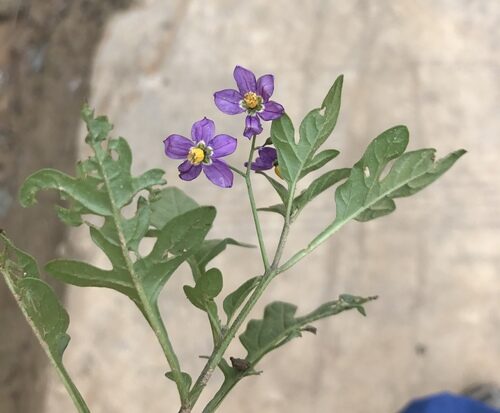
iNaturalist· cc-by-nc
(c) Curren Frasch, some rights reserved (CC BY-NC), uploaded by Curren Frasch
Description
A herb. It can be erect or creeping. It can be woody at the base. It grows 50-70 cm tall. It has needle like prickles. It is also hairy. The leaves are in unequal pairs. They are 4-9 cm long by 2-5 cm wide. There are usually 5-9 lobes. The flowers are in groups 4-7 cm long. They are blue to purple. The fruit is a pale yellow berry. It is 1-2 cm across. The seeds are almost kidney shaped.
Edible Uses
Fruit - raw or cooked. A slightly bitter flavour. They can be cooked in curries. They are often eaten whilst still green and immature, before the seeds become tough. Leaves - cooked and used as a potherb.
Traditional Uses
The unripe fruit are eaten. The fruit are used as a vegetable in curries. The leaves are eaten as a potherb. Caution: It contains solasodine the raw material for hormones.
Medicinal Uses
The seeds are expectorant. They are used in the treatment of asthma and catarrh. Solasodine can be extracted from the fruits, it is a source of raw material for hormone synthesis.
Known Hazards
Although providing many well-known foods for people, including the potato, tomato, pepper and aubergine, most species in this genus also contain toxic alkaloids. Whilst these alkaloids can make the plant useful in treaing a range of medical conditions, they can also cause problems such as nausea, vomiting, salivation, drowsiness, abdominal pain, diarrhoea, weakness and respiratory depression. Unless there are specific entries with information on edible uses, it would be unwise to ingest any part of this plant.
Distribution
It is a subtropical plant. It grows on sandy river beaches between 100-1,300 m above sea level in southern China. In Sichuan and Yunnan.
Where It Grows
Afghanistan, Africa, Asia, China, Himalayas, India, Indochina, Indonesia, Japan, Malaysia, Myanmar, Nepal, Northeastern India, NW India, Pacific, SE Asia, Sri Lanka, Taiwan, Thailand, Vietnam,
Propagation
Seed - sow in trays in a nursery. Prick out the seedlings into individual pots when they are large enough to handle and grow them on fast. Plant them out when 10cm or more tall. Cuttings of half-ripe wood. Very easy, the cuttings root within a couple of weeks Division
Other Uses
An extract of the whole plant is used as an ingredient in commercial cosmetic preparations as a skin conditioner An extract of the roots is used as an ingredient in commercial cosmetic preparations as a masking agent[1243
Also Known As
Bejari, Bhaskatiya, Bitter brinjal, Kandakathiri, Mulaka, Mye-bok-hkayan, Neeli kandhiari
References (6)
- Chandrakumar, P., et al, 2015, Ethnobotanical studies of wild edible plants of Gond, Halba and Kawar tribes of Salekasa Taluka, Gondia District, Maharashtra State, India. International Research Journal of Pharmacy 6(8)
- Kahlon, L. K. & Singh, R., 2019, Traditional knowledge & Dynamics of edible plants of primitive tribal group ‘Paudi Bhuyan’ with changing demography migration patterns in Northern Odisha. Indian Journal of Traditional Knowledge Vol 18(1), pp 7-15
- Khan, M. & Hussain, S., 2014, Diversity of wild edible plants and flowering phenology of district Poonch (J & K) in the northwest Himalaya. Indian Journal of Sci, Res. 9(1): 032-038 (As Solanum xanthocarpum)
- Rasingam, L., 2012, Ethnobotanical studies on the wild edible plants of Irula tribes of Pillur Valley, Coimbatore district, Tamil Nadu, India. Asian Pacific Journal of Tropical Biomedicine. (2012) S1493-S1497
- Reddy, K. N. et al, 2007, Traditional knowledge on wild food plants in Andhra Pradesh. Indian Journal of Traditional Knowledge. Vol. 6(1): 223-229
Show all 6 references Hide references
- Samuels, J., 2015, Biodiversity of Food Species of the Solanaceae Family: A Preliminary Taxonomic Inventory of Subfamily Solanoideae. Resources 2015, 4. 277-322