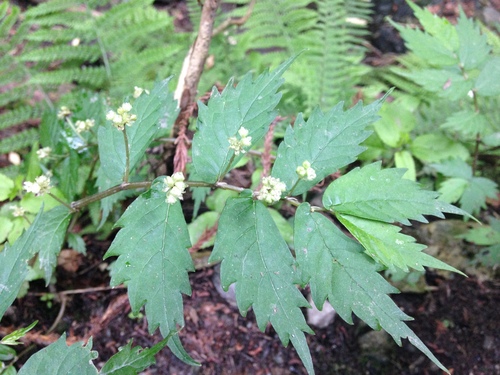
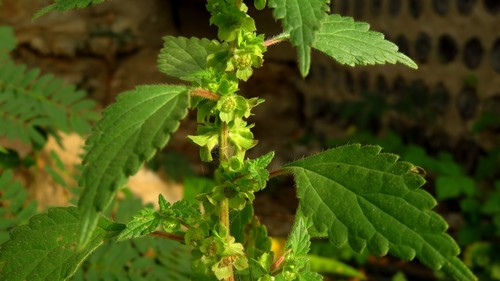
Debregeasia wallichiana
(Wedd.) Wedd.
iNaturalist· cc-by-nc
(c) Aditya Gadkari, some rights reserved (CC BY-NC), uploaded by Aditya Gadkari
iNaturalist· cc-by
(c) T R Shankar Raman, some rights reserved (CC BY), uploaded by T R Shankar Raman
Summary
An evergreen tree growing to 5m tall. Year-round foliage with flowers July to August and seeds ripening September to October. Dioecious—male and female flowers on separate plants, requiring both for seed production. Not self-fertile. Grows in light sandy, medium loamy, or heavy clay soils across mildly acid to mildly alkaline pH. Tolerates semi-shade in light woodland and prefers moist soil.
Description
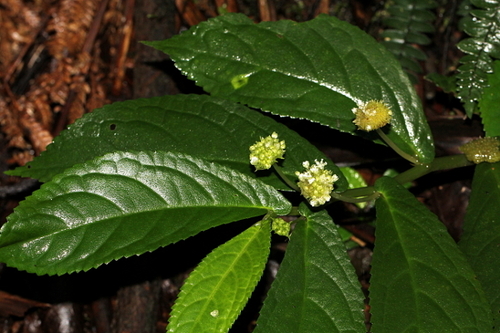
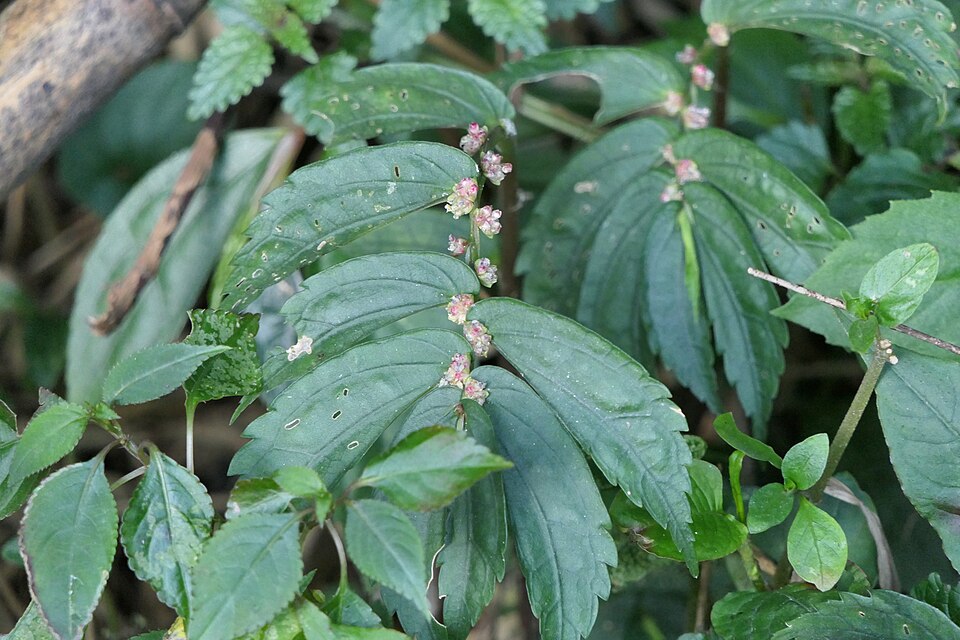
A shrub or small tree. It grows 6 m tall. The trunk can be 8 cm across. Plants have male and female flowers on the same plant. There are easy to see scars there the leaves fall off. The leaves are crowded at the tips of the small branches. The leaves are long and 12-20 cm long by 3-5 mm wide. They are divided at the tip. The leaf stalk is 3-15 cm long. The leaves are dark green on the upper surface. The flowers are on the current and the previous year's growth. They are in a branched flower arrangement. The male flowers have short stalks and the female flowers do not have stalks.
Edible Uses
We have no specific information for this species, but the fruits of most, if not all, members of this genus are edible and are used to make wine.
Medicinal Uses
No medicinal uses are known for this plant.
Known Hazards
Unlike many species in the nettle family (Urticaceae), members of this genus do not have stinging hairs.
Distribution
It is a subtropical plant. It grows between 1,200-2,300 m above sea level. It grows on limestone mountains. It grows in Yunnan.
Where It Grows
Asia, Bangladesh, Bhutan, Cambodia, China, Himalayas, India, Indochina, Myanmar, Nepal, Northeastern India, SE Asia, Sikkim, Sri Lanka, Thailand,
Cultivation
Debregeasia wallichiana is native to mainly subtropical regions in southern Asia, though there are reports that it can be found at elevations up to 2,100 metres in the Himalayas Prefers a fertile well-drained loam with some shelter at the hottest part of the day. A handsome plant ; the inflorescence is orange, and the under surface of the large leaves is snow-white.
Propagation
Sow seed in a greenhouse from late winter to mid-summer, barely covering it. Germination typically occurs within 1–2 months at 20°C. Once seedlings are large enough to handle, prick them out into individual pots and grow on in the greenhouse through at least their first winter. Plant out into permanent positions in late spring or early summer, after the last expected frosts. Can also be propagated by softwood cuttings taken in early summer.
Other Uses
A fibre obtained from the bark is used for making twine and rope.
Synonyms
Also Known As
Bahunlihara, Bahuni lahara, Bap-kung, Puruni
References (5)
- Flora of China @ efloras.org Volume 5
- Savita, et al, 2006, Studies on wild edible plants of ethnic people in east Sikkim. Asian J. of Bio Sci. (2006) Vol. 1 No. 2 : 117-125
- Sundriyal, M., et al, 1998, Wild edibles and other useful plants from the Sikkim Himalaya, India. Oecologia Montana 7:43-54
- Sundriyal, M., et al, 2004, Dietary Use of Wild Plant Resources in the Sikkim Himalaya, India. Economic Botany 58(4) pp 626-638 (Also incorrectly as Leoregessia wallichiana)
- Wild edible plants of Himachal Pradesh