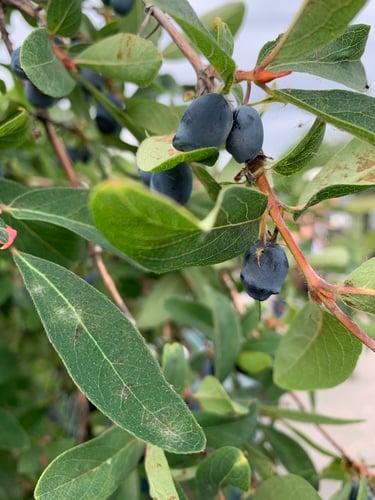
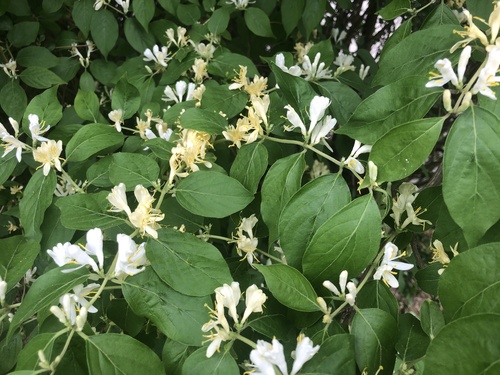
Lonicera periclymenum
L.
iNaturalist· cc-by
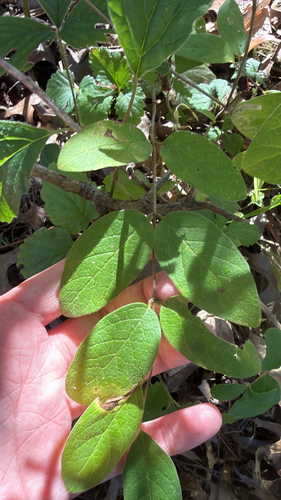
(c) Daniel Cahen, some rights reserved (CC BY), uploaded by Daniel Cahen
iNaturalist· cc-by-nc
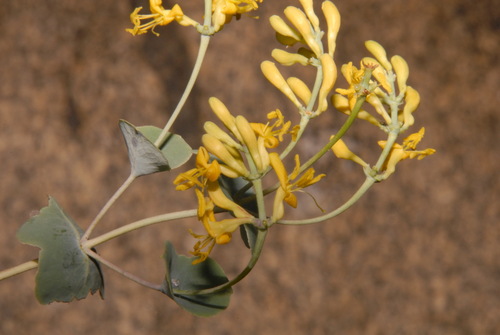
(c) michi1, some rights reserved (CC BY-NC), uploaded by michi1
iNaturalist· cc-by-nc
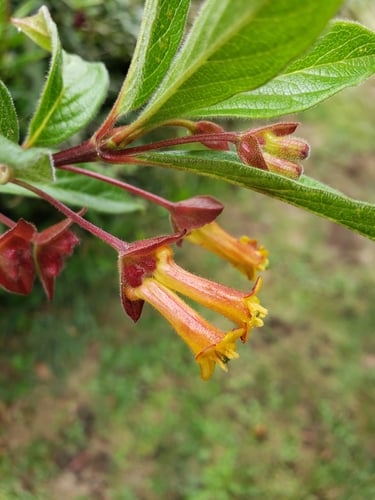
(c) Hjalte Kjærby, some rights reserved (CC BY-NC), uploaded by Hjalte Kjærby
Summary
Source: WikipediaLonicera periclymenum, common names honeysuckle, common honeysuckle, European honeysuckle, or woodbine, is a species of flowering plant in the family Caprifoliaceae native to much of Europe, North Africa, Turkey and the Caucasus. It is found as far north as southern Norway, Sweden and Finland.
Description
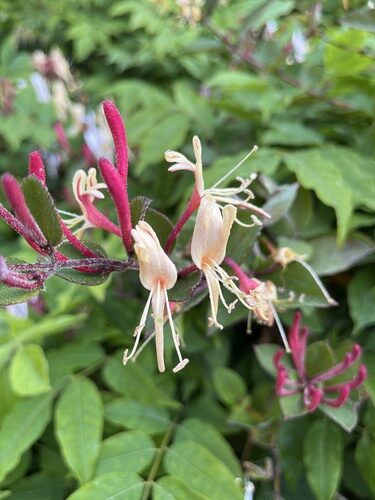
A shrub. It can be a climbing plant up to 6 m tall. The leaves are entire and opposite. They are narrowly oval and greyish-green. There are up to 12 flowers in a head all growing from a common point. They are trumpet shape. The fruit are bright red berries in a tight cluster.
Edible Uses
The flowers produce nectar that children (of all ages) suck from the base of the blooms.
Traditional Uses
The flowers are sucked for their nectar. The flowers are used in salads. The berries can be eaten in small amounts but lack flavour.
This uses section is brief — help expand it
Medicinal Uses
The plant has expectorant and laxative properties. A syrup made from the flowers has been used to treat respiratory diseases, and a decoction of the leaves is considered beneficial for diseases of the liver and spleen. It can be used as a mouthwash for ulcers and is regarded as a good ingredient in gargles. The flowers are antispasmodic, astringent, diuretic, expectorant, febrifuge, and sudorific. The fruit is emetic and cathartic. The herbage is used as a cutaneous and mucous tonic, as a vulnerary, and is also diaphoretic. The leaves are laxative and slightly astringent. The seed is diuretic. The bark is anticatarrhal, depurative, diuretic, and sudorific.
Known Hazards
None mentioned.
Distribution
It is a temperate or Mediterranean plant.
Where It Grows
Australia, Britain, Europe, Ireland, Luxembourg, Spain, Tasmania,
Cultivation
Succeeds in most soils from acid to base-rich. Prefers its roots in the shade with its shoots climbing up into the sun. Plants succeed even in quite deep shade. Established plants are fairly drought tolerant. Plants are hardy to about -20°c. A very ornamental plant, there are a number of named varieties. The flowers are very fragrant, especially in the evening when it attracts pollinating moths. New leaves often start to open in January with well-grown leaves in April. The leaves fall in November. Twining plants, they can bind themselves so tightly round young trees that they can prevent the trunk from being able to expand. A very good moth and butterfly plant, it is also an important food for many caterpillars including the larvae of the rare white admiral butterfly. The dense growth of the plant offers good nesting possibilities for birds. In garden design, as well as the above-ground architecture of a plant, root structure considerations help in choosing plants that work together for their optimal soil requirements including nutrients and water.
Propagation
Seed is best sown as soon as it is ripe in a cold frame. Stored seed requires 2 months of cold stratification and should be sown in a cold frame as soon as possible. Prick seedlings into individual pots when large enough to handle and grow on in the greenhouse through their first winter, then plant out in late spring or early summer after the last expected frosts. Take half-ripe cuttings 7–10cm long with or without a heel in July/August in a frame; good success rate. Cuttings of mature wood from the current season's growth, 15–20cm with or without a heel, can be taken in November in a cold frame; good success rate. Layer in autumn.
Other Uses
As a climbing plant, it can be allowed to scramble along the ground as a good ground cover, with plants spaced about 1.2 metres apart each way. It is an excellent plant for moths and butterflies and an important food source for many caterpillars, including larvae of the rare white admiral butterfly. The plant's dense growth also provides good nesting habitat for birds.
Also Known As
Iligabosc, Xuclamel
References (4)
- Baker, M. L. & de Salas, M. F., 2012, A Census of the Vascular Plants of Tasmania. (On line)
- Irving, M., 2009, The Forager Handbook, A Guide to the Edible Plants of Britain. Ebury Press p 201
- Menendez-Baceta, G., et al, 2012, Wild edible plants traditionally gathered in Gorbeialdea (Biscay, Basque Country) Genetic Resources and Crop Evolution 59:1329-1347
- Tardio, J., et al, Ethnobotanical review of wild edible plants in Spain. Botanical J. Linnean Soc. 152 (2006), 27-71