Wyethia mollis
Gray
Woolly wyethia
iNaturalist· cc-by-nc
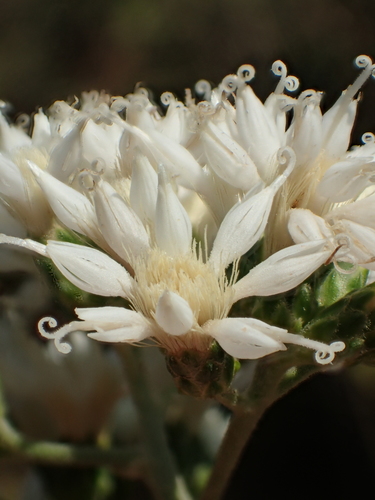
(c) faerthen, some rights reserved (CC BY-NC), uploaded by faerthen
iNaturalist· cc-by-nc
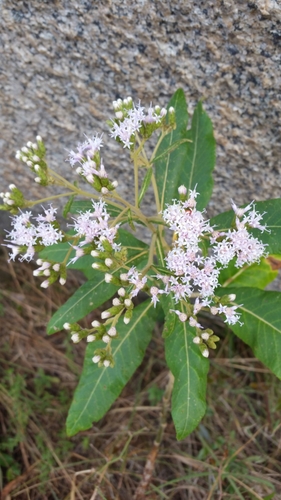
(c) Tony Iwane, some rights reserved (CC BY-NC)
Summary
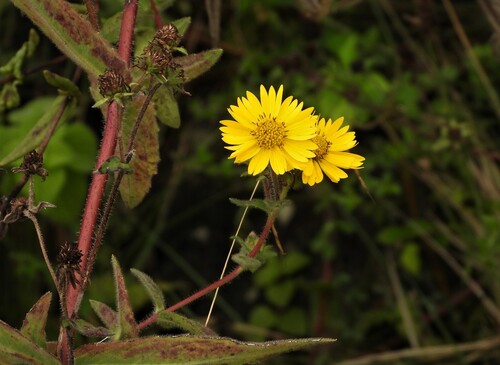
Source: WikipediaWyethia mollis is a species of flowering plant in the family Asteraceae known by the common name woolly mule's ears. The plant is hairy to woolly in texture, sometimes losing its hairs with age. Wyethia mollis is a coarse perennial herb native to the mountains of northern California, especially on the east side of the Sierra Nevada, and southeastern Oregon and western Nevada. It grows in forests and other mountain habitat such as dry open meadows with sagebrush. It grows from a tough taproot and caudex unit, producing a stem 30 to 40 centimeters tall, and reaching a meter in height at times. It thrives in volcanic soils because of its deep roots. The leaves have lance-shaped or oval blades up to 40 centimeters long, which are glandular and coated in woolly hairs, especially when new. They usually grow up vertically from the base. The inflorescence is a solitary flower head or a cluster of 2 or 3 heads, each with up to 11 yellow ray florets which may be up to 4.5 centimeters long. The fruit is an achene about a centimeter long, not counting its pappus. The seeds are edible and taste similar to sunflower seeds.
Description
Perennial reaching 1 m in height, hardy to UK zone 8. Flowers July to August. Hermaphroditic and insect-pollinated. Grows in light sandy to medium loamy, well-drained soils with mildly acid to basic pH. Requires full sun, prefers moist soil, and tolerates drought.
Edible Uses
The root is cooked and has a sweet, agreeable flavour. Native American Indians prepared it by lining pits with large stones, heating them with fire, then placing the roots on the hot stones, sealing them in with fern leaves and earth, and fermenting them for one or two days. The seeds can be eaten raw or cooked — used as a piñole, ground into a powder for mush, or mixed with cereal flours to make bread.
Traditional Uses
The seeds are parched and ground and used as meal. The stems and seeds are also eaten raw.
This uses section is brief — help expand it
Medicinal Uses
The root is antiphlogistic, diaphoretic, emetic, and febrifuge. A decoction has been used as a blood tonic and in the treatment of tuberculosis, venereal diseases, colds, and fevers. A poultice of crushed roots has been applied to swellings, and a poultice of crushed leaves has been applied to sprains, swellings, and broken bones.
Known Hazards
One report suggests that the leaves might be poisonous.
Distribution
It is a temperate plant.
Where It Grows
North America, USA,
Cultivation
Requires a free-draining, gritty but moisture-retentive soil in a sunny position. This species is more tolerant of drought than other members of the genus. Plants are not hardy in the colder areas of Britain.
Propagation
Sow seed in a greenhouse or cold frame in early spring using a very freely-draining compost. Prick out seedlings into individual pots as soon as they are large enough to handle, then plant out into permanent positions when sufficiently established. The crown can also be carefully divided as plants come into growth in spring.
Other Uses
None known
References (3)
- Moerman, D. F., 2010, Native American Ethnobotany. Timber Press. p 601
- Plants for a Future database, The Field, Penpol, Lostwithiel, Cornwall, PL22 0NG, UK. http://www.scs.leeds.ac.uk/pfaf/
- USDA Plants Database