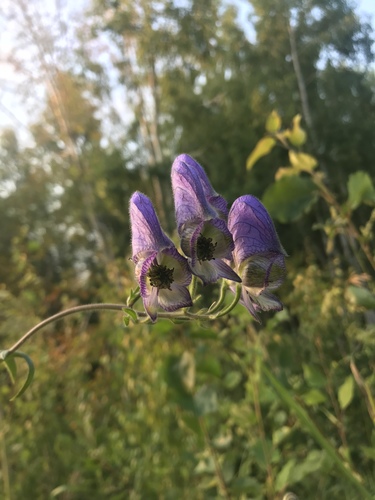
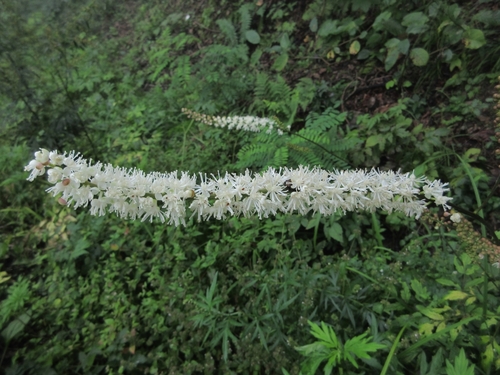
Aconitum violaceum
Jacq.
Tilia kachang
iNaturalist· cc-by-nc-sa
(c) licensed media from TrekNature DwCA without owner, some rights reserved (CC BY-NC-SA)
iNaturalist· cc-by-nc
(c) liliyako, some rights reserved (CC BY-NC)
Summary
Source: WikipediaAconitum violaceum is a species of perennial plant distributed in the Himalayan region of India, Pakistan, and Nepal. Within India, it has been recorded in the alpine slopes in an altitude range of 3,600–4,800 m (12,000–16,000 ft). The plant is used in traditional Tibetan medicine. It has a bitter taste and a cooling tendency.
Description
A shrub or small tree. It grows 5 m tall. There are prickles along the stem. The leaves are twice divided and there are 8-18 pairs of pinnae. There are up to 50 pairs of pinnules on each pinnae. The flowers are yellow. They are in large clusters at the ends of branches. The pods are flattened.
Edible Uses
The root is cooked and eaten as a pleasant tonic. These reports should be treated with great distrust given the poisonous nature of the genus.
Traditional Uses
Caution: The plant is poisonous. It contains an alkaloid and is used as a tonic. It has been reported that the roots are eaten after cooking.
This uses section is brief — help expand it
Medicinal Uses
In Tibetan medicine the entire plant is used and is said to have a bitter taste and a cooling potency. It is considered an antidote, anti-inflammatory, and febrifuge, and is used in the treatment of snake and scorpion bites, contagious infections, and inflammation of the intestines.
Known Hazards
The whole plant is highly toxic - simple skin contact has caused numbness in some people. Another report suggests that the root of this species might not be toxic.
Distribution
It is a temperate plant. It grows naturally in the Himalayas amongst shrubs and on open slopes between 3600 - 4800 metres from Pakistan to Central Nepal.
Where It Grows
Asia, Himalayas, India, Nepal, Pakistan,
Cultivation
We have very little information on this species and do not know if it will be hardy in Britain, though judging by the native range of the plant it should succeed outdoors in many parts of the country. It is a polymorphic species. The following notes are based on the general needs of the genus. Thrives in most soils and in the light shade of trees. Grows well in heavy clay soils. Prefers a moist soil in sun or semi-shade. Prefers a calcareous soil. Grows well in open woodlands. Members of this genus seem to be immune to the predations of rabbits and deer. A greedy plant, inhibiting the growth of nearby species, especially legumes.
Propagation
Sow seed as soon as it is ripe in a cold frame. Seed can be stratified and sown in spring, but germination will be slow. Prick seedlings out into individual pots once large enough to handle, grow on in a cold frame through their first winter, and plant out in late spring or early summer. Division is best done in spring, though autumn works too. Some sources recommend autumn or late winter for dividing, as plants come into growth very early in the year.
Other Uses
None known
Notes
There are about 100 Aconitum species.
References (2)
- Ambasta S.P. (Ed.), 2000, The Useful Plants of India. CSIR India. p 11
- Plants for a Future database, The Field, Penpol, Lostwithiel, Cornwall, PL22 0NG, UK. http://www.scs.leeds.ac.uk/pfaf/