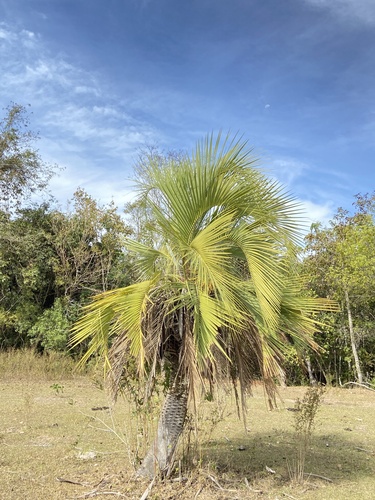
Mauritiella armata
(Mart.) Burret
Aguajillo, Thorny mauritiella
Wikipedia· cc-by-sa
Wikimedia Commons - Mauritiella_armata_(19854315082).jpg
iNaturalist· cc-by-nc
(c) Nelson Wisnik, some rights reserved (CC BY-NC)
iNaturalist· cc-by-nc
(c) Nelson Wisnik, some rights reserved (CC BY-NC)
Summary
Source: WikipediaMauritiella armata is a species of flowering plant in the family Arecaceae. It is found in South America.
Description
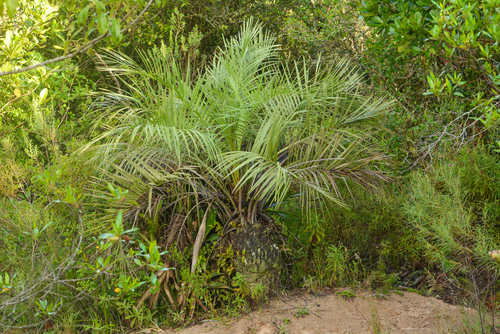
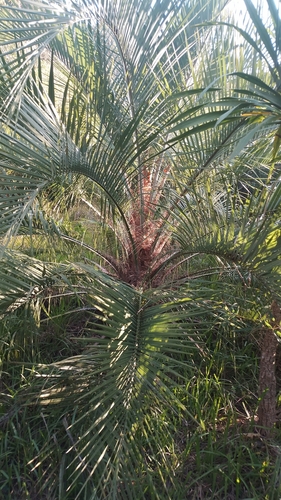
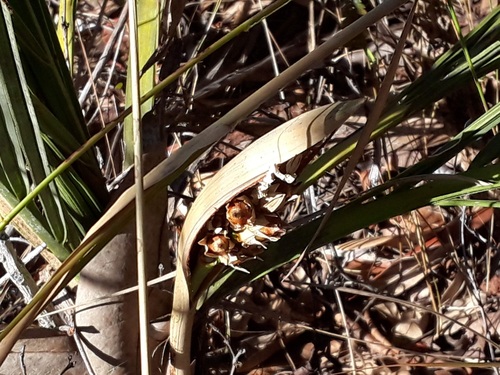
A palm. It can be 20 m tall. It grows in clumps. The fronds are fan shaped. They are silver grey underneath. The trunk is slender and short and has spines. The fruit occur as many in a bunch. The fruit are scaly and oval. They are 3 cm long by 2 cm wide. They are pale orange. The skin is thin and the pulp is yellow. Their is one red-brown seed.
Edible Uses
The fruit are softened in water and eaten fresh, and are sold in local markets. The palm heart and seeds are also edible portions.
Traditional Uses
The fruit are softened in water then eaten. They are also used for fruit.
This uses section is brief — help expand it
Distribution
It is a tropical plant. It grows up to 900 m above sea level. It grows in seasonally flooded savannahs. In Townsville palmetum.
Where It Grows
Amazon, Australia, Bolivia, Brazil*, Colombia, Ecuador, Guianas, Guyana, Peru*, South America, Suriname, Venezuela,
Cultivation
Prefers a position in full sun and a moist soil that does not dry out. Once established, this species is a very vigorous grower. A dioecious species, both male and female forms need to be grown if fruit and seed are required.
Other Uses
The petioles of the leaves serve as bottle tops. The seed is a vegetable ivory as hard as that obtained from Phytelephas macrocarpa. As the fruit is very small the buttons made are also much smaller than can be made from other vegetable ivories The wood is used for making bows.
Production
Fruit are harvested near the end of the rainy season.
Other Information
The fruit are sold in local markets.
Synonyms
Also Known As
Aguajillo, Bie ne ni, Buritirana, Buriti-ana, Buriti-mirim, Carana, Caranai, Moretillo, Pati
References (12)
- Gilmore, M. P., et al, 2013, The socio-cultural importance of Mauritia flexuosa palm swamps (aguajales) and implications for multi-use management in two Maijuna communities of the Peruvian Amazon. Journal of Ethnobiology and Ethnomedicine 2013, 9:29
- Grandtner, M. M. & Chevrette, J., 2013, Dictionary of Trees, Volume 2: South America: Nomenclature, Taxonomy and Ecology. Academic Press p 388
- Kermath, B. M., et al, 2014, Food Plants in the Americas: A survey of the domesticated, cultivated and wild plants used for Human food in North, Central and South America and the Caribbean. On line draft. p 527
- Lopez-Diago, D. & Garcia, N., 2021, Wild edible fruits of Colombia. Biota ColomBiana 22 (2) p 32
- Marcia, M. J., et al, 2011, Palm Uses in Northwestern South America: A Quantitative Review. Bot. Rev. (2011) 77:462-570
Show all 12 references Hide references
- Martins, R. C., et al, 2014, Use and Diversity of Palm (Arecaceae) Resources in Central Western Brazil. The Scientific World Journal.. Volume 2014, Article ID 942043
- Oliviera V. B., et al, 2012, Native foods from Brazilian biodiversity as a source of bioactive compounds. Food Research International 48 (2012) 170-179 (As Mauritia armata)
- Paz, F. S., et al, 2021, Edible Fruit Plant Species in the Amazon Forest Rely Mostly on Bees and Beetles as Pollinators. Journal of Economic Entomology, XX(XX), 2021, 1–13
- Roa, J. A. G. & Boada, D. S. G., 2018, Fundación para el Fortalecimiento de la Fruticultura y Plantas Alimenticias no Convencionales en Colombia.
- Smith, N., et al, 2007, Amazon River Fruits. Flavors for Conservation. Missouri Botanical Gardens Press. p 76
- Vasquez, R. and Gentry, A. H., 1989, Use and Misuse of Forest-harvested Fruits in the Iquitos Area. Conservation Biology 3(4): 350f
- World Checklist of Useful Plant Species 2020. Royal Botanic Gardens, Kew