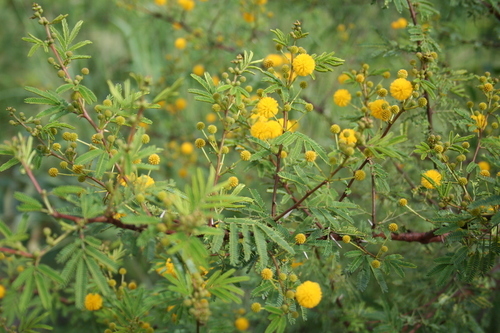
Senna singueana
(Delile) Lock
Winter cassia, Sticky pod
iNaturalist· cc-by
(c) i_c_riddell, some rights reserved (CC BY), uploaded by i_c_riddell
iNaturalist· cc-by-nc
(c) Anita Gould, some rights reserved (CC BY-NC)
Summary
Senna singueana is a fast-growing deciduous tree reaching 5 m tall by 4 m wide. Hardy to UK zone 10, it grows in light sandy, medium loamy, and heavy clay soils preferring good drainage. Tolerates mildly acid, neutral, and mildly alkaline pH; requires full sun and cannot grow in shade. Prefers moist soil. Flowers are bee-pollinated and the tree fixes nitrogen.
Description
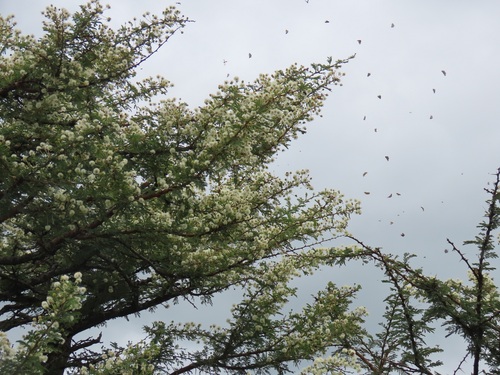
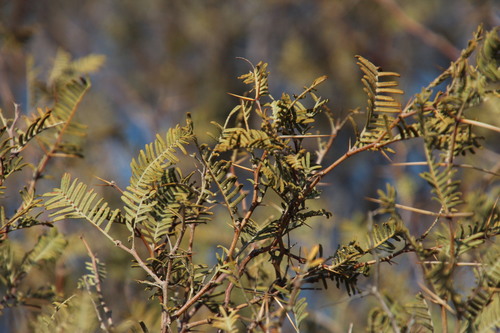
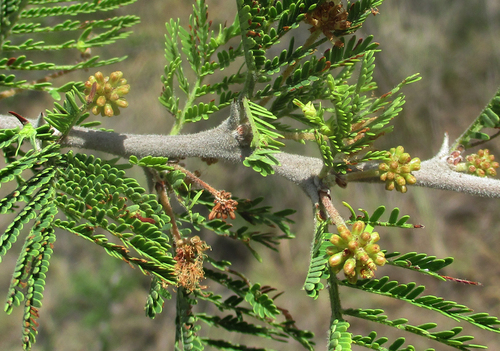
A shrub or small tree. It grows 4-5 m high. It can grow 15 m high. The bark is brown and rough. It loses its leaves during the year. The leaves are compound with leaflets along the stalk. The leaves have 4-10 pairs of leaflets. The leaflets are oval and 2.5-5 cm long and 1-1.5 cm wide. There is a gland between each pair of leaflets. The flowers are deep yellow. They occur in large loose sprays. These are about 15 cm long by 20 cm wide. The fruit is a narrow pod. It is 25 cm long. It is constricted between the seeds. They are yellow when ripe.
Edible Uses
The pods can be eaten raw or cooked — they are fleshy and sweet. Ripe pods are collected, broken open, the sweet pulp sucked out, and the seeds discarded. They are eaten mostly by children and herdsmen. The seeds are used as a coffee substitute. The leaves are eaten as a cooked vegetable in Malawi and Tanzania, though elsewhere they are considered poisonous.
Traditional Uses
The young leaves are eaten cooked. The pods are eaten raw or made into a porridge after soaking, then boiling. The seeds are roasted and used as a coffee substitute.
Medicinal Uses
The plant has many medicinal uses throughout Africa, with modern research confirming the presence of a range of active compounds. The roots contain four tetrahydroanthracene derivatives — singueanol-I and -II, torosachrysone, and germichrysone — as well as the pentacyclic triterpene lupeol and the steroids campesterol, ß-sitosterol, and stigmasterol. These anthracene derivatives have shown significant activity against several gram-positive bacteria in vitro and also antispasmodic activity. Root bark extracts have demonstrated significant analgesic, antipyretic, anthelmintic, and antiplasmodial activity. The leaves have shown anthelmintic and antiviral properties but no significant antibacterial activity. The stem bark and leaves contain tannins and are astringent. The leaves, stem, and root bark are used as anthelmintics and to treat bilharzia. A leaf infusion is taken as a remedy for venereal disease, malaria, convulsions, epilepsy, coughs, intestinal worms, constipation, heartburn, and stomach-ache. A hot water leaf infusion is drunk and warm leaves applied as a compress to treat fever. Leaves, as a decoction, infusion, or dried powder, are applied to wounds from leprosy and syphilis. A leaf infusion applied as eye drops treats conjunctivitis. A root decoction treats wounds and is taken for diarrhoea, convulsions, dementia, and sexually transmitted diseases. The roots are also used for stomach complaints, as a purgative, and to treat impotence caused by diabetes. Ash from burnt roots is eaten mixed with porridge to treat abdominal pain. Stem bark extracts treat stomach complaints, skin disorders, and malaria. A flower infusion is used as an eye lotion. Fruit pulp soaked in water and cooked with staple food is eaten by lactating women as a galactagogue.
Known Hazards
The leaves are considered poisonous in some regions outside of Malawi and Tanzania, where they are eaten as a vegetable.
Distribution
A tropical plant. It grows in the drier savannah in tropical Africa. It suits hot arid places with a marked dry season. It can grow in rocky soils. It grows from 1500-1850 m altitude, and up to 2400 m altitude in Ethiopia. It re-grows after fire. It can grow in arid places. It is often on termite mounds. It grows in woodland and rocky hillsides at medium to low altitudes.
Where It Grows
Africa, Angola, Asia, Botswana, Burkina Faso, Central Africa, Chad, Comoros, Côte d'Ivoire, East Africa, Eritrea, Ethiopia, Ghana, Guinea-Bissau, Ivory Coast, Kenya, Malawi, Mali, Mozambique, Namibia, Niger, Nigeria, Sierra Leone, South Africa, Southern Africa, SE Asia, Sudan, Tanzania, Uganda, West Africa, Zambia, Zimbabwe,
Cultivation
Plants are grown from seeds. Seeds germinate easily.
Propagation
Seed - pre-soak in warm water for 12 hours before sowing. Seed typically sprouts within 9 days, with a germination rate of around 78%.
Other Uses
The tree is used for soil improvement and is a nitrogen fixer, making it a suitable candidate for agroforestry in dry areas. The stem bark is used as a textile dye in Ethiopia and Zambia, and for tanning hides across much of East Africa. The fruits are used in Sudan for tanning skins. The leaves contain the flavonoid leucopelargonidin, which has dyeing properties. Bananas are wrapped in the leaves to accelerate ripening. Root fibres are used in hairpieces. The pale brown, distinctly grained wood is used for hut building, small furniture, tool handles, spoons, and carvings, as well as for fuel and charcoal production.
Production
It is quick growing. In Tanzania fruit are collected during the dry season usually from July to November.
Other Information
The pods are especially eaten by children. The leaves are often a famine food.
Notes
There are about 100 Cassia species. Also as Caesalpinaceae.
Synonyms
Also Known As
Busa, Hanqarar, Isihaqa esincinyane, Kadate, Kafungu-nasya, Karahaleko, Mbaraka, Mhumba, Mkundekunde, Mlewelewe, Mliwaliwa, Mpatsachokolo, Msua, Mtogo, Muhasa, Mukengeka, Munzungunzungu, Mutungulu, Mwisa, Ndiapimbwa, Ntantanyerere, Ntewelewe, Nuhumba, Tawetawe, Winter senna
References (31)
- Addis, G., Asfaw, Z & Woldu, Z., 2013, Ethnobotany of Wild and Semi-wild Edible Plants of Konso Ethnic Community, South Ethiopia. Ethnobotany Research and Applications. 11:121-141
- Assefa, A. & Abebe, T., 2010, Wild Edible Trees and Shrubs in the Semi-arid Lowlands of Southern Ethiopia. Journal of Science and Development 1 (1) 2010
- Centurie de plantes d'Afrique 28. 1826 (F. Cailliaud, Voy. Meroe; 4:321. 1827) (As Cassia singueana)
- Dharani, N., 2002, Field Guide to common Trees & Shrubs of East Africa. Struik. p 269
- Drummond, R. B., 1981, Common Trees of the Central Watershed Woodlands of Zimbabwe, National Herbarium Salisbury. p 78 (As Cassia singueana)
Show all 31 references Hide references
- FAO, 1988, Traditional Food Plants, FAO Food and Nutrition Paper 42. FAO Rome p 160
- Fowler, D. G., 2007, Zambian Plants: Their Vernacular Names and Uses. Kew. p 32
- Fox, F. W. & Young, M. E. N., 1982, Food from the Veld. Delta Books. p 206
- Grubben, G. J. H. and Denton, O. A. (eds), 2004, Plant Resources of Tropical Africa 2. Vegetables. PROTA, Wageningen, Netherlands. p 564
- http://www.fao.org/forestry/25323-096344a3de335832e8f363c3ac5184a66.pdf
- Jardin, C., 1970, List of Foods Used In Africa, FAO Nutrition Information Document Series No 2.p 25, 64
- Kew Bull. 43:340. 1988
- Kidane, B., et al, 2014, Ethnobotany of Wild and Semi-wild Edible Fruit Species used by Maale and Ari Ethnic Communities in South Ethiopia. Ethnobotany Research and Applications. Vol. 12, 1546-3465-12-455
- Lulekal, E., et al, 2011, Wild edible plants in Ethiopia: a review on their potential to combat food insecurity. Afrika Focus - Vol. 24, No 2. pp 71-121
- Mannheimer, C. A. & Curtis. B.A. (eds), 2009, Le Roux and Muller's Field Guide to the Trees and Shrubs of Namibia. Windhoek: Macmillan Education Namibia. p 152
- Martin, F.W. & Ruberte, R.M., 1979, Edible Leaves of the Tropics. Antillian College Press, Mayaguez, Puerto Rico. p 198
- Mutie, F. M., et al, 2023, Important Medicinal and Food Taxa (Orders and Families) in Kenya, Based on Three Quantitative Approaches. Plants 2023, 12, 1145
- Ocho, D. L., et al, 2012, Assessing the levels of food shortage using the traffic light metaphor by analyzing the gathering and consumption of wild food plants, crop parts and crop residues in Konso, Ethiopia. Journal of Ethnobiology and Ethnomedicine 8:30
- Palgrave, K.C., 1996, Trees of Southern Africa. Struik Publishers. p 288
- Peters, C. R., O'Brien, E. M., and Drummond, R.B., 1992, Edible Wild plants of Sub-saharan Africa. Kew. p 124
- Royal Botanic Gardens, Kew (1999). Survey of Economic Plants for Arid and Semi-Arid Lands (SEPASAL) database. Published on the Internet; http://www.rbgkew.org.uk/ceb/sepasal/internet [Accessed 26th April 2011]
- Ruffo, C. K., Birnie, A. & Tengnas, B., 2002, Edible Wild Plants of Tanzania. RELMA p 600
- Ruiters-Welcome, A. K., 2019, Food plants of southern Africa. Ph.D. thesis. Univ. of Johannesburg p 61
- Storrs, A. E. C., 1995 reprint, Know Your Trees. Some Common Trees found in Zambia, Forestry Division. Regional Soil Conservation Unit, Nairobi, p 127 (As Cassia singueana)
- van Wyk, B, van Wyk, P, and van Wyk B., 2000, Photographic guide to Trees of Southern Africa. Briza. p 286
- van Wyk, Ben-Erik, 2019, The diversity and multiple uses of southern African legumes. Australian Systematic Botany, 2019, 32, 519–546
- Welcome, A. K. & Van Wyk, B.-E., 2019, An inventory and analysis of the food plants of southern Africa. South African Journal of Botany 122 (2019) 136–179
- Williamson, 1972, 1975,
- Williamson, J., 2005, Useful Plants of Malawi. 3rd. Edition. Mdadzi Book Trust. p 58 (As Cassia singueana)
- World Checklist of Useful Plant Species 2020. Royal Botanic Gardens, Kew
- www.worldagroforestrycentre.org/treedb/