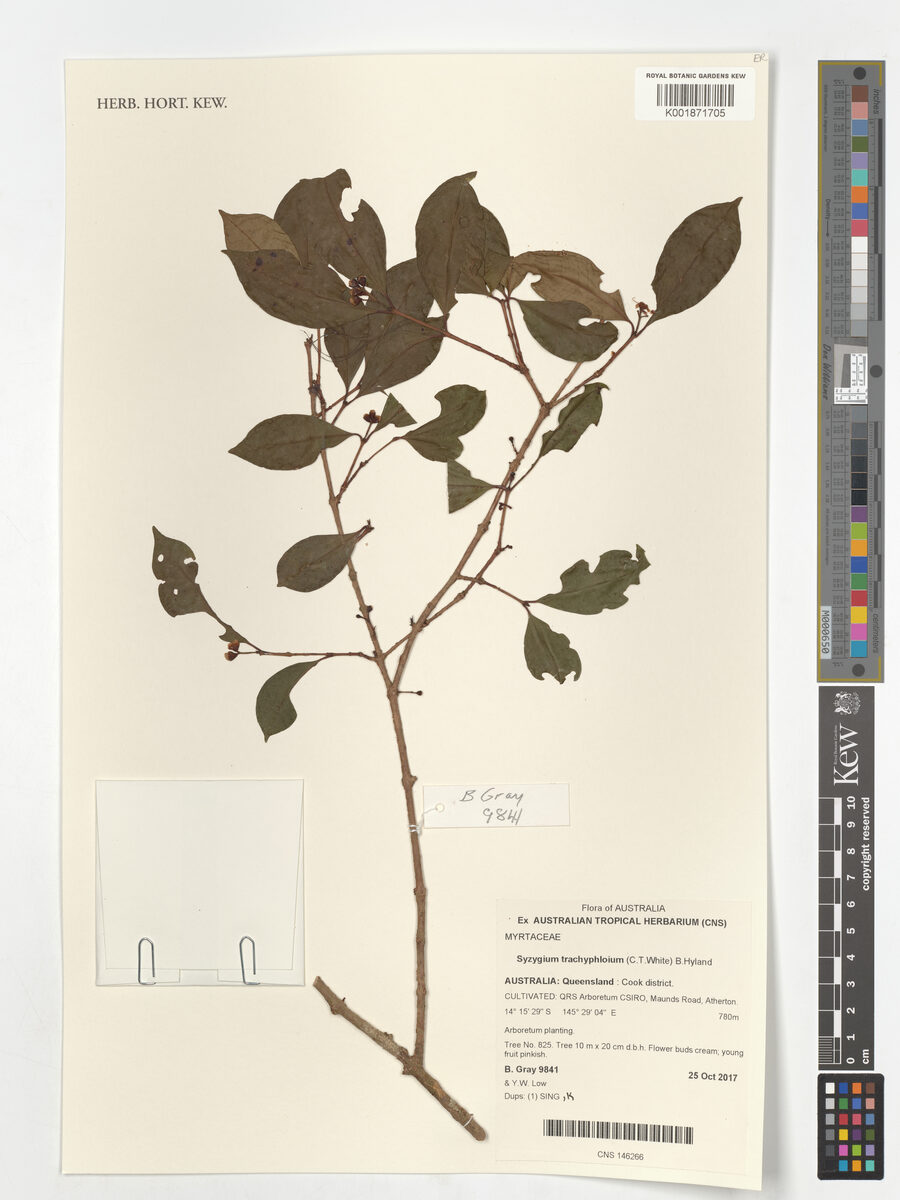
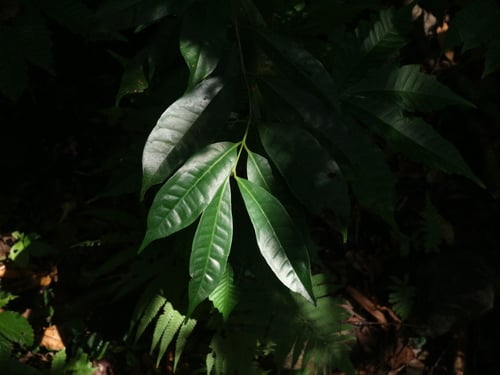
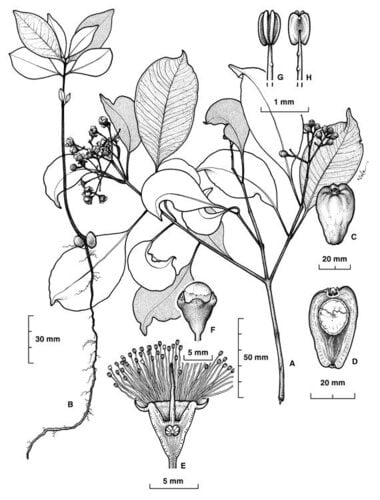
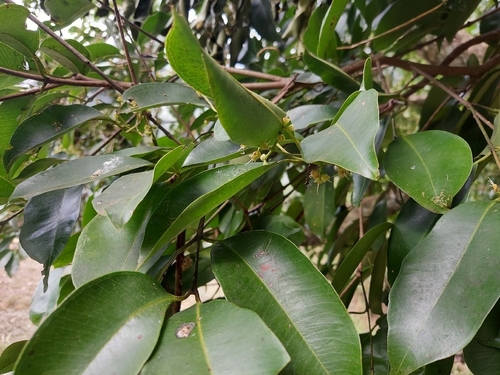
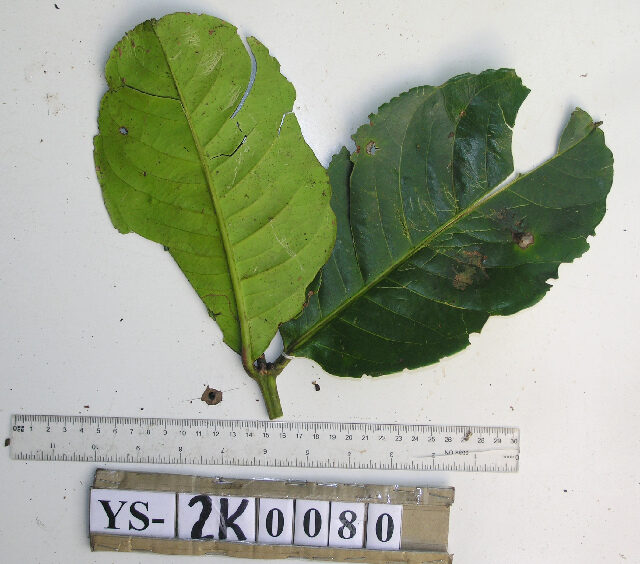
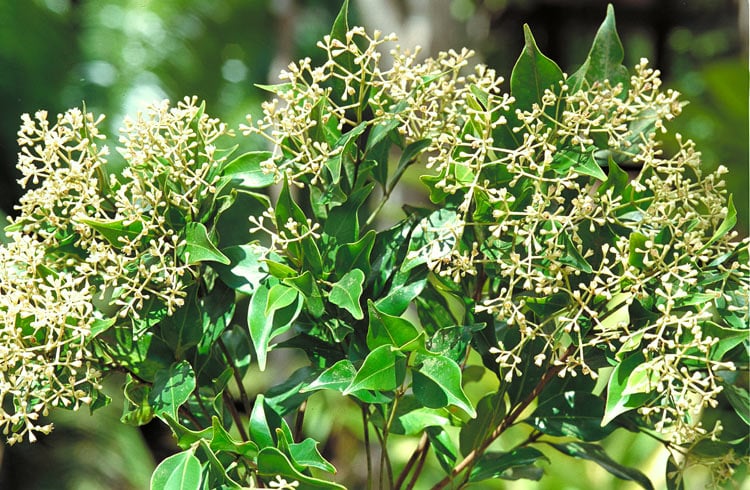
Syzygium fruticosum
Roxburgh ex Candolle
iNaturalist· cc-by-nc-nd
(c) Subhajit Roy, some rights reserved (CC BY-NC-ND), uploaded by Subhajit Roy
wikimedia· cc-by-sa
Wikimedia Commons - কামরুল ইসলাম শাহীন
wikimedia· cc-by-sa
Wikimedia Commons - Nikitakamka
Description
A shrub or small tree. It grows 12 m tall. The branches are smooth. It keeps its leaves throughout the year. The leaf blade is narrowly oval and 9-13 cm long by 4-6 cm wide. The leaves are thinly leathery. The flowers are small and without stalks. They have 4 petals. The fruit is a small round berry. It is red when ripe. It is 6-7 mm across.
Edible Uses
Jambolan fruits have a sweet or slightly acidic flavor, are eaten raw, and may be made into sauces or jam. Fruits may be made into juice, jelly, sorbet, syrup (e.g., kala khatta), or fruit salad.
Traditional Uses
The ripe fruit are eaten raw.
This uses section is brief — help expand it
Medicinal Uses
"The fruit is much eaten by the natives of India: in appearance it resembles a damson, has a harsh but sweetish flavour, somewhat astringent and acid. Is much eaten by birds; a favourite food of the large bat (flying fox). A kind of vinegar is prepared from it, which is used in diseases of the spleen." The fruit has been used in traditional medicine.
Distribution
It is a tropical plant. It grows in southern Assam up to 1,000 m above sea level. In southern China it grows between 500-1,700 m above sea level. It grows in Yunnan.
Where It Grows
Asia, Bangladesh, Cambodia, China, Himalayas, India, Indochina, Laos, Myanmar, Northeastern India, SE Asia, Thailand,
Production
In China it flowers from May to June and fruits from June to July.
Notes
It has been shown to have antioxidant and anticancer properties.
Synonyms
Also Known As
Ban jam, Bon jam, Jongkeng, Kak jam, Kathiya jamu, Khudi jam, Kurak schein, Pring angkam, Puti jam, Taw-thabye, Tepet jamu, Thabye-ywet-thay
References (13)
- BARC, 2016, State of Biodiversity for Food and Agriculture in Bangladesh. Bangladesh Agricultural Research Council.
- Chowdery, T., et al, 2014, Wild edible plants of Uttar Dinajpur District, West Bengal. Life Science Leaflets. 47:pp 20-36 http://lifesciencesleaflets.ning.com
- http://Satoyama-initiative.org/en/community-forestry-in-thailand/ (As Eugenia fruticosa)
- Majumdar, K and Datta, N., 2009, Traditional wild edible fruits for the forest dwellers of Tripura, India. Pleione 3(2) 167-178
- Murtem, G. & Chaudhrey, P., 2016, An ethnobotanical note on wild edible plants of Upper Eastern Himalaya, India. Brazilian Journal of Biological Sciences, 2016, v. 3, no. 5, p. 63-81
Show all 13 references Hide references
- Pasha, M. K. & Uddin, S. B., 2019, Minor Edible Fruits of Bangladesh. Bangladesh J. Plant Taxon. 26(2): 299–313
- Patiri, B. & Borah, A., 2007, Wild Edible Plants of Assam. Geethaki Publishers. p 55
- Pegu, R., et al, 2013, Ethnobotanical study of Wild Edible Plants in Poba Reserved Forest, Assam, India. Research Journal of Agriculture and Forestry Sciences 1(3):1-10
- Sarma, H., et al, 2010, Updated Estimates of Wild Edible and Threatened Plants of Assam: A Meta-analysis. International Journal of Botany 6(4): 414-423
- Sawian, J. T., et al, 2007, Wild edible plants of Meghalaya, North-east India. Natural Product Radiance Vol. 6(5): p 416
- Taram, M., et al, 2018, Wild Food Plant Resources of Komkar Adi Tribe of Upper Siang District in Arunachal Pradesh, India. Bulletin of Arunachal Forest Research, Vol. 33(2), 27-35
- Turreira Garcia, N., et al, 2017, Ethnobotanical knowledgeof the Kuy and Khmer people in Prey Lang, Cambodia. Cambodian Journal of Natural History 2017 (1): 76-101
- Use of Native Plants in the Pala River Basin North Thailand. Eco Thai German Farm (As Eugenia fruticosa)