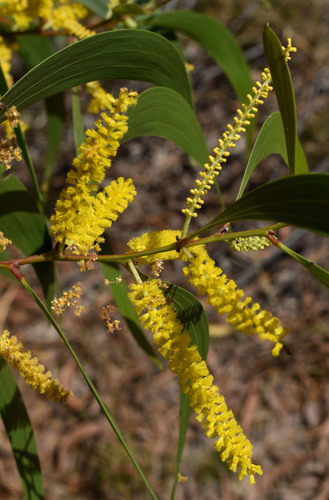
Arachis glabrata
Benth.
Perennial peanut
iNaturalist· cc-by-sa
(c) Nurhafizah Abdullah, some rights reserved (CC BY-SA)
iNaturalist· cc-by-nc-sa
(c) "<a href=""http://nt.ars-grin.gov/"">ARS Systematic Botany and Mycology Laboratory</a>. Brazil.", some rights reserved (CC BY-NC-SA)
iNaturalist· cc-by-nc-sa
(c) dogtooth77, some rights reserved (CC BY-NC-SA)
Summary
Source: WikipediaArachis glabrata (creeping forage peanut, rhizoma peanut, rhizoma perennial peanut, perennial forage peanut, golden glory, ornamental peanut grass) is a high-quality forage plant native to Argentina, Brazil, and Paraguay vegetation. This plant is also used for soil conservation and as an ornamental plant. It is adapted to sandy soils in the Gulf Coast region of the United States. It is often cultivated together as a following grass species: Axonopus affinis, Axonopus fissifolius, Brachiaria decumbens, Cynodon dactylon, Digitaria eriantha, Paspalum nicorae, and Paspalum notatum. These legume species are also cited as a companion species: Aeschynomene villosa, Medicago sativa, and Trifolium repens. It is a warm-season, perennial legume.
Description
A herb. It has a dense mat of rhizomes 3-5 mm across. There is a deep woody taproot. The stems can be erect or lie over. They are 5-35 cm long and 2-3 mm across. They can be hollow. The leaves have 4 leaflets. They are 4 cm long by 2 cm wide. The flowers are in the axils of the leaves and do not have stalks. They are tube shaped and 10 cm long. They are yellow to orange. The fruit are oval and 1 cm long by 5-6 mm wide.
Edible Uses
Edible Parts: Flowers Edible Uses: Possibly the flowers are edible. Green Deane at growables.org says the yellow blossoms are eaten raw and have a pea to bean-like flavor.
Traditional Uses
The flowers can be added to salads and stir fried dishes.
This uses section is brief — help expand it
Medicinal Uses
None known
Distribution
It is a warm temperate to tropical plant. In Argentina it grows from sea level to 500 m above sea level. It is best in areas with a rainfall between 1,000-2,000 mm per year. It suits hardiness zones 8b-11.
Where It Grows
Argentina, Asia, Brazil, China, Paraguay, South America, Uruguay,
Cultivation
Plants are productive from about latitudes 30N and 30c to near the equator. They have persisted in areas receiving rainfall as low as 750 mm per year but are probably best suited to areas receiving 1,000 - 2,000 mm. Unlike many tropical legumes, it can compete successfully with sward-forming grasses. It grows best when mean monthly temperatures are above about 20°c. Although tops are cut by frost, plants regrow vigorously with the onset of warmth and moisture. During very dry conditions, top growth may die off, but rhizomes mostly survive, providing a nucleus for recovery. Grows successfully on soils with textures ranging from sands to clays provided they are well-drained. While apparently preferring acid soils, it has produced good yields on neutral to slightly alkaline soils. It grows well on soils low in phosphorus Grows well on infertile or fertile soils, but may suffer from excessive grass competition on the latter. Appears to be less P-demanding than A. pintoi .This species has a symbiotic relationship with certain soil bacteria, these bacteria form nodules on the roots and fix atmospheric nitrogen. Some of this nitrogen is utilized by the growing plant but some can also be used by other plants growing nearby. When planting in new areas, it is generally not necessary to inoculate the rhizomes. Four cultivars have been released in Florida: 'Arb', 'Arblick', 'Florigraze' and 'Arbrook'. 'Arb' and 'Arblick' were selected initially, based on productivity and spreading ability respectively; 'Florigraze' was selected because it combined both characteristics, and 'Arbrook', the most recent release, because it is more drought-tolerant than 'Florigraze' but is of similar productivity. One accession known as the Maiwa peanut (probably the Australian accession CPI 12121) has persisted well in Indonesia.
Propagation
Despite often dense flowering, few seeds are set, except in some accessions prior to dense sward development. Seedlings are usually quite large before they form rhizomes. The plant is best propagated from rhizomes. While pieces of rhizome as short as 5 cm may strike, it is generally considered best to plant 30 cm square pieces of rhizome mat about 1.8 metres apart. Alternatively, the rhizomes can be teased out, broadcast over the soil surface and disked in. Rhizomes are planted at a depth of 3 cm in clay soils to 6.5 cm in coarse sands. A clean seed-bed is preferable, to minimize competition for the developing plants. Ideally, rhizomes should be produced in sandy soils for ease of digging. Planting appears to be most successful when rhizomes are dormant. With adequate temperature and moisture, shoots usually emerge 2 - 3 weeks after planting; dense swards develop as rhizomes form and extend the margins of the stand at up to 2 metres per year in the absence of competition, or 5 - 30 cm per year with grass competition.
Other Uses
Green manure Soil conditioner Agroforestry Uses: The plant has potential for soil conservation and can be grown under some tree crops to provide nitrogen. It is showing promise growing under coconuts in Indonesia. The plant has been recommended as a green manure in Brazil. Used in intensively grazed pastures, for hay and silage production, and agroforestry (e.g. under coconuts). Also used for soil conservation (e.g. road verges) and as an ornamental. May also have value in companion cropping systems, either with cool or warm season grains. A high quality forage plant. Special Uses Carbon Farming Food Forest Nitrogen Fixer
Synonyms
Also Known As
Amendoim-do-campo-baixo
References (1)
- Bortolotto, I. M., et al, 2018, Lista preliminar das plantas alimenticias nativas de Mato Grosso do Sul, Brasil. Iheringia, Serie Botanica, Porto Alegre, 73 (supl.):101-116