Morinda lucida
Benth.
iNaturalist· cc-by-nc
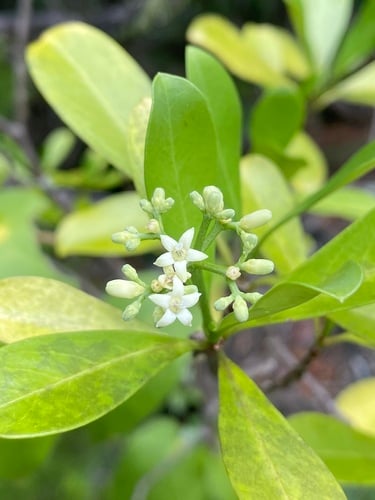
(c) Robin Heymans, some rights reserved (CC BY-NC), uploaded by Robin Heymans
iNaturalist· cc-by-nc-sa
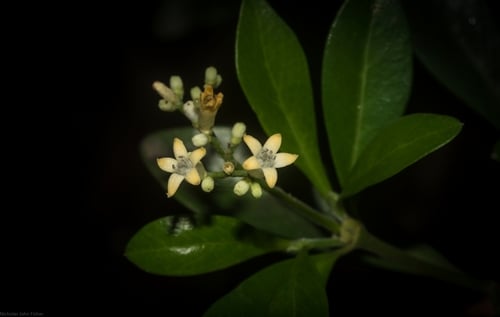
(c) Marco Schmidt, some rights reserved (CC BY-NC-SA), uploaded by Marco Schmidt
iNaturalist· cc-by-nc
(c) Carel Jongkind, some rights reserved (CC BY-NC), uploaded by Carel Jongkind
Description
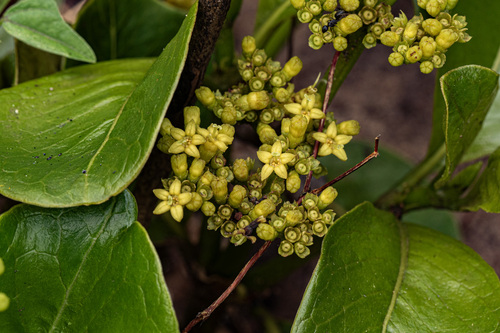
A shrub or tree. It grows 15 m tall. The bark is light coloured and cracked. The leaves are shiny, and dark green on the upper surface and wavy. They are oval and taper to both ends. They are dull green underneath. The flowers are fused at the base.
Edible Uses
The bitter-tasting roots are used as flavouring for food and alcoholic beverages.
Medicinal Uses
Morinda lucida is an important plant in traditional medicine in west Africa and various trials have confirmed the effectiveness of several of these uses. Eighteen anthraquinones have been isolated from the wood and bark, including the red colorants 1-methylether-alizarin, rubiadin and derivatives, lucidin, soranjidiol, damnacanthal, nordamnacanthal, morindin, munjistin and purpuroxanthin. Two anthraquinols, oruwal and oruwalol, have also been found; these give a yellow colour and possibly are intermediates in the formation of anthraquinones. In addition to anthraquinones, tannins, flavonoids and saponosides have been isolated. Extracts of the plant have shown anti-inflammatory, febrifugal and pain-reducing activity, as well as promoting gastric emptying and intestinal motility. Leaf extracts have shown in vitro antimalarial activity against Plasmodium falciparum, while in several other tests antidiabetic properties have been confirmed. Inhibiting effects on cancer tumours have also been reported. A leaf extract gave 100% mortality in the freshwater snail Bulinus globulus at a concentration of 100 ppm. The plant is powerfully astringent. Decoctions and infusions or plasters of the root, bark and leaves are recognized remedies against different types of fever, including yellow fever, malaria, trypanosomiasis and feverish condition during childbirth. The plant is also employed in cases of diabetes, hypertension, cerebral congestion, dysentery, stomach-ache, ulcers, leprosy and gonorrhoea. In Nigeria, Morinda lucida is one of the four most used traditional medicines against fever. A bark or leaf decoction is used in the treatment of jaundice, and is combined with a dressing of powdered root bark as a treatment against itch and ringworm.
Distribution
It is a tropical plant. It grows in woodland. It grows in areas exposed to sunlight.
Where It Grows
Africa, Angola, Benin, Central Africa, Central African Republic, CAR, Congo DR, Congo R, Guinea, Guinée, Guinea-Bissau, Sao Tome and Principe, Senegal, Sudan, Tanzania, West Africa,
Cultivation
Plants are grown from seed. They can also be grown from cuttings.
Propagation
Seed - Cuttings.
Other Uses
The wood yields yellow to red dyes. The root bark is used to dye textiles into scarlet red. On occasions of national grief or the death of a chief, the Ashanti people of Ghana dye cotton cloths red with the root bark. These cloths, called 'kobene', are worn as mourning dress by official people and by the family of the deceased. The root is the most important traditional source of yellow dye for textiles in the Kasai Province of DR Congo. It can be used without a mordant. It is also added to indigo vats in Côte d’Ivoire, to contribute both to the fermentation and reduction process necessary for dyeing with indigo and to get darker blues. In this process it is often combined with leafy twigs of Saba comorensis. For dyeing, the root bark or leaves are used fresh, pounded or chopped. For red colours, the fibres to be dyed must first be mordanted with tannin-containing plants and alum. For red and yellow colours, the dye baths are prepared by boiling the root bark or leafy twigs in water for one or two hours before filtering and plunging the textiles into the coloured liquid and boiling it again until the desired shade is obtained. In the region of Kasongo in north-eastern DR Congo, young leaves of Morinda lucida are combined with leaves of a Philenoptera species (a source of indigo) to obtain a pale green dye used in basket weaving. The bitter-tasting roots are popular in Nigeria as chewing sticks. The leaves are used for cleaning and scouring items such as calabashes. The wood is yellow (hence the name brimstone tree), darkening to yellow-brown in the sapwood and to dark brown in the heartwood. It is medium-weight and hard; it works and finishes well, and it is durable, being resistant to fungi, termites and other insects. It is used for construction, mining props, furniture, canoes, poles etc. The wood is used for fuel and is excellent for making charcoal.
Production
In Central African Republic fruit have been observed in August.
Also Known As
Masiki, Nsiki, Nxiki
References (5)
- Achigan-Dako, E, et al (Eds), 2009, Catalogue of Traditional Vegetables in Benin. International Foundation for Science.
- Latham, P., 2004, Useful Plants of Bas-Congo province. Salvation Army & DFID p 195
- Latham, P & Mbuta, A., 2017, Useful Plants of Central Province, Democratic Republic of Congo. Volume 2. Salvation Army p 47
- Lautenschläger, T., et al, 2018, First large-scale ethnobotanical survey in the province of Uíge, northern Angola. Journal of Ethnobiology and Ethnomedicine (2018) 14:51
- World Checklist of Useful Plant Species 2020. Royal Botanic Gardens, Kew