Melicope triphylla
(Lam.) Merr.
iNaturalist· cc-by-nc
(c) Han-Ting Liu, some rights reserved (CC BY-NC), uploaded by Han-Ting Liu
iNaturalist· cc-by-nc
(c) liushengyu, some rights reserved (CC BY-NC)
Summary
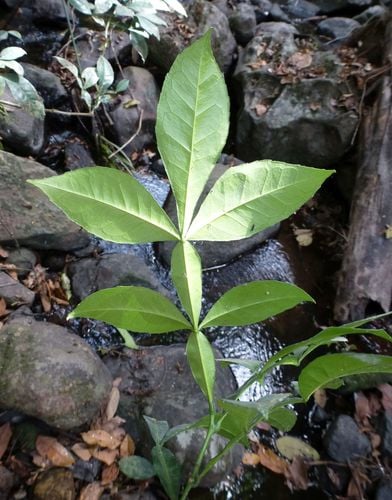
Source: WikipediaMelicope triphylla is a plant in the family Rutaceae. The specific epithet triphylla is from the Greek meaning 'three leaf', referring to the trifoliolate leaves.
Description
A shrub or small tree. It grows 2-6 m tall. Often male and female flowers are on different trees. The leaves usually have 3 leaflets. The leaflets are oval and 3-7 cm long by 2-6 cm wide. The fruit are a flattened round shape and 3-5 mm across.
Edible Uses
The leaves are cooked.
Traditional Uses
The leaves are cooked.
This uses section is brief — help expand it
Medicinal Uses
The dried leaves are heated over a fire and the sap taken orally in the treatment of tuberculosis. The leaves, combined with the leaves, bark and fruit of Citrus species, are used in the treatment of stomach pain, constipation and diarrhoea; and also for the removal of intestinal worms.
Distribution
It is a tropical plant. It grows at low elevations.
Where It Grows
Asia, Indonesia, Japan, Myanmar, New Guinea, Pacific, Philippines, Ryukyu, SE Asia, Taiwan, Vanuatu,
Cultivation
Plants are usually dioecious. Both male and female forms will need to be grown if fruit and seed are required.
Synonyms
Also Known As
Bangelebute, Butsu mamsil, Wadan
References (2)
- Cabalion, P. and Morat, P., 1983, Introduction le vegetation, la flore et aux noms vernaculaires de l'ile de Pentcoste (Vanuatu), In: Journal d'agriculture traditionnelle et de botanique appliquee JATBA Vol. 30, 3-4 (As Euodia triphylla)
- Martin, F. W., et al, 1987, Perennial Edible Fruits of the Tropics. USDA Handbook 642 p 78