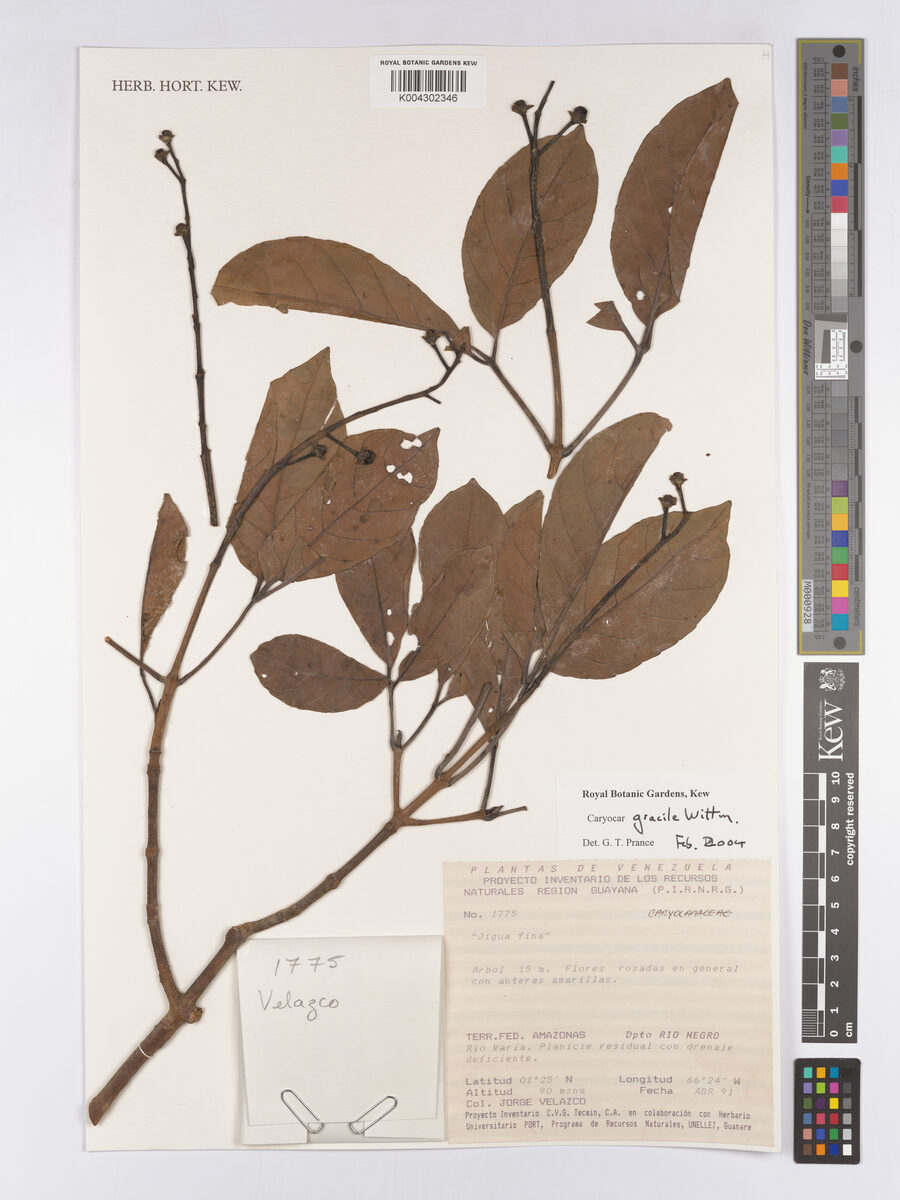
Caryocar amygdaliferum
Mutis
Sawarri nut
iNaturalist· cc-by-nc
(c) Andres Camilo Gomez, some rights reserved (CC BY-NC), uploaded by Andres Camilo Gomez
iNaturalist· cc-by-nc
(c) Andres Camilo Gomez, some rights reserved (CC BY-NC)
Summary
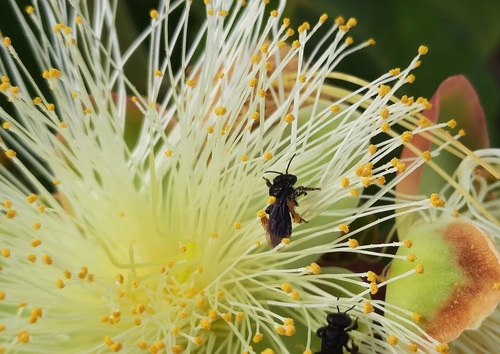
Source: WikipediaCaryocar amygdaliferum is a plant native to the rain forests of the Choco region of Colombia and Panama. Its fruit consists of a spiny husk inside which a seed about three times the size of an almond develops. It has been used for similar purpose as the almond and was traded as a luxury item among the Inca in pre-conquest times and grown in the land of the Chachapoyas. It is also eaten by some species of bats.
Description
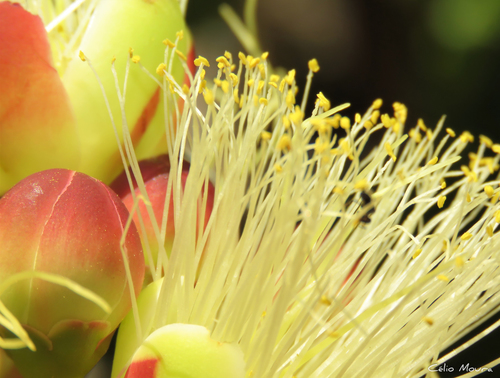
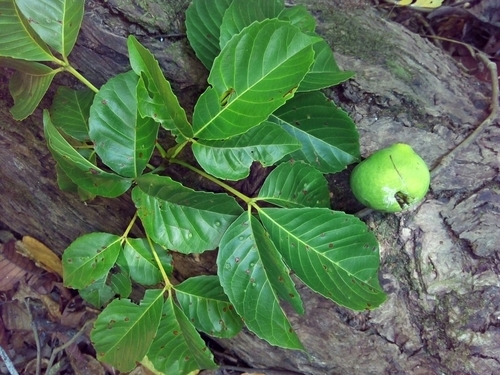
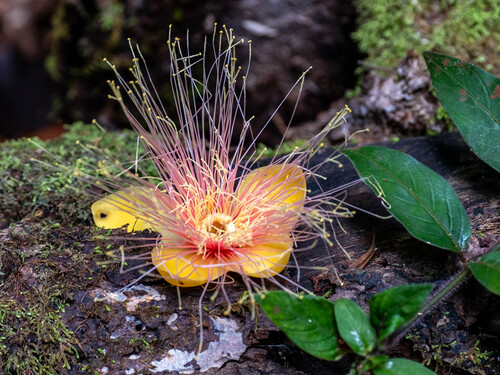
A tall tree. It grows 55 m tall. The trunk has buttresses 3 m high. The bark is reddish. The leaves have 3 leaflets. There are teeth along the edge. The end leaflet is 8-12 cm long by 3-6 cm wide. Side leaflets are slightly smaller. The flowers are in clustered groups. They are greenish yellow. The fruit is oval and 6 cm long.
Edible Uses
The nuts are eaten raw or roasted. The kernels, seeds, and fruit are all edible portions.
Traditional Uses
The nut is eaten raw or roasted.
This uses section is brief — help expand it
Known Hazards
The fruit is used as a fish poison.
Distribution
A tropical plant. It grows in forests along river valleys.
Where It Grows
Amazon, Central America, Colombia, Costa Rica, Ecuador, Panama, Peru, South America,
Cultivation
A tree of moist, lowland tropical areas.
Propagation
Seed - takes 6 - 12 months to germinate. Grow young plants on in a sheltered position with some shelter from the sun.
Other Uses
The wood is harvested for commercial use. The heartwood is yellowish to light grayish-brown; it is hardly separable from the sapwood. The texture is medium to rather coarse; the grain interlocked; fresh material has a mild vinegary scent, but there is no discernible odour or taste when dry. The heartwood is rated as very durable in resistance to both brown-rot and white-rot fungi; classified as resistant to dry-wood termites and moderately resistant to marine borers. It is said to be easy to moderately difficult to saw, producing a rapid dulling of cutting edges; radial faces are difficult to finish smoothly because of interlocked grain. The wood is used for general and marine construction, heavy flooring, railway crossties, boat parts, furniture components; it is especially suitable where hardness and high wear resistance are needed.
Notes
The Caryocaraceae occur in tropical America. There are 16 Caryocar species.
Also Known As
Achiotillo, Aji, Ajicillo, Almendron, Caryocar, Chalmagra, Suari nut
References (21)
- Bircher, A. G. & Bircher, W. H., 2000, Encyclopedia of Fruit Trees and Edible Flowering Plants in Egypt and the Subtropics. AUC Press. p 87
- Cav., Icon. 4:37, t. 361-362. 1798
- Duke, J. A. 1989. Handbook of Nuts. CRC Press.
- Etkin, N.L. (Ed.), 1994, Eating on the Wild Side, Univ. of Arizona. p 122, 137
- Fouqué, A. 1972. Espèces fruitières d'Amérique tropicale. Institut français de recherches fruitierès outre-mer
Show all 21 references Hide references
- Grandtner, M. M., 2008, World Dictionary of Trees. Wood and Forest Science Department. Laval University, Quebec, Qc Canada. (Internet database http://www.WDT.QC.ca)
- Grandtner, M. M. & Chevrette, J., 2013, Dictionary of Trees, Volume 2: South America: Nomenclature, Taxonomy and Ecology. Academic Press p 103
- Lopez-Diago, D. & Garcia, N., 2021, Wild edible fruits of Colombia. Biota ColomBiana 22 (2) p 34
- Martin, F. W., et al, 1987, Perennial Edible Fruits of the Tropics. USDA Handbook 642 p 91
- Prance, G. T. and Marlene Freitas da Silva, 1973, Caryocaraceae, Flora Neotropica, Vol. 12, Caryocaraceae pp. 1-75
- Hedrick, U.P., 1919, (Ed.), Sturtevant's edible plants of the world. p 170
- Kiple, K.F. & Ornelas, K.C., (eds), 2000, The Cambridge World History of Food. CUP p 1854
- Menninger, E.A., 1977, Edible Nuts of the World. Horticultural Books. Florida p 66
- Prance, Ghillean T. and Marlene Freitas da Silva, 1973, Caryocaraceae, Flora Neotropica, Vol. 12, Caryocaraceae p 51
- Roa, J. A. G. & Boada, D. S. G., 2018, Fundación para el Fortalecimiento de la Fruticultura y Plantas Alimenticias no Convencionales en Colombia.
- Uphof, 1968,
- USDA, ARS, National Genetic Resources Program. Germplasm Resources Information Network - (GRIN). [Online Database] National Germplasm Resources Laboratory, Beltsville, Maryland. Available: www.ars-grin.gov/cgi-bin/npgs/html/econ.pl (10 April 2000)
- Usher, 1974,
- Wickens, G.E., 1995, Edible Nuts. FAO Non-wood forest products. FAO, Rome. p 112
- Wiersema, J. H. & Leon, B., 2013, World Economic Plants. A Standard Reference CRC Press. 2nd Ed. p 148
- World Checklist of Useful Plant Species 2020. Royal Botanic Gardens, Kew