Carya glabra
(Mill.) Sweet
Pignut, Redheart Hickory, Sweet pignut, Broom hickory, False shagbark hickory, Hognut broom hickory
iNaturalist· cc-by-sa
(c) Douglas Goldman, some rights reserved (CC BY-SA), uploaded by Douglas Goldman
iNaturalist· cc0
no rights reserved, uploaded by Nonbinary-Naturalist
iNaturalist· cc0
no rights reserved, uploaded by Nonbinary-Naturalist
Summary
Source: WikipediaCarya glabra, the pignut hickory, is a common, but not abundant species of hickory in the oak-hickory forest association in the Eastern United States and Canada. Other common names are pignut, sweet pignut, coast pignut hickory, smoothbark hickory, swamp hickory, and broom hickory. The pear-shaped nut ripens in September and October, has a sweet maple like smell, and is an important part of the diet of many wild animals. The wood is used for a variety of products, including fuel for home heating. It has pinnately compound leaves that turn a golden yellow in the fall.
Description
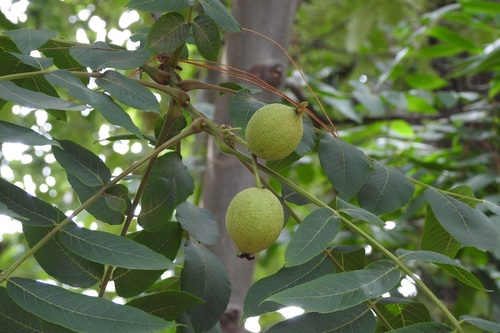
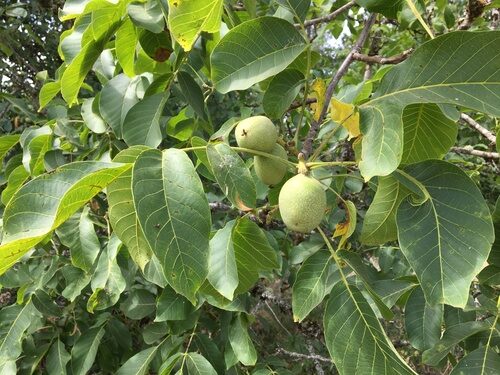
A tree that loses its leaves. It grows 24-30 m high. The trunk is 30-60 cm across. The bark is grey and has narrow ridges. It has an irregular spreading crown. The leaves are mid green. They are 15-25 cm long. There are 5-7 leaflets which are sword shaped. These are 7.5-15 cm long. The flowers are very small and greenish. The male flowers are in slender drooping catkins. There are 3 hanging from one stalk. There are 2-10 female flowers at the tip of the same twig. The fruit are 2.5-5 cm long and slightly pear shaped. The nuts are small. It produces large numbers of nuts. They are thinned shelled and egg shaped. They can be bitter or sweet.
Edible Uses
The seed can be eaten raw or cooked, though quality is highly variable — some nuts are sweet and pleasant, others bitter and astringent, and in general this species is inferior to other hickories. The nut is small, has a very thick shell, and yields little edible matter. Seeds ripen in late autumn and keep for at least 6 months when stored in the shell in a cool place. In spring, the sap can be tapped and drunk fresh as a sweet, refreshing beverage.
Traditional Uses
The seeds vary and can be bitter. Some are sweet and pleasant and eaten. Ripe nuts should be used. Some are used for drinks.
This uses section is brief — help expand it
Medicinal Uses
None known.
Distribution
It grows in both dry and moist uplands in hardwood forests. It needs deep, rich loamy soils and an open sunny position. It is resistant to frost but damaged by drought. It suits hardiness zones 4-9.
Where It Grows
Australia, Britain, Canada, Europe, Germany, North America*, USA,
Cultivation
Plants are grown from seeds.
Propagation
Seed requires cold stratification — 3 months of cold stratification has achieved a 91% germination rate. Sow in a cold frame as soon as seed is ripe; stored seed should be kept moist (but not wet) and sown in a cold frame as soon as possible. Where possible, sow 1 or 2 seeds per deep pot and thin to the strongest seedling. Transplant seedlings as soon as they are large enough to handle, using deep pots to accommodate the taproot, and move plants to their permanent positions as soon as possible — ideally in their first summer — with cold protection for at least the first winter. Seed can also be sown in situ with protection from mice and cold; a bottomless plastic bottle capped with wire mesh works well for both purposes.
Other Uses
The wood is hard, strong, tough, and very flexible, weighing 51 lb per cubic foot. It is excellent timber used for tool handles, agricultural implements, and similar applications. It is also a very good fuel, burning well and producing a great deal of heat.
Notes
There are about 14-25 Carya species.
Synonyms
References (21)
- Beckstrom-Sternberg, Stephen M., and James A. Duke. "The Foodplant Database." http://probe.nalusda.gov:8300/cgi-bin/browse/foodplantdb.(ACEDB version 4.0 - data version July 1994) (As Hicoria glabra)
- Bircher, A. G. & Bircher, W. H., 2000, Encyclopedia of Fruit Trees and Edible Flowering Plants in Egypt and the Subtropics. AUC Press. p 86
- Bodkin, F., 1991, Encyclopedia Botanica. Cornstalk publishing, p 219
- Brickell, C. (Ed.), 1999, The Royal Horticultural Society A-Z Encyclopedia of Garden Plants. Convent Garden Books. p 233
- Brouk, B., 1975, Plants Consumed by Man. Academic Press, London. p 221
Show all 21 references Hide references
- Cundall, P., (ed.), 2004, Gardening Australia: flora: the gardener's bible. ABC Books. p 334
- Etherington, K., & Imwold, D., (Eds), 2001, Botanica's Trees & Shrubs. The illustrated A-Z of over 8500 trees and shrubs. Random House, Australia. p 184
- Facciola, S., 1998, Cornucopia 2: a Source Book of Edible Plants. Kampong Publications, p 123
- Farrar, J.L., 1995, Trees of the Northern United States and Canada. Iowa State University press/Ames p 208 (var. odorata is said to be bitter and not edible)
- Glowinski, L., 1999, The Complete Book of Fruit Growing in Australia. Lothian. p 106
- Gouldstone, S., 1983, Growing your own Food-bearing Plants in Australia. Macmillan p 144
- Grandtner, M. M., 2008, World Dictionary of Trees. Wood and Forest Science Department. Laval University, Quebec, Qc Canada. (Internet database http://www.WDT.QC.ca)
- Hedrick, U.P., 1919, (Ed.), Sturtevant's edible plants of the world. p 170 (As Carya porcina)
- Hort. brit. ed. 1:97. 1826
- Krochmal, A. & Krochmal, C., 1982, Uncultivated Nuts of The United States. United States Department of Agriculture Forest Service. p 41
- Little, E.L., 1980, National Audubon Society Field Guide to North American Trees. Alfred A. Knopf. p 347
- Lyle, S., 2006, Discovering fruit and nuts. Land Links. p 112
- Menninger, E.A., 1977, Edible Nuts of the World. Horticultural Books. Florida p 5
- Plants for a Future database, The Field, Penpol, Lostwithiel, Cornwall, PL22 0NG, UK. http://www.scs.leeds.ac.uk/pfaf/
- Tozer, F., 2007, The Uses of Wild Plants. Green Man Publishing. p 57
- Wickens, G.E., 1995, Edible Nuts. FAO Non-wood forest products. FAO, Rome. p 134