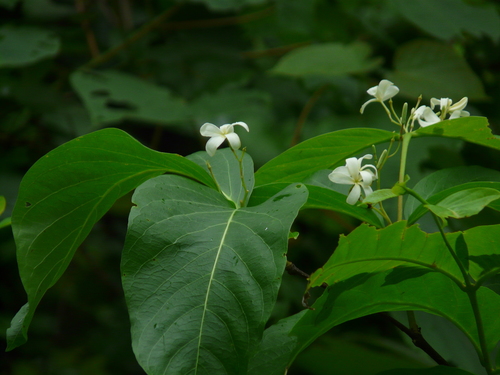
Carissa opaca
Stapf ex Haines
Karonda
wikimedia· cc-by-sa
Wikimedia Commons - Franz Xaver
wikimedia· cc-by
Wikimedia Commons - J.M.Garg
Description
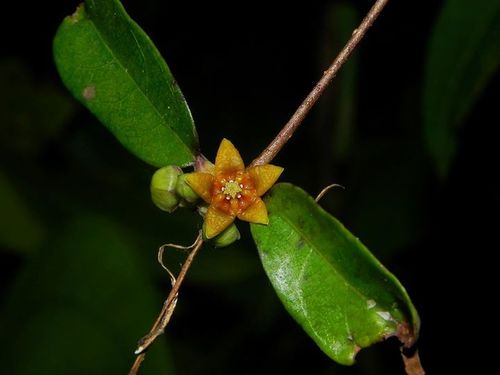
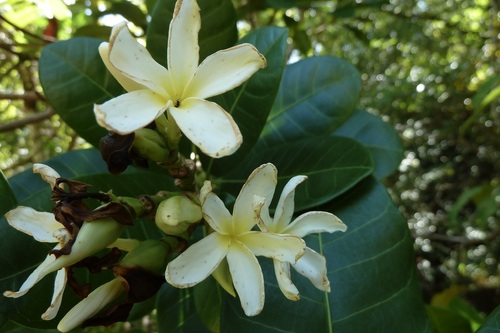
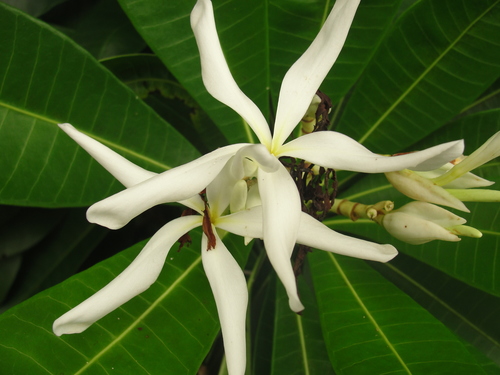
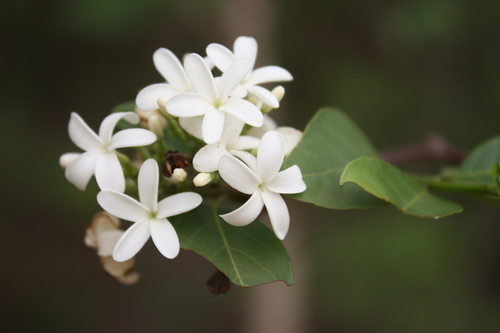
A shrub. It grows 3.5 m high. It keeps its leaves throughout the year. There are spines about 3 cm long. They can be straight or divided. The young shoots have milky sap. The leaves are opposite and oval or rounded. They are 1.5 cm long by 2 cm wide. Usually flowers are in threes. The fruit is an oval berry. It is 6-8 mm long. It is dark purple when ripe. It is juicy and edible.
Edible Uses
The ripe fruit is eaten raw and made into jams, while unripe fruit is used for pickles. The fruit is particularly popular among children.
Traditional Uses
The ripe fruit is eaten raw and also used for jams. The unripe fruit are used for pickles
This uses section is brief — help expand it
Distribution
A tropical plant. It grows in the drier parts of India and Pakistan. It grows up into the Himalayas to 2,000 m above sea level.
Where It Grows
Asia, Himalayas, India, Myanmar, NW India, Pakistan, SE Asia, Sri Lanka,
Cultivation
Plants can be grown from seed or cuttings.
Production
In Jammu & Kashmir plants flower and fruit June to December.
Other Information
The fruit are eaten especially by children.
Notes
There about 20-37 Carissa species. All Carissa species bear edible fruit. They grow in the tropics and subtropics.
Synonyms
Also Known As
Gan, Garanda, Garna, Garnoin, Garnu, Karaunda, Karaunj, Karonda, Khirokoli
References (19)
- Abbasi, A. M., Khan, M & Zafar, M., 2013, Ethno-medicinal assessment of some selected wild edible fruits and vegetables of Lesser-Himalayas, Pakistan. Pak. J. Bot. 45 (SI):215-222
- Dobriyal, M. J. R. & Dobriyal, R., 2014, Non Wood Forest Produce an Option for Ethnic Food and Nutritional Security in India. Int. J. of Usuf. Mngt. 15(1):17-37
- Flora of Pakistan. www.eFloras.org
- GUPTA
- Indian forester 47:378. 1921
Show all 19 references Hide references
- Kala, C. P., 2007, Prioritization of cultivated and wild edibles by local people in the Uttaranchal hills of Indian Himalaya. Indian Journal of Traditional Knowledge. 6(1) pp 239-244
- Khan, M. & Hussain, S., 2014, Diversity of wild edible plants and flowering phenology of district Poonch (J & K) in the northwest Himalaya. Indian Journal of Sci, Res. 9(1): 032-038
- Kumar, R. & Saikia, P., 2020, Wild edible plants of Jharkhand and their utilitarian perspectives. Indian Journal of Traditional Knowledge Vol 19 (2), April 2020, pp 237-250
- Maheshwari, J.K., & Singh, J.P., 1984, Contribution to the Ethnobotany of Bhoxa Tribe of Bijnor and Pauri Garhwal Districts, U.P. J. Econ. Tax. Bot. Vol.5. No.2 pp 253-
- Masoodi, H. U. R. & Sundriyal, R. C., 2020, Richness of non-timber forest products in Himalayan communities—diversity, distribution, use pattern and conservation status. Journal of Ethnobiology and Ethnomedicine 16:56
- Mehta, P. S. et al, 2010, Native plant genetic resources and traditional foods of Uttarakhand Himalaya for sustainable food security and livelihood. Indian Journal or Natural products and Resources. Vol 1(1), March 2010 pp 89-96
- Mishra, S. & Chaudhury, S. S., 2012, Ethnobotanical flora used by four major tribes of Koraput, Odisha, India. Genetic Resources Crop Evolution 59:793-804
- Pandy, R. K. & Saini, S. K., 2007, Edible plants of tropical forests among tribal communities of Madhya Pradesh. Indian Journal of Traditional Knowledge. 6(1), pp 185-190
- Reis, S. V. and Lipp, F. L., 1982, New Plant Sources for Drugs and Foods from the New York Botanical Garden herbarium. Harvard. p 241
- Sharma, P., et al, 2013, Wild edibles of Murari Devi and surrounding areas in Mandi district of Himachal Pradesh, India. International Journal of Biodiversity and Conservation. Vol. 5(9), pp. 580-592, September 2013
- Tiwari, J. K., et al, 2010, Some Promising Wild Edible Plants of Srinagar and its Adjacent Area in Alaknanda Valley of Garhwal Himalaya, India. Journal of American Science 6(4) p 167ff
- Upreti, K., et al, 2010, Diversity and Distribution of Wild Edible Fruit Plants of Uttarakhand. Bioversity Potentials of the Himalaya. p 165
- Wild edible plants of Himachal Pradesh
- Zereen, A., et al, 2013, Ethnobotanical Studies of Wild Herbs of Central Punjab, Pakistan. Bangladesh J. Plant Taxon 20(1): 67-76