Carissa edulis
(Forsk.) Vahl.
Carandas plum, Simple-spined carissa
iNaturalist· cc-by
(c) National Geographic Okavango Wilderness Project, some rights reserved (CC BY)
iNaturalist· cc-by
(c) National Geographic Okavango Wilderness Project, some rights reserved (CC BY)
iNaturalist· cc-by
(c) National Geographic Okavango Wilderness Project, some rights reserved (CC BY)
Description
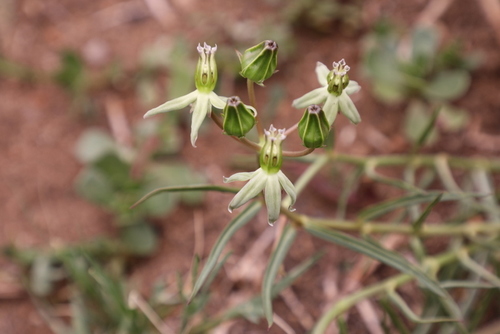
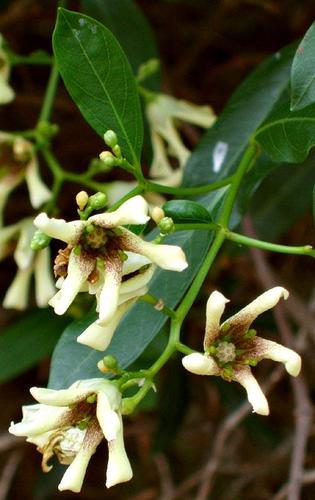
A shrub or small tree. It grows up to 1.5-5 m tall. It has green straggly branches. There are many spines 10-40 mm long. The spines are simple. The leaves are opposite one another. They have short stalks. The leaves are leathery and widest below the middle. The flowers are white and pink. The are in the shape of a tube and 18 mm long. They are crowded in the axils of leaves. The fruit occur as berries in pairs. They are round and about 1 cm across. They are waxy and dark red when ripe. They have red sweet pulp. The fruit are edible. Probably now Carissa spinarum
Edible Uses
Raw fruit are eaten fresh, especially by children, or made into jam, wine, or vinegar. The roots are boiled as a vegetable and used as a spice, while the leaves serve as a pot herb.
Traditional Uses
The fruit are eaten raw especially by children. They can be made into jam. The fruit are fermented into wine or vinegar. The roots are eaten as a boiled vegetable. They are used as a spice. The leaves are used as a pot herb.
Distribution
It is a tropical plant. It occurs in semi arid lowlands and in the highlands. They occur in regions with temperatures in the range 14-22°C. They occur from sea level to 2400 m but are more common at 800-1200 m altitude. It is damaged by frost but resistant to drought. They will grow on most soils. In Tanzania it grows in areas with a rainfall between 1,000-2,100 mm. They do not do well in wet areas. It can grow in arid places. It often grows on termite mounds. It suits hardiness zones 10-11. In Yunnan.
Where It Grows
Africa*, Angola, Arabia, Asia, Australia, Benin, Botswana, Burkina Faso, Cameroon, Central Africa, China, Côte d'Ivoire, Cuba, East Africa, Eritrea, Ethiopia, Ghana, Guinea, Guinée, India, Indochina, Ivory Coast, Kenya, Madagascar, Malawi, Mali, Middle East, Mozambique, Namibia, Nigeria, Oman, Pacific, Philippines, Rwanda, Saudi Arabia*, SE Asia, Senegal, Seychelles, Somalia, South Africa, Southern Africa, South Sudan, Sudan, Tanzania, Thailand, Togo, Uganda, West Africa, West Indies, Yemen, Zambia, Zimbabwe,
Cultivation
Plants can be grown from seed or cuttings. For hedges they are planted at between 1 and 2 m apart and pruned to 1-1.5 m high. Seedlings need watering. Seeds are best sown in a nursery and then transplanted. Plants can be used as a hedge and pruned.
Production
Fruit reaches maturity 4 months after flowering. Fruit are collected during the dry season. Fruit are harvested off the tree.
Other Information
The fruit are eaten especially by children. It is a cultivated food plant.
Notes
There about 20-37 Carissa species. All Carissa species bear edible fruit. They grow in the tropics and subtropics. Now Carissa spinarum.
Nutrition
| Part | Moisture | kJ | kcal | Protein | Vit A | Vit C | Iron | Zinc |
|---|---|---|---|---|---|---|---|---|
| Fruit | 87.3 | 1745 | 418 | 9.2 | — | — | — | — |
| Root | — | — | — | — | — | — | — | — |
Synonyms
Also Known As
Achuga, Acoga, Acuga, Adokokolia, Adishawel, Agam, Agamita, Agamsa, Aimuria, Akamba, Aletelete, Amatungula, Amuria, Arabian num-num, Botsu, Dhagamsa, Dougourah, Egyptian carissa, Ekamuria, Enyonza, Gurura, Hazolahy, Iminyonza, Kirumba, Kumakuma, Lakalet, Laka-tetwa, Lamriai, Lamuriei, Lokotetwo, Machame, Manka, Mfumba, Mfumbwe, Mkalakala, Mkolokolo, Mothokolo, Mpambulu, Msuuku, Mtanda-mboo, mu-Kawa, Mudyabveni, Mudzambara, Muhlababzunzi, Mukawa, Mukagwa, Mukomfwa, Mulowe, Mumbingwa, Muruguru, Mutsamviringa, Mutwooga, Muyonza, Ochuoga, Omuyonza, Qach, Simple-spined num-num, Small num-num, Tian jia hu ci, Titiwi, Tshirungulu, Umlugulu, Umuyonza
References (87)
- Acipa, A. et al, 2013, Nutritional Profile of some Selected Food Plants of Otwal and Ngai Counties, Oyam District, Northern Uganda. African Journal or Food, Agriculture, Nutrition and Development. 13(2)
- Addis, G., et al, 2005, Ethnobotanical Study of Edible Wild Plants in Some Selected Districts of Ethiopia. Human Ecology, Vol. 33, No. 1, pp. 83-118
- Agea, J. G., et al 2011, Wild and Semi-wild Food Plants of Bunyoro-Kitara Kingdom of Uganda: etc. Environmental Research Journal 5(2) 74-86
- Alfarhan, A. H., 2005, Flora of Jizan Region. AR 17-7. King andulaziz City for Science and Technology (KACST). p 295 (As Carissa edulis var. tomentosa)
- Anywar, G., et al, 2014, Wild Plants Used as Nutraceuticals from Nebbi District, Uganda. European Journal of Medicinal Plants 4(6): 641-660, 2014
Show all 87 references Hide references
- Asfaw, Z. and Tadesse, M., 2001, Prospects for Sustainable Use and Development of Wild Food Plants in Ethiopia. Economic Botany, Vol. 55, No. 1, pp. 47-62
- Atato, A., et al, 2010, Diversity of Edible Wild Fruit Tree Species of Togo. Global Science Books.
- Bekele-Tesemma A., Birnie, A., & Tengnas, B., 1993, Useful Trees and Shrubs for Ethiopia. Regional Soil Conservation Unit. Technical Handbook No 5. p 130
- Bigirimana, C., et al, 2016, Utilisation of Indigenous Fruit Tree Species within the Lake Victoria Basin, Rwanda. Agricultural Science: An International Journal. (AGRIJ) Vol. 1, No. 1
- Bircher, A. G. & Bircher, W. H., 2000, Encyclopedia of Fruit Trees and Edible Flowering Plants in Egypt and the Subtropics. AUC Press. p 84
- BROKENSHA & RILEY
- Burkill, H. M., 1985, The useful plants of west tropical Africa, Vol. 1. Kew.
- Bussman, R. W., 2006, Ethnobotany of the Samburu of Mt. Nyiru, South Turkana, Kenya. Journal of Ethnobiology and Ethnomedicine. 2:35
- Bussman, R. W., et al, 2011, Plant Use in Odo-Bulu and Demaro, Bale region, Ethiopia. Journal of Ethnobiology and Ethnomedicine. 2011, 7:28
- Coronel, R.E., 1982, Fruit Collections in the Philippines. IBPGR Newsletter p 9
- Cundall, P., (ed.), 2004, Gardening Australia: flora: the gardener's bible. ABC Books. p 331
- Dale, I. R. and Greenway, P. J., 1961, Kenya Trees and Shrubs. Nairobi. p 45
- Demise, S. & Asfaw, Z., 2020, Ethno Botanical Study of Wild Edible Plants in Adola District, Southern, Ethiopia. International Journal of Research and Analytical Reviews (IJRAR) 7(2).
- Dharani, N., 2002, Field Guide to common Trees & Shrubs of East Africa. Struik. p 210
- Etherington, K., & Imwold, D., (Eds), 2001, Botanica's Trees & Shrubs. The illustrated A-Z of over 8500 trees and shrubs. Random House, Australia. p 181
- Ethiopia: Famine Food Field Guide. http://www.africa.upenn.edu/faminefood/category3.htm
- Facciola, S., 1998, Cornucopia 2: a Source Book of Edible Plants. Kampong Publications, p 22
- FAO, 1988, Traditional Food Plants, FAO Food and Nutrition Paper 42. FAO Rome p 140
- Flora of China Vol 16 p 146
- Food Composition Tables for use in Africa FAO http://www.fao.org/infoods/directory No. 884
- Fowler, D. G., 2007, Zambian Plants: Their Vernacular Names and Uses. Kew. p 9
- Fox, F. W. & Young, M. E. N., 1982, Food from the Veld. Delta Books. p 88
- Gemedo-Dalle, T., et al, 2005, Plant Biodiversity and Ethnobotany of Borana Pastoralists in Southern Oromia, Ethiopia. Economic Botany 59(1) pp. 43-65
- Glew, R. H., et al, 1997, Amino Acid, Fatty Avid and Mineral Composition of 24 Indigenous Plants of Burkina Faso. Journal of Food Composition and Analysis 10, 205-217
- Godfrey, J. et al, 2013, Harvesting, preparationand preservation of commonly consumed wild and semi-wild food plants in Bunyoro-Kitara Kingdom, Uganda. Int. J. Med. Arom. Plants. Vol.3 No.2 pp 262-282
- Goode, P., 1989, Edible Plants of Uganda. FAO p 27
- Goode, P., 1989, Edible Plants of Uganda. FAO p 37
- Goode, P., 1989, Edible Plants of Uganda. FAO p 40
- Grivetti, L. E., 1980, Agricultural development: present and potential role of edible wild plants. Part 2: Sub-Saharan Africa, Report to the Department of State Agency for International Development. p 24, 43
- Gueye, M., et al, 2014, Wild Fruits Traditionally Gathered by the Malinke Ethnic Group in the Edge of Niokolo Koba Park (Senegal). American Journal of Plant Sciences 5, 1306-1317
- Ichikawa, M., 1980, The Utilization of Wild Food Plants by the Suiei Dorobo in Northern Kenya. J. Anthrop. Soc. Nippon. 88(1): 25-48
- Jardin, C., 1970, List of Foods Used In Africa, FAO Nutrition Information Document Series No 2.p 64, 125
- Joffe, P., 2007, Creative Gardening with Indigenous Plants. A South African Guide. Briza. p 215
- Johns, T., and Kokwaro, J.O., 1991, Food Plants of the Luo of Siayo District, Kenya. Economic Botany 45(1), pp 103-113
- Johns, T., Mhoro, E. B. and Sanaya, P., 1996, Food Plants and Masticants of the Batemi of Ngorongoro District, Tanzania. Economic Botany, Vol. 50, No. 1, pp. 115-121
- Katende, A.B., Birnie, A & Tengnas B., 1995, Useful Trees and Shrubs for Uganda. Identification, Propagation and Management for Agricultural and Pastoral Communities. Technical handbook No 10. Regional Soil Conservation Unit, Nairobi, Kenya. p 160
- Kuhnlein, H. V., et al, 2009, Indigenous Peoples' food systems. FAO Rome p 239
- Le Houerou, H. N., (Ed.), 1980, Browse in Africa. The current state of knowledge. International Livestock Centre for Africa, Ethiopia. p 161
- Li Ping-tao; Antony J. M. Leeuwenberg, David J. Middleton, Apocynaceae, Flora of China, Vol. 16, p 146
- Magwede, K., van Wyk, B.-E., & van Wyk, A. E., 2019, An inventory of Vhavenḓa useful plants. South African Journal of Botany 122 (2019) 57–89
- Malaisse, F., 1997, Se nourrir en floret claire africaine. Approche ecologique et nutritionnelle. CTA., p 59, 91
- Malaisse, F., 2010, How to live and survive in Zambezian open forest (Miombo Ecoregion). Les Presses Agronomiques de Gembloux.
- Mannheimer, C. A. & Curtis. B.A. (eds), 2009, Le Roux and Muller's Field Guide to the Trees and Shrubs of Namibia. Windhoek: Macmillan Education Namibia. p 406
- Maroyi, A., 2011, The Gathering and Consumption of Wild Edible Plants in Nhema Communal Area, Midlands Province, Zimbabwe. Ecology of Food and Nutrition 50:6, 506-525
- Maroyi, A. & Cheikhyoussef, A., 2017, Traditional knowledge of wild edible fruit in southern Africa: A comparative use patterns in Namibia and Zimbabwe. Indian Journal of Traditional Knowledge. 16(3): 385-392
- Martin, F. W., et al, 1987, Perennial Edible Fruits of the Tropics. USDA Handbook 642 p 19
- Mashile, S. P., et al, 2019, Indigenous fruit plants species of the Mapulana of Ehlanzeni district in Mpumalanga province, South Africa. South African Journal of Botany 122 (2019) 180–183
- Maundu, P. et al, 1999, Traditional Food Plants of Kenya. National Museum of Kenya. 288p
- Mbuya, L.P., Msanga, H.P., Ruffo, C.K., Birnie, A & Tengnas, B., 1994, Useful Trees and Shrubs for Tanzania. Regional Soil Conservation Unit. Technical Handbook No 6. p 162
- Mengistu, F. & Hager, H., 2008, Wild Edible Fruit Species Cultural Domain, Informant Species Competence and Preference in Three Districts of Amhara Region, Ethiopia. Ethnobotany Research & Applications 6:487-502
- Miller, A. G., Morris, M. & Stuart-Smith, S., 1988, Plants of Dhofar. The Southern Region of Oman, Traditional, Economic and Medicinal Uses. Sultanate of Oman. p 32
- Moksia, F., et al, 2019, Diversity and Socio-Economic Value of Wild Edible Plants in the Mounts Mandara Region, Cameroon. International Journal of Sciences. Vol. 8:10
- Molla, A., Ethiopian Plant Names. http://www.ethiopic.com/aplants.htm
- Mpasiwakomu, R. A., 2017, The Diversity and Utilization of Wild Edible and Medicinal Plant Species found in Uvinza Miombo Woodlands, Tanzania. M. Sc. thesis University of Tanzania.
- Msuya, T. S., et al, 2010, Availability, Preference and Consumption of Indigenous Foods in the Eastern Arc Mountains, Tanzania, Ecology of Food and Nutrition, 49:3, 208-227
- Musinguzi, E., et al, 2006, Utilization of Indigenous Food Plants in Uganda: A Case Study of South-Western Uganda. AJFAND Vol. 6(2):
- Oryema, C., et al, 2013, Edible wild fruit species of Gulu District, Uganda. International Journal of Biology and Biological Sciences Vol 2(4) pp 068-082
- Palgrave, K.C., 1996, Trees of Southern Africa. Struik Publishers. p 783
- Peters, C. R., O'Brien, E. M., and Drummond, R.B., 1992, Edible Wild plants of Sub-saharan Africa. Kew. p 57
- Pickering, H., & Roe, E., 2009, Wild Flowers of the Victoria Falls Area. Helen Pickering, London. p 27
- Plowes, N. J. & Taylor, F. W., 1997, The Processing of Indigenous Fruits and other Wildfoods of Southern Africa. in Smartt, L. & Haq. (Eds) Domestication, Production and Utilization of New Crops. ICUC p 187
- Purseglove, J.W., 1968, Tropical Crops Dicotyledons, Longmans. p 626
- RILEY & BROKENSHA
- Roodt, V., 1998, Trees & Shrubs of the Okavango Delta. Medicinal Uses and Nutritional value. The Shell Field Guide Series: Part 1. Shell Botswana. p 95
- Royal Botanic Gardens, Kew (1999). Survey of Economic Plants for Arid and Semi-Arid Lands (SEPASAL) database. Published on the Internet; http://www.rbgkew.org.uk/ceb/sepasal/internet [Accessed 28th March 2011]
- Ruffo, C. K., Birnie, A. & Tengnas, B., 2002, Edible Wild Plants of Tanzania. RELMA p 186
- Schmidt, E., Lotter, M., & McCleland, W., 2007, Trees and shrubs of Mpumalanga and Kruger National Park. Jacana Media p 558
- Seidemann J., 2005, World Spice Plants. Economic Usage, Botany, Taxonomy. Springer. p 86
- Shumsky, S., et al, 2014, Institutional factors affecting wild edible plant (WEP) harvest and consumption in semi-arid Kenya. Land Use Policy 38(2014) 48-69
- Styger, E., et al, 1999, Indigenous fruit trees of Madagascar: potential components of agroforestry systems to improve human nutrition and restore biological diversity. Agroforestry Systems 46: 289-310
- Symb. bot. 1:22. 1790
- Tabuti, J. R. S., 2012, Important Woody Plant Species, their Management and Conservation Status in Balawoli Sub-country, Uganda. Ethnobotany Research & Applications 10:269-286
- Tebkew, M., et al, 2018, Uses of wild edible plants in Quara district, northwest Ethiopia: implication for forest management. Agriculture and Food Security (2018) 7:12
- Termote, C., et al, 2014, Assessing the potential of wild foods to reduce the cost of a nutritionally adequate diet: An example from eastern Baringo District, Kenya. Food and Nutrition Bulletin, vol. 35, no. 4
- Tredgold, M.H., 1986, Food Plants of Zimbabwe. Mambo Press. p 91
- USDA, ARS, National Genetic Resources Program. Germplasm Resources Information Network - (GRIN). [Online Database] National Germplasm Resources Laboratory, Beltsville, Maryland. Available: www.ars-grin.gov/cgi-bin/npgs/html/econ.pl (10 April 2000)
- Venter, F & J., 2009, Making the most of Indigenous Trees. Briza. p 88
- Vivien, J., & Faure, J.J., 1996, Fruitiers Sauvages d'Afrique. Especes du Cameroun. CTA p 55
- White, F., Dowsett-Lemaire, F. and Chapman, J. D., 2001, Evergreen Forest Flora of Malawi. Kew. p 137
- Williamson, J., 2005, Useful Plants of Malawi. 3rd. Edition. Mdadzi Book Trust. p 57
- www.worldagroforestrycentre.org/treedb/
- www.zimbabweflora.co.zw 2011