Carissa congesta
Wight
Bengal currant
iNaturalist· cc-by
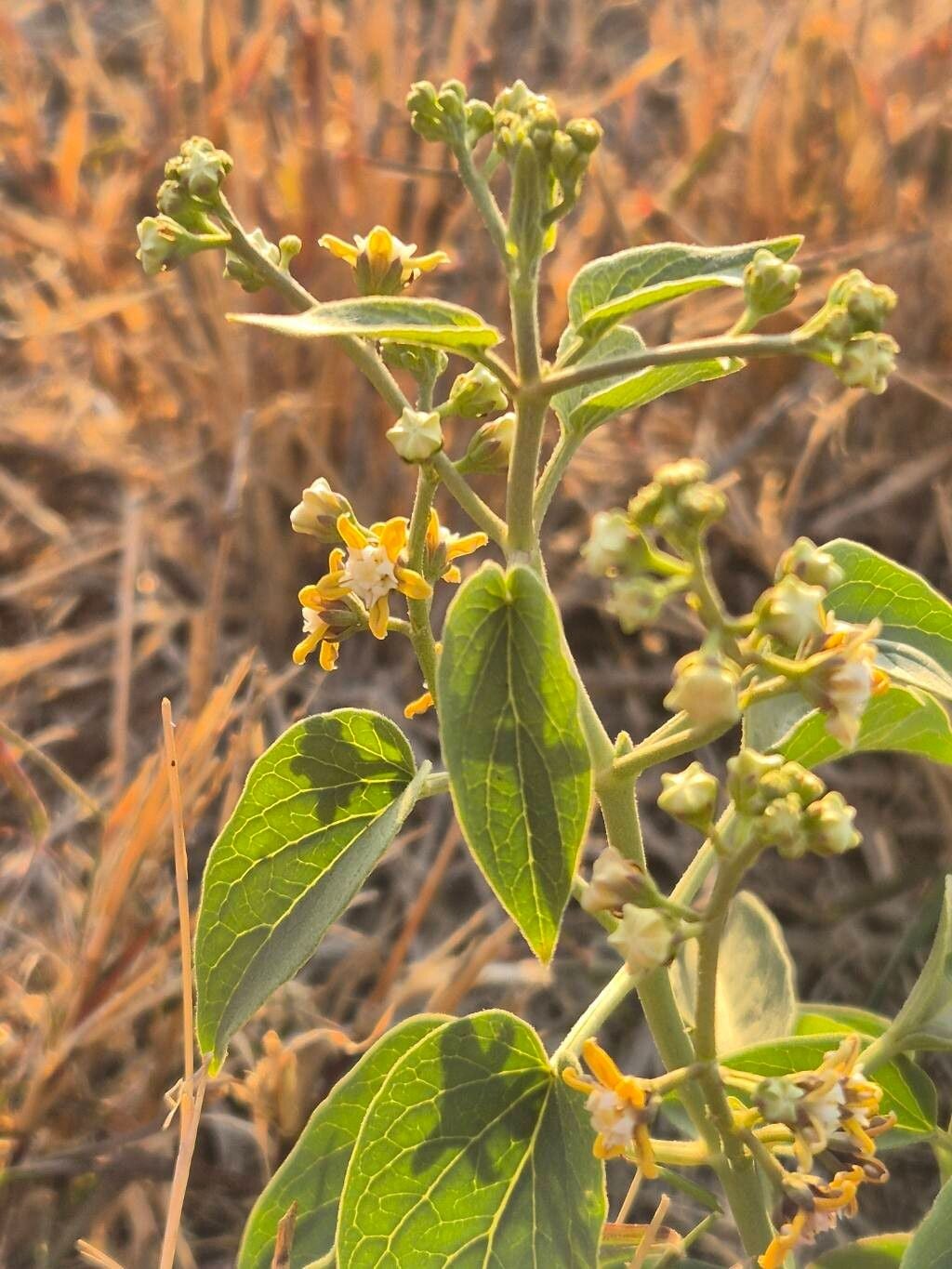
(c) National Geographic Okavango Wilderness Project, some rights reserved (CC BY)
iNaturalist· cc-by
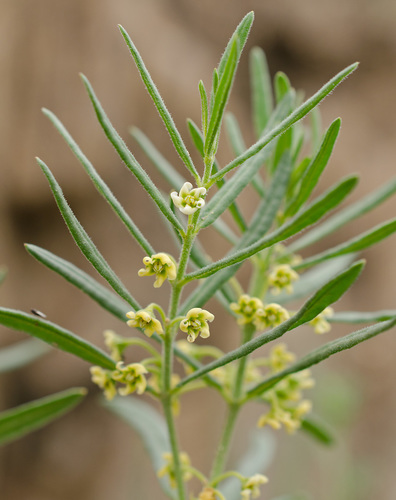
(c) National Geographic Okavango Wilderness Project, some rights reserved (CC BY)
iNaturalist· cc-by
(c) National Geographic Okavango Wilderness Project, some rights reserved (CC BY)
Description
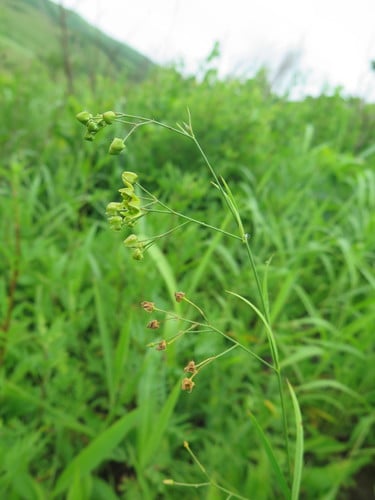
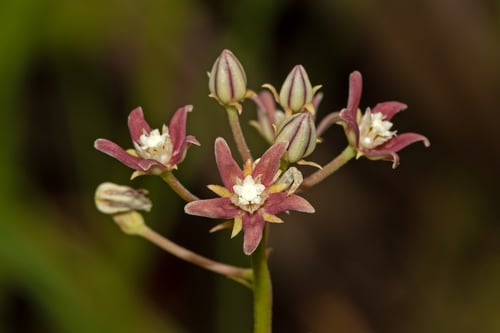
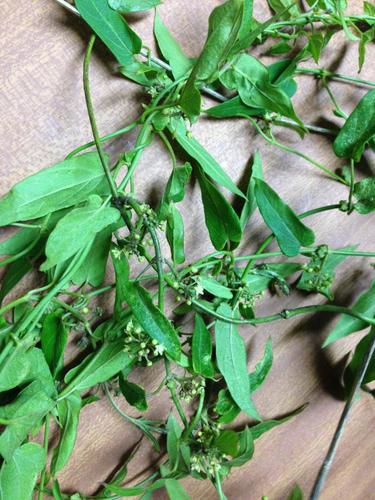
A shrub or small tree. It grows to 3-5 m tall. It can spread like a vine. It is thorny and prickly. The spines can be simple or forked and up to 5 cm long. It produces latex. The bark is pale brown or greyish and not very rough. The leaves are in opposite pairs. They taper at the base and are rounded at the tip. The tip has a tiny sharp point. Young leaves are red. The flowers are small and white. They are 3.5 cm across and tube shaped. They occur at the ends of the twigs. There are 5 pointy petals that overlap to the right. The fruit are pinkish or reddish-purple berries. They are 2.5 cm long. They have juicy acid pulp.
Edible Uses
Ripe fruit are eaten fresh or processed into juice, jelly, jam, puddings, and cooked fruit dishes, while unripe fruit are pickled.
Traditional Uses
Fruit can be eaten fresh or used for juice or jelly. The can be very sour but ripe fruit are sweet. They are used for puddings, pickles, jams or as cooked fruit. The unripe fruit are pickled.
Distribution
A tropical and subtropical plant. Salt tolerance is high. In Nepal it grows to 1000 m altitude. It suits dry sunny places. In India they are common on dry, sandy or loamy soils in the plains and low hills. It is very hardy and drought tolerant. It cannot tolerate heavy rainfall or waterlogged soils.
Where It Grows
Asia, China, East Africa, East Timor, Himalayas, India, Indochina, Indonesia, Iran, Malaysia, Middle East, Myanmar, Nepal, Northeastern India, Pacific, Pakistan, Philippines, SE Asia, Sri Lanka, Taiwan, Thailand, Timor-Leste, Vietnam,
Cultivation
Plants can be grown from seed. Plants can be kept clipped into a shrub otherwise they will be a climbing creeper. Plants can be grown from cuttings. Plants are often grown as a hedge.
Production
Plants grown from seed fruit is the third year. A plant can keep producing for 30 years. A plant produces 4-5 kg of fruit. Fruit mature 100-110 days after fruit set. The fruit become darker and softer on ripening. In southern India plants fruit in April to May.
Other Information
The fruit are sold in markets in India. It is a cultivated food plant.
Notes
There about 20-37 Carissa species. All Carissa species bear edible fruit. They grow in the tropics and subtropics. Now Carissa spinarum.
Nutrition
| Part | Moisture | kJ | kcal | Protein | Vit A | Vit C | Iron | Zinc |
|---|---|---|---|---|---|---|---|---|
| Fruit | — | — | — | — | — | — | — | — |
| Fruit | 83 | — | 75 | 0.5 | — | 10 | — | — |
Synonyms
Also Known As
Avighna, Berenda, Caramba, Cay siro, Ci huang guo, Garchana kaayi, Kalakai, Kalakkay, Karamarda, Karamcha, Karanda, Karandan, Karande kaayi, Karaunda, Karaunte, Karekayi, Karonda, Karvanda, Karwand, Kerandang, Kerenda, Manaao ho, Naam daeng, Naam khee kaet, Nam-daeng, Perunkila, Senggaritan, Vaka, Wakay okachettu
References (43)
- Aberoumand, A., 2008, Comparison of protein values from seven wild edible plants of Iran. African Journal of Food Science. Vol 2. pp 73-76 (As Carissa karandus)
- Ambasta S.P. (Ed.), 2000, The Useful Plants of India. CSIR India. p 106 (As Carissa carandas)
- Arora, R. K., 2014, Diversity in Underutilized Plant Species - An Asia-Pacific Perspective. Bioversity International. p 62
- Bircher, A. G. & Bircher, W. H., 2000, Encyclopedia of Fruit Trees and Edible Flowering Plants in Egypt and the Subtropics. AUC Press. p 84 (As Carissa carandas)
- Bole, P.V., & Yaghani, Y., 1985, Field Guide to the Common Trees of India. OUP p 69 (As Carissa carandas)
Show all 43 references Hide references
- Burkill, I.H., 1966, A Dictionary of the Economic Products of the Malay Peninsula. Ministry of Agriculture and Cooperatives, Kuala Lumpur, Malaysia. Vol 1 (A-H) p 470 (As Carissa carandas)
- Chandrashekara, U. M., 2009, Tree species yielding edible fruit in the coffee-based homegardens of Kerala, India: their diversity, uses and management. Food Sec. 1:361-370
- Chin, H.F., & Yong, H.S., 1996, Malaysian Fruits in Colour. Tropical press, Kuala Lumpur p 61
- Coronel, R.E., 1982, Fruit Collections in the Philippines. IBPGR Newsletter p 6 (As Carissa carandas)
- Davis, S.D., Heywood, V.H., & Hamilton, A.C. (eds), 1994, Centres of plant Diversity. WWF. Vol 1 or 2. p 117 (As Carissa carandas)
- Facciola, S., 1998, Cornucopia 2: a Source Book of Edible Plants. Kampong Publications, p 22 (As Carissa carandas)
- Flora of Pakistan. www.eFloras.org (As Carissa carandas)
- Flowerdew, B., 2000, Complete Fruit Book. Kyle Cathie Ltd., London. p 163 (As Carissa carandas)
- GAMMIE (As Carissa carandas)
- Hu, Shiu-ying, 2005, Food Plants of China. The Chinese University Press. p 630 (As Carissa carandas)
- Janick, J. & Paul, R. E. (Eds.), 2008, The Encyclopedia of Fruit & Nuts. CABI p 70
- Kiple, K.F. & Ornelas, K.C., (eds), 2000, The Cambridge World History of Food. CUP p 1745 (As Carissa carandas)
- Krishen P., 2006, Trees of Delhi, A Field Guide. DK Books. p 95
- Li Ping-tao; Antony J. M. Leeuwenberg, David J. Middleton, Apocynaceae, Flora of China Vol. 15 p 146 (As Carissa carandas)
- Lyle, S., 2006, Discovering fruit and nuts. Land Links. p 105
- Macmillan, H.F. (Revised Barlow, H.S., et al) 1991, Tropical Planting and Gardening. Sixth edition. Malayan Nature Society. Kuala Lumpur. p 296 (As Carissa carandas)
- Manandhar, N.P., 2002, Plants and People of Nepal. Timber Press. Portland, Oregon. p 137 (As Carissa carandas)
- Martin, F. W., et al, 1987, Perennial Edible Fruits of the Tropics. USDA Handbook 642 p 18 (As Carissa carandas)
- McMakin, P.D., 2000, Flowering Plants of Thailand. A Field Guide. White Lotus. p 7 (As Carissa carandas)
- Morton, Julia F., 1987, Fruits of Warm Climates. Creative Resources Systems, Inc. . p. 422
- Patil, M. V. & Patil, D. A., 2000, Some More Wild Edible Plants of Nasik District (Maharashtra). Ancient Science of Life Vol. X1X (3&4): 102-104
- PROSEA (As Carissa carandas)
- Purseglove, J.W., 1968, Tropical Crops Dicotyledons, Longmans. p 626 (As Carissa carandas)
- Sadhale, A., et al, 1991, Ethnobotanical studies of sacred grove at Ajiwali, Pune district. J. Econ. Tax. Bot. Vol. 15 No. 1 pp 167-172
- Shah, G.L. et al, 1981, An account of the Ethnobotany of Saurashtra in Gujarat State (India). J. Econ. Tax. Bot. Vol 2 pp 173-182
- Shah, G.L., 1984, Some economically important plant of Salsette Island near Bombay. J. Econ. Tax. Bot. Vol. 5 No. 4 pp 753-765
- Sharma, B.B., 2005, Growing fruits and vegetables. Publications Division. Ministry of Information and broadcasting. India. p 76 (As Carissa carandas)
- SHORTT (As Carissa carandas)
- Singh, H.B., Arora R.K.,1978, Wild edible Plants of India. Indian Council of Agricultural Research, New Delhi. p 53
- Singh, V. and Singh, P., 1981, Edible Wild Plants of Eastern Rajasthan. J. Econ. Tax. Bot. Vol 2 pp 197-207
- Singh, V. B., et al, (Ed.) Horticulture for Sustainable Income and Environmental Protection. Vol. 1 p 214
- Swaminathan, M.S., and Kochnar, S.L., 2007, An Atlas of Major Flowering Trees in India. Macmillan. p 207 (As Carissa carandas)
- USDA, ARS, National Genetic Resources Program. Germplasm Resources Information Network - (GRIN). [Online Database] National Germplasm Resources Laboratory, Beltsville, Maryland. Available: www.ars-grin.gov/cgi-bin/npgs/html/econ.pl (10 April 2000) (As Carissa carandas)
- Upreti, K., et al, 2010, Diversity and Distribution of Wild Edible Fruit Plants of Uttarakhand. Bioversity Potentials of the Himalaya. p 164
- Verheij, E. W. M. and Coronel, R.E., (Eds.), 1991, Plant Resources of South-East Asia. PROSEA No 2. Edible fruits and nuts. Pudoc Wageningen. p 322 (As Carissa carandas)
- Ravikrishna, S., 2011, Ethno-medico-botanical survey on Wild Edible fruits of Udupi Taluq, Udupi p 64 WATT. (As Carissa carandas)
- Wong, K. C., 1995, Collection and Evaluation of Under-Utilized Tropical and Subtropical Fruit Tree Genetic Resources in Malaysia. JIRCAS International Symposium Series No. 3: 27-38
- www.worldagroforestrycentre.org/treedb/