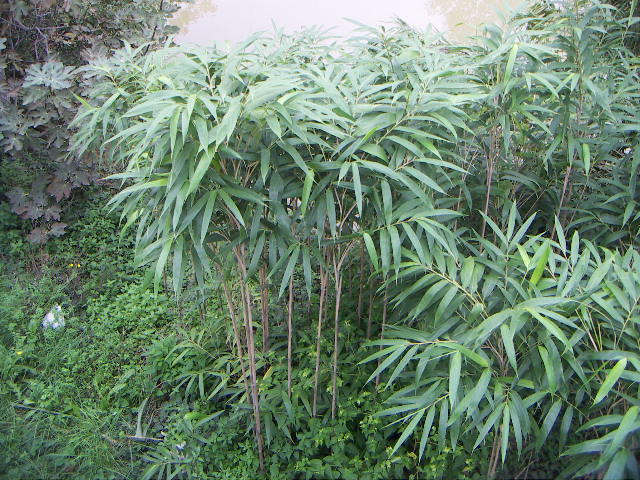
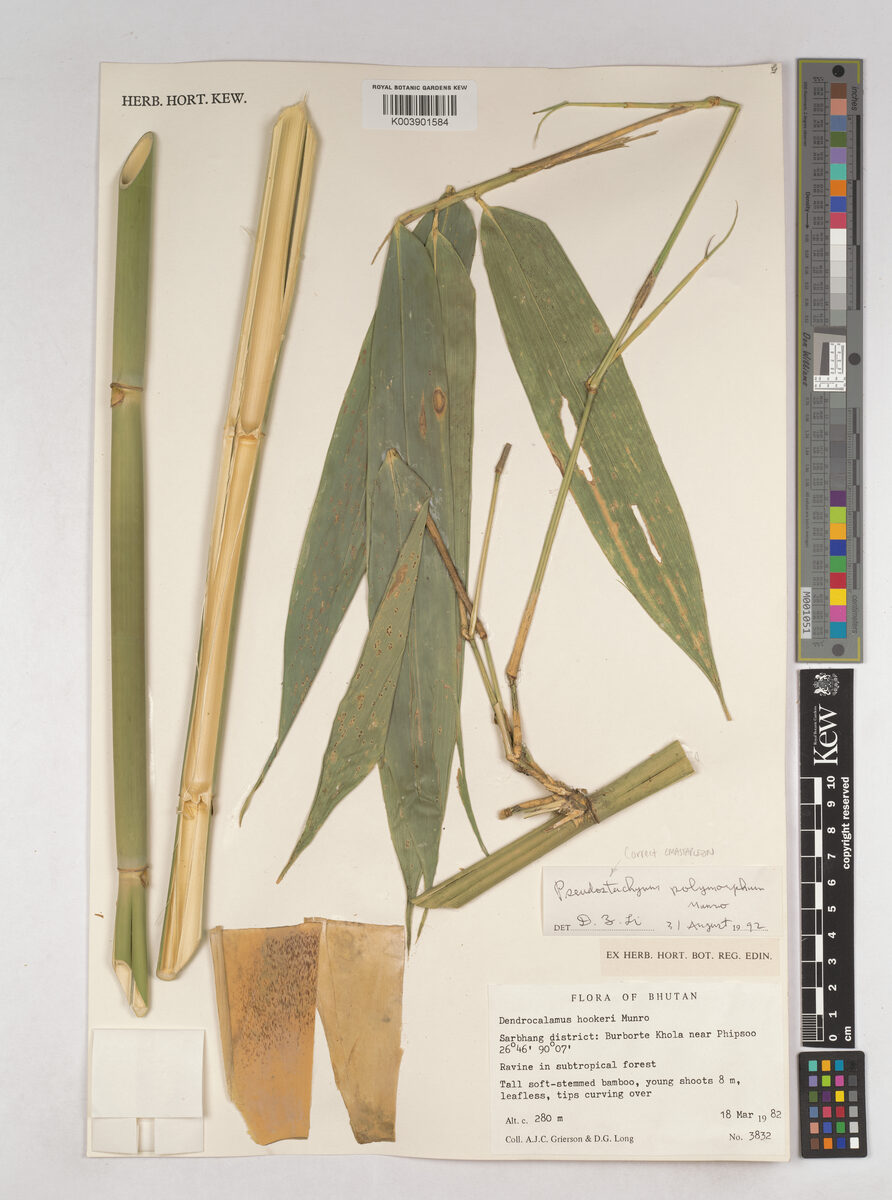
Gigantochloa balui
K. M. Wong
Buluh balui
gbif· cc0
President and Fellows of Harvard College
gbif· cc0
President and Fellows of Harvard College
Summary
Gigantochloa balui is a fast-growing evergreen bamboo reaching 10 m tall and 4 m wide. Wind-pollinated and hardy to UK zone 10. Tolerates light, loamy, or clay soils with well-drained conditions and mildly acidic, neutral, or mildly alkaline pH. Requires full sun and prefers moist soil.
Description
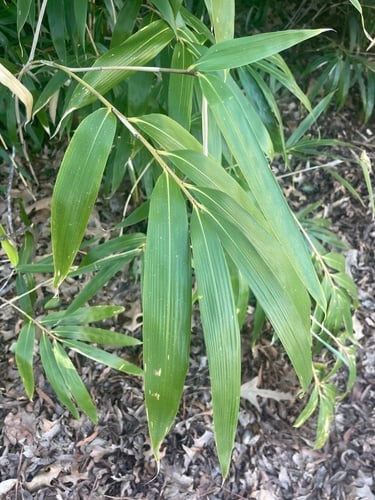
A bamboo. It forms dense tufts. The stems bend slightly outwards. They are 12 m long and 3-8 cm across. The internodes are 40 cm long.
This description is brief — help expand it
Edible Uses
Young shoots are cooked and eaten, though other species such as Gigantochloa levis and Dendrocalamus asper are generally preferred.
Traditional Uses
The young shoots are cooked and eaten.
This uses section is brief — help expand it
Medicinal Uses
None known
Distribution
It is a tropical plant. It is best in rich alluvial soils.
Where It Grows
Asia, Brunei, Indochina, Indonesia, Malaysia, SE Asia, Thailand,
Cultivation
The plant appears to grow best on rich alluvial sites, especially near rivers, and also establishes well in secondary forest. The plant usually grows in tight clumps to the exclusion of most other plants. This is partly due to the accumulation of much siliceous leaf litter on the ground, which decays only slowly and prevents effective establishment of other plants. In a trial plot in Sabah, Malaysia, eight years after planting from cuttings, the number of healthy mature culms per clump was estimated at 20 - 40. Mature culms, 2 or more years old, are usually harvested, though in some areas one year old culms are preferred for basketry. Bamboos have an interesting method of growth. Each plant produces a number of new stems annually - these stems grow to their maximum height in their first year of growth, subsequent growth in the stem being limited to the production of new side branches and leaves. In the case of some mature tropical species the new stem could be as much as 30 metres tall, with daily increases in height of 30cm or more during their peak growth time. This makes them some of the fastest-growing species in the world. Bamboos in general are usually monocarpic, living for many years before flowering, then flowering and seeding profusely for a period of 1 - 3 years before usually dying. Bamboos in general are usually monocarpic, living for many years before flowering, then flowering and seeding profusely for a period of 1 - 3 years before usually dying. This pattern can vary - sometimes flowering is sporadic, with plants flowering annually and not dying; at other times it is gregarious with all the plants in a specific species coming into flower at the same time. In this species, flowering clumps are not commonly encountered, which is probably a major reason why the botanical identity of the plant eluded workers for a long time. However, when a clump does flower, most or all culms gradually become generative, and an entire flowering episode can last up to a whole year. One clump observed in Brunei Darussalam flowered during a period of 14 months - although all the culms died afterwards, the plantitself did not die but produced new growth from the rhizome system.
Propagation
Rhizome cuttings (offsets) and culm cuttings are both effective for propagation. Cuttings taken from mature but not senescent culms reliably produce new plants within 3–4 months provided water is not limiting. Rooted cuttings with several leafy branches can be planted out in the field in holes prepared with manure and fertilizer. Preliminary observations from a trial in Sandakan, Sabah, suggest that spacing individual clumps 4–6 metres apart facilitates optimum growth and minimises weed problems.
Other Uses
The culms have a wide range of uses. They are used whole in construction and as poles, fishing stakes, sailing masts, and framing. They are also split for making baskets and handicrafts. Culm internodes serve as containers for cooking meat and vegetables and for making handicrafts.
Other Information
The shoots are eaten but are not popular. It is a cultivated plant.
Synonyms
Also Known As
Balui, Bambu taris, Buluh abe, Phai ba lui