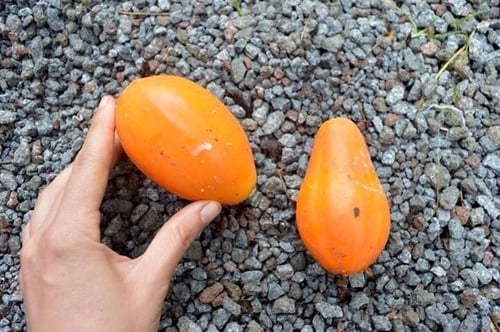
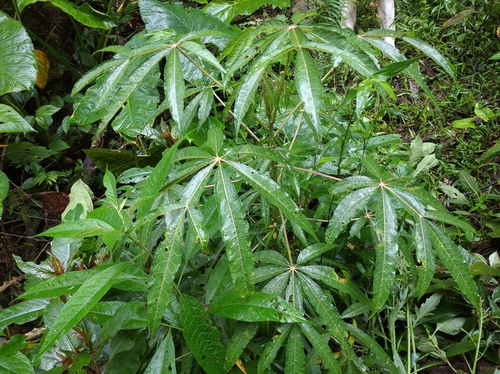
Carica x pentagona
Heilborn
Babaco, Mountain papaya
iNaturalist· cc-by-nc
(c) Diana Carolina VInueza Vinueza, some rights reserved (CC BY-NC)
iNaturalist· cc-by-nc
(c) Victor}, some rights reserved (CC BY-NC)
iNaturalist· cc-by-nc
(c) camisca, some rights reserved (CC BY-NC)
Description
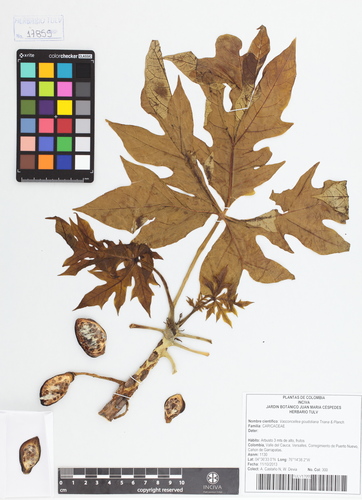
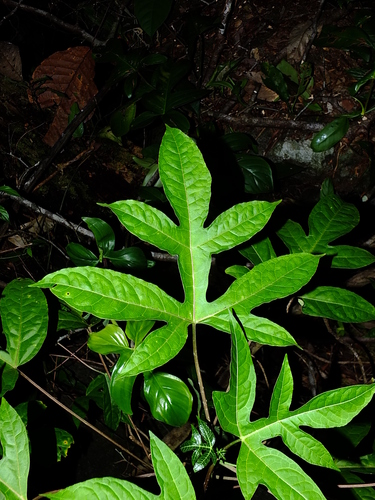
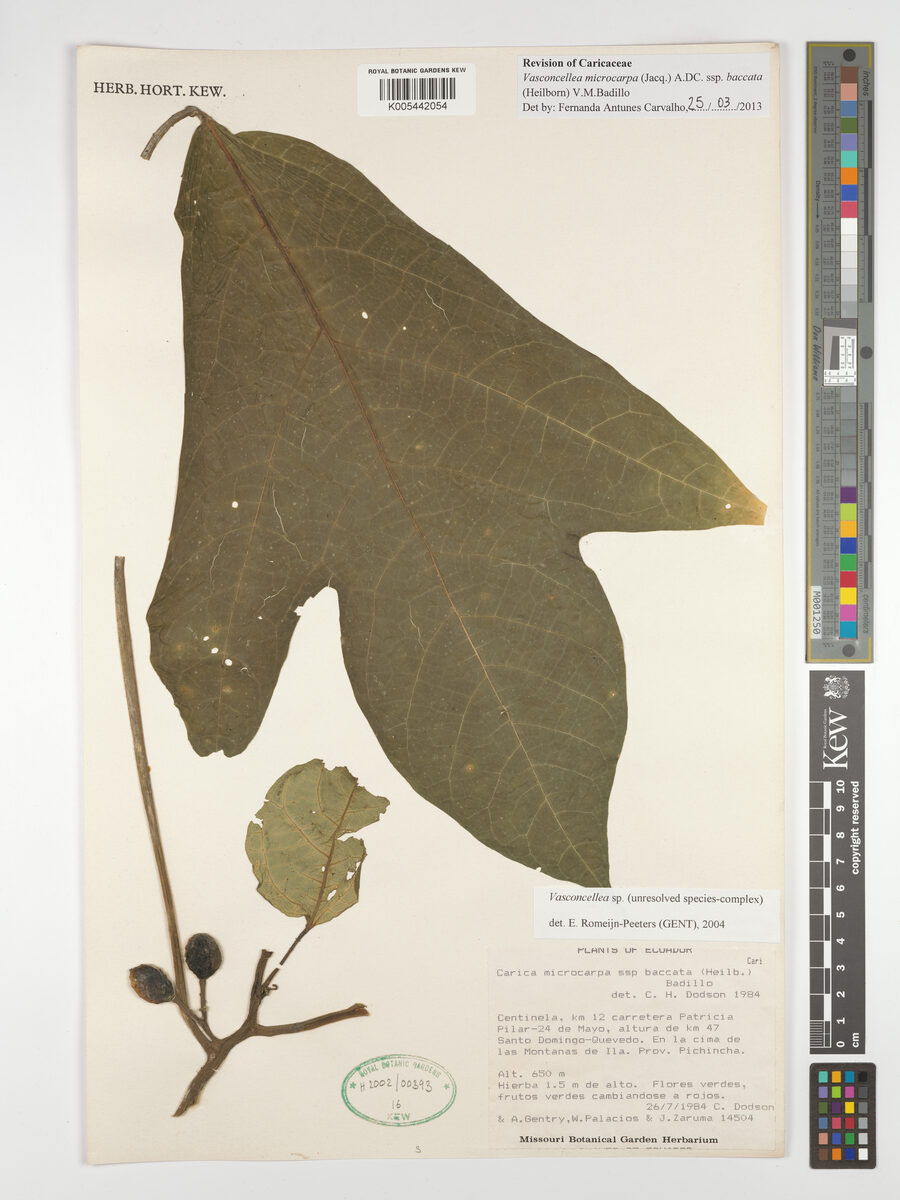
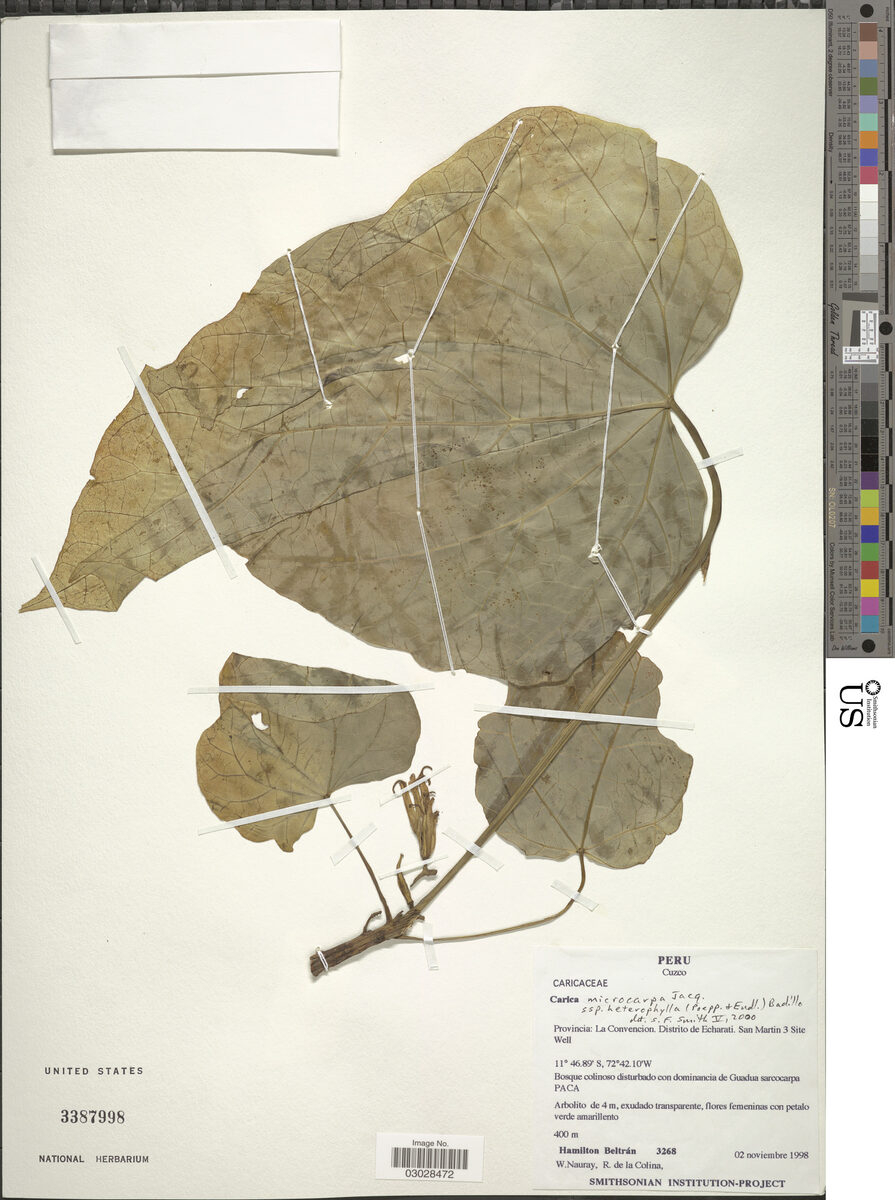
A hybrid between Carica pubescens and Carica stipulata. A small shrub about 2-3 m tall. It has a soft trunk and leaf scars along the trunk. It is self fertile. The leaves are large and spread out like fingers on a hand. The leaves are 45 cm wide. The veins are easily seen. Flowers develop on the trunk as the tree grows. Individual leaves last about 4-6 months and flowers are in the angles of leaves. Flowers are female. The fruit develop without pollination or setting seed. The fruit are seedless. Fruit can be 30 cm long by 20 cm wide. The fruit is five sided and turns yellow as it ripens. The fruit has a smooth thin skin. The flesh is soft. Fruit are normally seedless.
Edible Uses
The seedless fruit are eaten raw or cooked.
Traditional Uses
The fruit are eaten raw or cooked.
This uses section is brief — help expand it
Distribution
It grows in a cool subtropical climate. It needs to be frost free or it will lose its leaves. They need a sheltered position and prefer a sunny position. It needs a well drained soil. It is best with a soil pH of 6-6.5. It cannot tolerate salty water. It can tolerate light frosts. In the Andes it grows between 1,500-2,500 m above sea level. It suits hardiness zones 10-11.
Where It Grows
Andes, Australia, Colombia, Ecuador, Europe, Hawaii, Israel, Mediterranean, Middle East, New Zealand, North America, Pacific, South America, Spain, USA,
Cultivation
Plants can be grown from cuttings about 30 cm long taken from near the base of older maturing plants. A second shoot can be allowed to grow from the base of the trunk as the first trunk becomes more mature and fruit production declines. Sometimes seeds are produced and these can be used for planting.
Production
Fruit is produced about 15 months after planting cuttings. Ripe fruit can be stored for 4 weeks. Fruit can be stored with refrigeration.
Other Information
It is a cultivated food plant.
Notes
It is probably a cross between Carica pubescens and Carica stipulata - the chamburo. There are at least 22-40 species of Carica. A hybrid between Vasconcellea cundimarcensis and Vasconelllea stipulata,
Synonyms
References (19)
- Bircher, A. G. & Bircher, W. H., 2000, Encyclopedia of Fruit Trees and Edible Flowering Plants in Egypt and the Subtropics. AUC Press. p 83 (As Carica peltata)
- Castillo, R. O., 1995, Plant Genetic Resources in the Andes: Impact, Conservation, and Management. Crop Science 35:355-360
- Darley, J.J., 1993, Know and Enjoy Tropical Fruit. P & S Publishers. p 90 (As Carica pentagona)
- Gouldstone, S., 1983, Growing your own Food-bearing Plants in Australia. Macmillan p 76 (As Carica pentagona)
- Heywood, V.H., Brummitt, R.K., Culham, A., and Seberg, O. 2007, Flowering Plant Families of the World. Royal Botanical Gardens, Kew. p 88 (As Carica pentagona)
Show all 19 references Hide references
- Hibbert, M., 2002, The Aussie Plant Finder 2002, Florilegium. p 60 (As Carica pentagona)
- Kermath, B. M., et al, 2014, Food Plants in the Americas: A survey of the domesticated, cultivated and wild plants used for Human food in North, Central and South America and the Caribbean. On line draft. p 904 (As Vasconcellea x heilbornii)
- Kiple, K.F. & Ornelas, K.C., (eds), 2000, The Cambridge World History of Food. CUP p 1725 (As Carica pentagona)
- Lyle, S., 2006, Discovering fruit and nuts. Land Links. p 99 (As Carica x heolbornii var. pentagona)
- Martin, F. W., et al, 1987, Perennial Edible Fruits of the Tropics. USDA Handbook 642 p 90 (As Carica frutifragrans) (Also as Carica pentagona)
- Morton, Julia F., 1987, Fruits of Warm Climates. Creative Resources Systems, Inc. . p. 346 (As Carica pentagona)
- Roa, J. A. G. & Boada, D. S. G., 2018, Fundación para el Fortalecimiento de la Fruticultura y Plantas Alimenticias no Convencionales en Colombia.
- Staples, G.W. and Herbst, D.R., 2005, A tropical Garden Flora. Bishop Museum Press, Honolulu, Hawaii. p 225
- Tankard, G., 1990, Tropical fruit. An Australian Guide to Growing and using exotic fruit. Viking p 22 (As Carica pentagona)
- Torre, de la, L., et al, 2008, Enciclopedia de las Plantas Útiles del Ecuador. Herbario QCA. Pontificia Universidad Católica del Ecuador. p 276 (As Vasconcellea x heilbornii)
- USDA, ARS, National Genetic Resources Program. Germplasm Resources Information Network - (GRIN). [Online Database] National Germplasm Resources Laboratory, Beltsville, Maryland. Available: www.ars-grin.gov/cgi-bin/npgs/html/econ.pl (10 April 2000)
- Van den Eynden, V., et al, 2003, Wild Foods from South Ecuador. Economic Botany 57(4): 576-603 (As Carica x heilbornii)
- Van den Eynden, V., et al, 2004, Regional and ecological variations of wild edible plants in southern Ecuador. Lyonia. 7(2) (As Vasconcellea x heilbornii)
- Wiersema, J. H. & Leon, B., 2013, World Economic Plants. A Standard Reference CRC Press. 2nd Ed. p 712 (As Vasconcellea x heilbornii)