Brachystelma arnottii
Baker
l'audohmtsxana
gbif· cc-by
Royal Botanic Gardens, Kew
Description
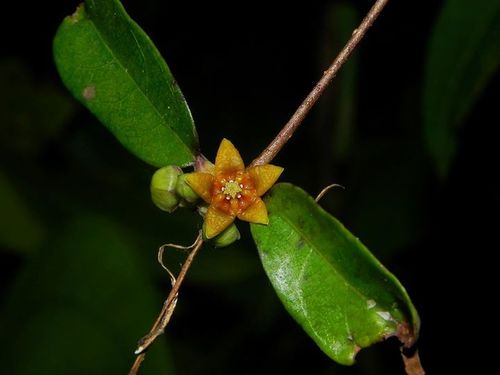
A herb. It has underground stems or rhizomes. It grows 20 cm high. It is a succulent plant. The leaves vary in shape and are 4 cm long. They are hairy underneath. The edges fold upwards. The flowers occur as 2-6 together. The tubers are 5-6 cm across.
Edible Uses
Root - raw or cooked. The skin is bitter and is usually removed before the tuber is eaten. The tuber can be 50 - 60mm in diameter.
Traditional Uses
The tubers are eaten raw or cooked in the ashes.
This uses section is brief — help expand it
Medicinal Uses
The tubers are used in traditional practices.
Distribution
It grows in areas with a marked dry season. It is a subtropical plant and grows in hot arid conditions. In southern Africa it grows between 900-1,600 m above sea level. It grows in sandy soils. It can grow in arid places.
Where It Grows
Africa, Botswana, Namibia, South Africa, Southern Africa,
Cultivation
Requires a sunny position. Prefers a moist but well-drained soil.
Notes
Also put in the family Asclepiadaceae.
Synonyms
References (3)
- Royal Botanic Gardens, Kew (1999). Survey of Economic Plants for Arid and Semi-Arid Lands (SEPASAL) database. Published on the Internet; http://www.rbgkew.org.uk/ceb/sepasal/internet [Accessed 28th March 2011]
- Ruiters-Welcome, A. K., 2019, Food plants of southern Africa. Ph.D. thesis. Univ. of Johannesburg p 22
- Welcome, A. K. & Van Wyk, B.-E., 2019, An inventory and analysis of the food plants of southern Africa. South African Journal of Botany 122 (2019) 136–179