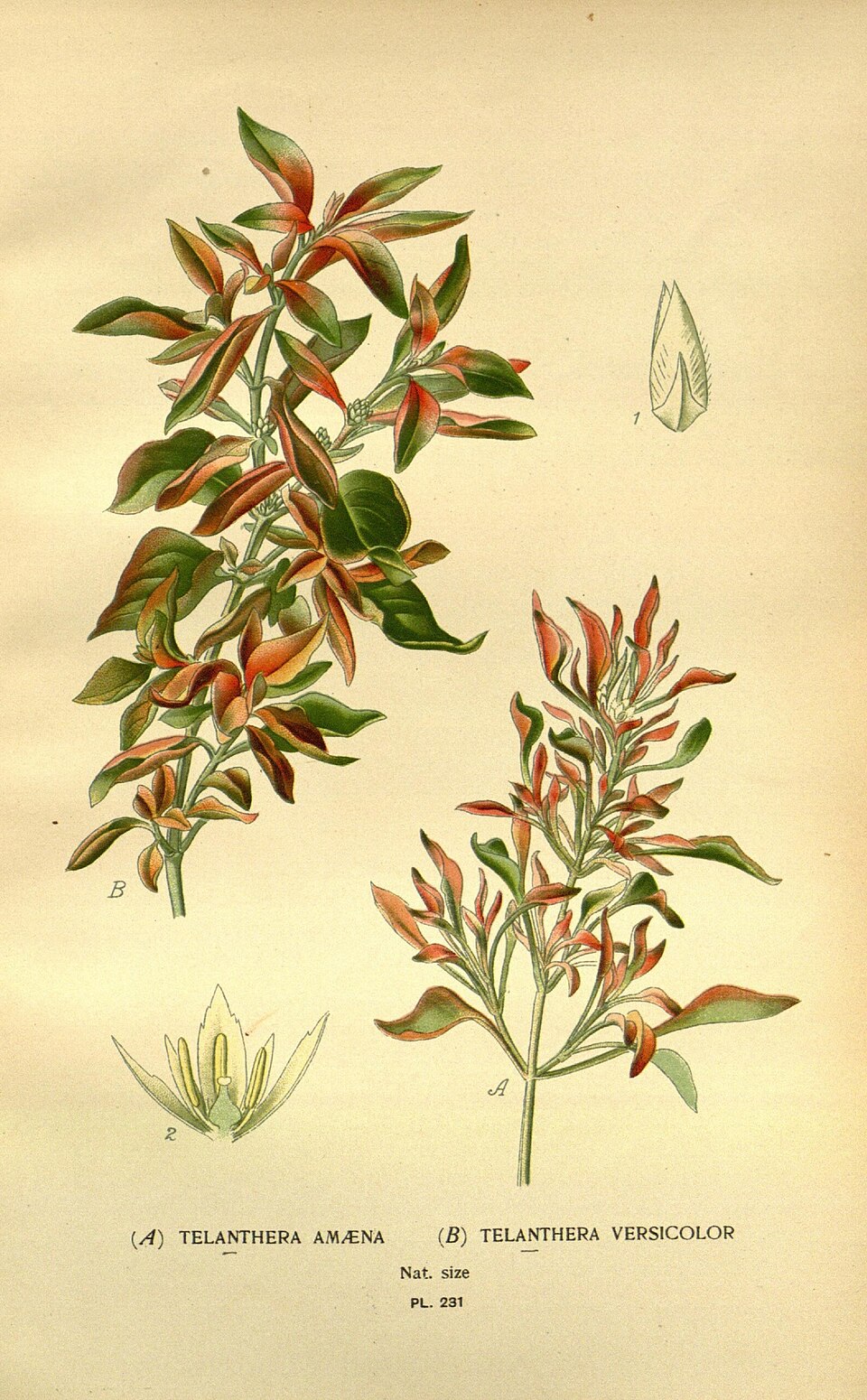
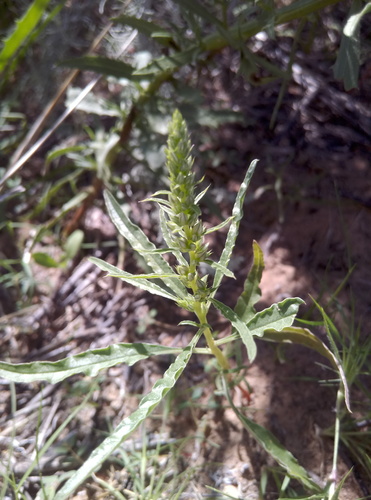
Achyranthes aspera
L.
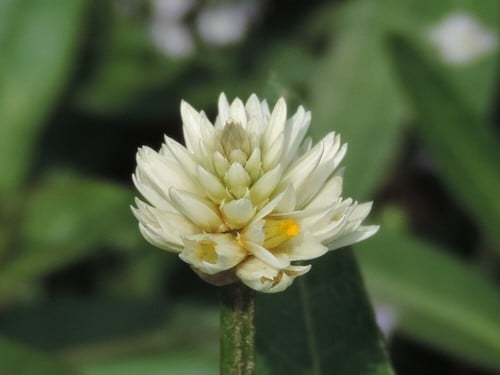
Chaff-flower, Rough chaff tree
iNaturalist· cc-by-nc-sa
(c) Edison Díaz, some rights reserved (CC BY-NC-SA), uploaded by Edison Díaz
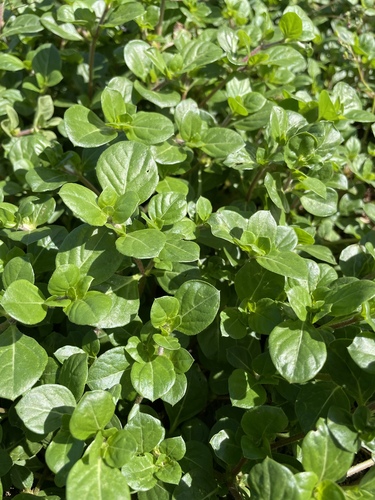
iNaturalist· cc-by-sa
(c) Dinesh Valke, some rights reserved (CC BY-SA)
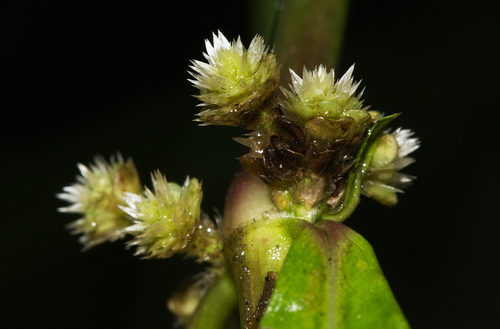
iNaturalist· cc-by-nc
(c) Pete Woodall, some rights reserved (CC BY-NC), uploaded by Pete Woodall
Summary
Source: WikipediaAchyranthes aspera (common names: chaff-flower, prickly chaff flower, devil's horsewhip, Sanskrit: अपामार्ग apāmārga) is a species of plant in the family Amaranthaceae. It is distributed throughout the tropical world. It can be found in many places growing as an introduced species and a common weed. It is an invasive species in some areas, including many Pacific Islands environments.
Description
A shrub or small tree. It grows 5 m tall. There are prickles along the stem. The leaves are twice divided and there are 8-18 pairs of pinnae. There are up to 50 pairs of pinnules on each pinnae. The flowers are yellow. They are in large clusters at the ends of branches. The pods are flattened.
Edible Uses
Leaves are edible cooked and can be used as a spinach substitute. The seeds are also edible when cooked and are said to be eaten with milk to check hunger without loss of body weight. The brown, ovoid seed is about 2mm long.
Traditional Uses
The young leaves and seeds are cooked and eaten. They are boiled without salt. They are boiled or stir-fried with other spices. The ash is used for flavouring.
Medicinal Uses
One of the more important medicinal herbs of Nepal, widely used for a range of complaints. The whole plant is used medicinally, but the roots are generally considered more effective and contain triterpenoid saponins. The root is astringent, diuretic and antispasmodic, used in the treatment of dropsy, rheumatism, stomach problems, cholera, skin diseases and rabies. Root juice mixed with the root of Urena lobata and the bark of Psidium guajava is used to treat diarrhoea and dysentery. The plant overall is astringent, digestive, diuretic, laxative, purgative and stomachic. Plant juice is applied in the treatment of boils, diarrhoea, dysentery, haemorrhoids, rheumatic pains, itches and skin eruptions. Ash from the burnt plant, often mixed with mustard oil and a pinch of salt, is used as a tooth powder believed to relieve pyorrhoea and toothache. The leaf is emetic, and a decoction is used to treat diarrhoea and dysentery. A paste of the leaves is applied for rabies, nervous disorders, hysteria, and insect and snake bites.
Distribution
A tropical plant. A native plant of tropical areas. It occurs in waste places at low and medium altitudes in the Philippines. It grows in northern Australia. It prefers moist well drained soils. It can grow in a partly shaded position but is most commonly in full sunshine. It is drought and frost tender. It does best in soils with high organic matter but can grow in sandy areas. It can grow in arid places. It has become common in Papua New Guinea in low altitudes in areas with seasonal climates. It Java it grows up to 300 m above sea levels. In Tanzania it grows up to 3,000 m above sea level and in areas with 700-1,300 mm rainfall.
Where It Grows
Afghanistan, Africa, American Samoa, Americas, Angola, Asia, Australia, Bangladesh, Benin, Bhutan, Botswana, Burkina Faso, Cambodia, Cameroon, Caroline Islands, Caribbean, Central Africa, Chad, China, Congo, Dominica, Dominican Republic, East Africa, East Timor, Egypt, Eritrea, Eswatini, Ethiopia, Europe, Fiji, Gabon, Greater Antilles, Guianas, Guinea, Guinée, Guinea-Bissau, Haiti, Hawaii, Himalayas, India, Indochina, Indonesia, Kenya, Laos, Lesser Antilles, Madagascar, Malawi, Malaysia, Marquesas, Micronesia, Mozambique, Myanmar, Nepal, New Caledonia, Nigeria, Norfolk Island, North Africa, Northeastern India, Pacific, Pakistan, Palau, Papua New Guinea, PNG, Philippines, Rotuma, Samoa, Sao Tome and Principe, Saudi Arabia, SE Asia, Senegal, Sierra Leone, Slovenia, Somalia, South Africa, Southern Africa, South America, South Sudan, Spain, Sri Lanka, St Helena, Swaziland, Tanzania, Thailand, Timor-Leste, Tonga, Tuvalu, Uganda, Vietnam, Wallis and Futuna, West Africa, West Indies, Zambia, Zimbabwe,
Cultivation
It is grown by seed.
Propagation
Seed - sow in spring in situ.
Other Uses
Ash from the burnt plant, often mixed with mustard oil and a pinch of salt, is used as a tooth powder for cleaning teeth. Dried twigs are used as toothbrushes. The ash of the burnt plant is a rich source of potash and is used for washing clothes.
Other Information
It is used as a famine food in a range of countries. It is not known if it is eaten in PNG. It is sold in local markets in China.
Notes
This one is used as medicine in Nepal. It has some anticancer properties. There are 6 Achyranthes species. The grow in tropical and warm temperate regions.
Nutrition
| Part | Moisture | kJ | kcal | Protein | Vit A | Vit C | Iron | Zinc |
|---|---|---|---|---|---|---|---|---|
| Leaves | 70.6 | 387 | 93 | 5.3 | 43 | 20 | — | — |
| Seeds | 83.9 | 176 | 42 | 4.3 | — | — | — | — |
| Flowers | 85 | — | 46 | 6.4 | — | — | — | — |
Synonyms
Also Known As
Aga, Aghadha, Agharda, Aghedo, Agudha, Akamaro, Amazinycenja, Ankhle, Apamarga, Apamaranga, Apang, Apangshak, Ara songsang, Arpchinjudo, Athian alur, Ato ite oryang, Bantjen, Chesirimiion, Chirchita, Co suot, Datiwan, Daun inget, Jarongan, Jercok, Kalamata, Kasita, Katalati, Kulbek, Kyet-mauk-pyan, Kyet-mauk-sue-pyan, Latjira, Layobe, Lenamo, Landklits, Lautafifi, Mukuluvhali, Naagar, Nairusedi keerai, Naukpo, Nayurivi, Nayuruvi, Ngwirisi ndi kakose, Nta basimane, Nyarang sunsang, Obhat kata, Puthkanda, Rag-ragadi, Sangketan, Sisi vao, Suga-dugodok, Tamatama, Tsipolomanitra, Tu niu xi, Tǔniúxī, Ulti hot, Umdombe, landigasepu, UtbUthareni, Uttarane, Uttaren, Uthrani soppu, Uttreni, Valiyakadaladi
References (104)
- Achigan-Dako, E. G., et al, (Eds.), 2010, Traditional vegetables in Benin. Institut National des Recherches Agricoles du Bénin. Imprimeries du CENAP, Cotonou.
- Al-Sodany, Y. M., et al, 2013, Medicinal Plants in Saudi Arabia: I. Sarrwat Mountains at Taif, KSA. Academic Journal of Plant Sciences 6 (4): 134-145
- Ambasta S.P. (Ed.), 2000, The Useful Plants of India. CSIR India. p 10
- Bao Bojian; Steve Clemants, Thomas Borsch, Amaranthaceae [Draft], Flora of China
- Behera, K. K. et al, 2008, Wild Edible Plants of Mayurbhanj District, Orissa, India. J. Econ. Taxon. Bot. Vol. 32 (Suppl,) pp 305-314
Show all 104 references Hide references
- BHANDARI,
- Bhaskarachary, K., et al, 1995, Carotene content of some common and less familiar foods of plant origin. Food Chemistry 54: 189-193
- Bircher, A. G. & Bircher, W. H., 2000, Encyclopedia of Fruit Trees and Edible Flowering Plants in Egypt and the Subtropics. AUC Press. p 7
- Bodkin, F., 1991, Encyclopedia Botanica. Cornstalk publishing, p 44
- Burkill, H. M., 1985, The useful plants of west tropical Africa, Vol. 1. Kew.
- Burkill, I.H., 1966, A Dictionary of the Economic Products of the Malay Peninsula. Ministry of Agriculture and Cooperatives, Kuala Lumpur, Malaysia. Vol 1 (A-H) p 33
- Borrell, O.W., 1989, An Annotated Checklist of the Flora of Kairiru Island, New Guinea. Marcellin College, Victoria Australia. p 47
- Chauhan, S. H., et al, 2018, Consumption patterns of wild edibles by the Vasavas: a case study from Gujarat, India. Journal of Ethnobiology and Ethnomedicine (2018) 14:57
- Checklist of NT Vascular Plant Species. January 2003.
- Cooper, W. and Cooper, W., 2004, Fruits of the Australian Tropical Rainforest. Nokomis Editions, Victoria, Australia. p 14
- Cowie, I, 2006, A Survey of Flora and vegetation of the proposed Jaco-Tutuala-Lore National Park. Timor-Lests (East Timor) www.territorystories.nt/gov.au p 42
- Cribb, A.B. & J.W., 1976, Wild Food in Australia, Fontana. p 115
- Cunningham, 1985,
- Devarkar, V. D., et al, 2011, Dietary and Medicinal Significance of Wild Vegetables from Osmanabad Region, Maharashtra (India). Life sciences Leaflets 11:317-332.
- Dey, A. & Mukhererjee, A., 2015, Living and Survival Amidst Hunger: Wild Edible Botanicals as a Prime Forest Productivity in the Rural Purulia District, West Bengal, India from Colonial to Present. Research Journal of Forestry 9(3): 71-86
- Facciola, S., 1998, Cornucopia 2: a Source Book of Edible Plants. Kampong Publications, p 8
- Flora of Australia Volume 49, Oceanic Islands 1, Australian Government Publishing Service, Canberra. (1994) p 88
- Fowler, D. G., 2007, Zambian Plants: Their Vernacular Names and Uses. Kew. p 6
- Fox, F. W. & Young, M. E. N., 1982, Food from the Veld. Delta Books. p 70
- Franklin, J., Keppel, G., & Whistler, W., 2008, The vegetation and flora of Lakeba, Nayau and Aiwa Islands, Central Lau Group, Fiji. Micronesica 40(1/2): 169–225, 2008
- GAMMIE;
- Grivetti, L. E., 1980, Agricultural development: present and potential role of edible wild plants. Part 2: Sub-Saharan Africa, Report to the Department of State Agency for International Development. p 49
- Grubben, G. J. H. and Denton, O. A. (eds), 2004, Plant Resources of Tropical Africa 2. Vegetables. PROTA, Wageningen, Netherlands. p 559
- GUPTA & KANODIA,
- Harisha, R. P. & Padmavathy, S., 2013, Knowledge and Use of Wild Edible Plants in Two Communities in Malai Madeshwara Hills, Southern India. International Journal of Botany 9(2): 64-72.
- Henty, E.E., & Pritchard, G.S., 1973, Weeds of New Guinea and their control. Botany Bulletin No 7, Division of Botany, Lae, PNG. p 55
- Hiddins, L., 1999, Explore Wild Australia with the Bush Tucker Man. Penguin Books/ABC Books. p 134
- Hossain, U. & Rahman, A., 2018, Study and quantitative analysis of wild vegetable floral diversity available in Barisal district, Bangladesh. Asian J. Med. Biol. Res. 2018, 4 (4), 362-371
- Jan, M., et al, 2018, Ethnobotanical Study of Plants Used By Ethnic People of Karbari Grant Village Dehradun, Uttarakhand. SERBD-International Journal of Multidisciplinary Sciences
- Jardin, C., 1970, List of Foods Used In Africa, FAO Nutrition Information Document Series No 2.p 51
- Karthi, Sathya, & Salome, 2014, Uncultivated Edible Greens from Small Millet Farms Tamil Nadu India. IDRC
- Kenneally, K.E., Edinger, D. C., and Willing T., 1996, Broome and Beyond, Plants and People of the Dampier Peninsula, Kimberley, Western Australia. Department of Conservation and Land Management. p 54
- Khan, M. & Hussain, S., 2014, Diversity of wild edible plants and flowering phenology of district Poonch (J & K) in the northwest Himalaya. Indian Journal of Sci, Res. 9(1): 032-038
- Kuhnlein, H. V., et al, 2009, Indigenous Peoples' food systems. FAO Rome p 191
- Kumar, S. A., Manus, D. & Mallika, M., 2018, Impact of non-timber forest products on Forest and in Livelihood Economy of the People of Adjoining Areas of Jalpaiguri Forest Division, West Bengal, India. Int. J. of Life Sciences, 2018; 6 (2):365-385
- Lazarides, M. & Hince, B., 1993, Handbook of Economic Plants of Australia, CSIRO. p 8
- Levitt, D., 1981, Plants and people. Aboriginal uses of plants on Groote Eylandt, Australian Institute of Aboriginal Studies, Canberra. p 80
- Li, D. et al, 2017, Ethnobotanical survey of herbal tea plants from the traditional markets in Chaoshan, China. Journal of Ethnopharmacology. 205 (2017) 195-206
- Long, C., 2005, Swaziland's Flora - siSwati names and Uses http://www.sntc.org.sz/flora/
- Macmillan, H.F. (Revised Barlow, H.S., et al), 1991, Tropical Planting and Gardening. Sixth edition. Malayan Nature Society. Kuala Lumpur. p 356
- Magwede, K., van Wyk, B.-E., & van Wyk, A. E., 2019, An inventory of Vhavenḓa useful plants. South African Journal of Botany 122 (2019) 57–89
- Manandhar, N.P., 2002, Plants and People of Nepal. Timber Press. Portland, Oregon. p 68
- Martin, F.W. & Ruberte, R.M., 1979, Edible Leaves of the Tropics. Antillian College Press, Mayaguez, Puerto Rico. p 172
- Masters, T., 2021, Traditional food plants of the upper Aswa River catchment of northern Uganda—a cultural crossroads. Journal of Ethnobiology and Ethnomedicine (2021) 17:24
- McMakin, P.D., 2000, Flowering Plants of Thailand. A Field Guide. White Lotus. p 87
- Misra, S., 2020, Survey of edible plants for human consumption in south Odisha, India. Journal of Emerging Technologies and Innovative Research (JETIR) Vol. 7, Issue 12 p 277
- Monsalud, M.R., Tongacan, A.L., Lopez, F.R., & Lagrimas, M.Q., 1966, Edible Wild Plants in Philippine Forests. Philippine Journal of Science. p 436
- Mot So Rau Dai an Duoc O Vietnam. Wild edible Vegetables. Ha Noi 1994, p 28
- Mutie, F. M., et al, 2023, Important Medicinal and Food Taxa (Orders and Families) in Kenya, Based on Three Quantitative Approaches. Plants 2023, 12, 1145
- Narayanan Ratheesh, M. K. et al, 2011, Wild edible plants used by the Kattunaikka, Paniya and Kuruma tribes of Wayanad District, Kerala, India. Journal of Medicinal Plants Research Vol. 5(15), pp. 3520-3529
- Ochse, J.J. et al, 1931, Vegetables of the Dutch East Indies. Asher reprint. p 10
- Paczkowska, G. & Chapman, A.R., 2000, The Western Australian Flora. A Descriptive Catalogue. Western Australian Herbarium. p 136
- Pandy, R. K. & Saini, S. K., 2007, Edible plants of tropical forests among tribal communities of Madhya Pradesh. Indian Journal of Traditional Knowledge. 6(1), pp 185-190
- Pagag, K. & Borthakur, S. K., 2012, Wild edible wetland plants from Lakhimpur district of Assam, India. Pleione 6(2): 322 - 327. 2012.
- Patiri, B. & Borah, A., 2007, Wild Edible Plants of Assam. Geethaki Publishers. p 106
- Peekel, P.G., 1984, (Translation E.E.Henty), Flora of the Bismarck Archipelago for Naturalists, Division of Botany, Lae, PNG. p 170, 171
- Peters, C. R., O'Brien, E. M., and Drummond, R.B., 1992, Edible Wild plants of Sub-saharan Africa. Kew. p 46
- Pham-Hoang Ho, 1999, An Illustrated Flora of Vietnam. Nha Xuat Ban Tre. p 730
- Pickering, H., & Roe, E., 2009, Wild Flowers of the Victoria Falls Area. Helen Pickering, London. p 20
- Plants of Haiti Smithsonian Institute http://botany.si.edu
- Rajkalkshmi, P. et al, 2001, Total carotenoid and beta-carotene contents of forest green leafy vegetables consumed by tribals of south India. Plant Foods for Human Nutrition 56:225-238
- Ramachandran, V. S., 2007, Wild edible plants of the Anamalais, Coimbatore district, western Ghats, Tamil Nadu. Indian Journal or Traditional Knowledge. 6(1) pp 173-176
- Reddy, K. N., et al, 2006, Traditional knowledge on wild food plants in Andhra Pradesh. Indian Journal of Traditional Knowledge 6(1) pp 223-229
- Ruiters-Welcome, A. K., 2019, Food plants of southern Africa. Ph.D. thesis. Univ. of Johannesburg p 9
- Roodt, V., 1998, Common Wild Flowers of the Okavango Delta. Medicinal Uses and Nutritional value. The Shell Field Guide Series: Part 2. Shell Botswana. p 13
- Royal Botanic Gardens, Kew (1999). Survey of Economic Plants for Arid and Semi-Arid Lands (SEPASAL) database. Published on the Internet; http://www.rbgkew.org.uk/ceb/sepasal/internet [Accessed 24th March 2011]
- Ruffo, C. K., Birnie, A. & Tengnas, B., 2002, Edible Wild Plants of Tanzania. RELMA p 98
- Ruiters-Welcome, A. K., 2019, Food plants of southern Africa. Ph.D. thesis. Univ. of Johannesburg p 9 (As Achyranthes robusta)
- Sarma, H., et al, 2010, Updated Estimates of Wild Edible and Threatened Plants of Assam: A Meta-analysis. International Journal of Botany 6(4): 414-423
- SAXENA;
- Scudder, 1962,
- Seidemann J., 2005, World Spice Plants. Economic Usage, Botany, Taxonomy. Springer. p 4
- Shackleton, S. E., et al, 1998, Use and Trading of Wild Edible Herbs in the Central Lowveld Savanna Region, South Africa. Economic Botany, Vol. 52, No. 3, pp. 251-259 (As Achyranthes robusta)
- SHANKARNARAYAN & SAXENA,
- SHORTT,
- Siemonsma, J. S. & Kasem Piluek, eds. 1993. Vegetables. In: Plant Resources of South-East Asia (PROSEA) 8:311
- Singh, A., 2009, Bioactivity of Famine Food Plants from the family: Amaranthaceae. University of Technology, Durban, South Africa. Masters Degree Thesis. p 1-116
- Singh, G. K. & Ahirwar, R. K., 2013, An Ethnobotanical Survey for Certain Wild Edible Plants of Chanda Forest District Dindori Central India. International Journal of Science and Research. 6:14
- Singh, H.B., Arora R.K.,1978, Wild edible Plants of India. Indian Council of Agricultural Research, New Delhi. p 39, 82
- Smith, A.C., 1981, Flora Vitiensis Nova, Lawaii, Kuai, Hawaii, Volume 2 p 290
- Sp. pl. 1:204. 1753
- Swaziland's Flora Database http://www.sntc.org.sz/flora
- Termote, C., et al, 2014, Assessing the potential of wild foods to reduce the cost of a nutritionally adequate diet: An example from eastern Baringo District, Kenya. Food and Nutrition Bulletin, vol. 35, no. 4
- Thaman, R. R, 2016, The flora of Tuvalu. Atoll Research Bulletin No. 611. Smithsonian Institute p 60
- Thiselton-Dywer, W.T., (Ed.), 1913, Flora of Tropical Africa. Vol VI-section 1. Reeve, p 65
- Tredgold, M.H., 1986, Food Plants of Zimbabwe. Mambo Press. p 32
- Tsering, J., et al, 2017, Ethnobotanical appraisal on wild edible plants used by the Monpa community of Arunchal Pradesh. Indian Journal of Traditional Knowledge. Vol 16(4), October 2017, pp 626-637
- Usher, G., 1974, A Dictionary of Plants Used by Man. Constable. p 16
- Vernon, R., 1983, Field Guide to Important Arable Weeds of Zambia. Dept of Agriculture, Chilanga, Zambia. p 24
- von Katja Rembold, 2011, Conservation status of the vascular plants in East African rain forests. Dissertation Universitat Koblenz-Landau
- WATT.
- Kanis, A in Womersley, J.S., (Ed), 1978, Handbooks of the Flora of Papua New Guinea. Melbourne University Press. Vol 1. p 13
- Welcome, A. K. & Van Wyk, B.-E., 2019, An inventory and analysis of the food plants of southern Africa. South African Journal of Botany 122 (2019) 136–179
- Williams, K.A.W., 1999, Native Plants of Queensland Volume 4. Keith A.W. Williams North Ipswich, Australia. p 42
- Williamson, J., 2005, Useful Plants of Malawi. 3rd. Edition. Mdadzi Book Trust. p 12
- World Checklist of Useful Plant Species 2020. Royal Botanic Gardens, Kew
- www.eFloras.org Flora of China
- Yasukawa, K., Medicinal and Edible Plants as Cancer Preventive Agents. Drug Discovery Research in Pharmacognosy. p185 www.intechopen.com
- Yuncker, T.G., 1959, Plants of Tonga, Bernice P. Bishop Museum, Hawaii, Bulletin 220. p 108