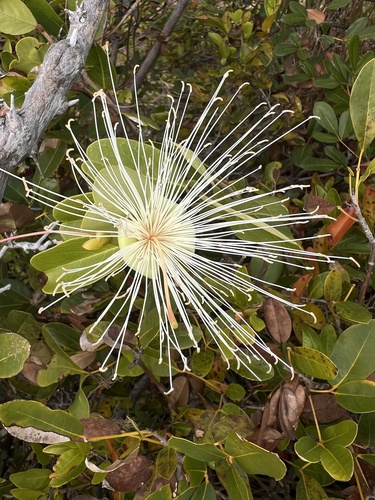
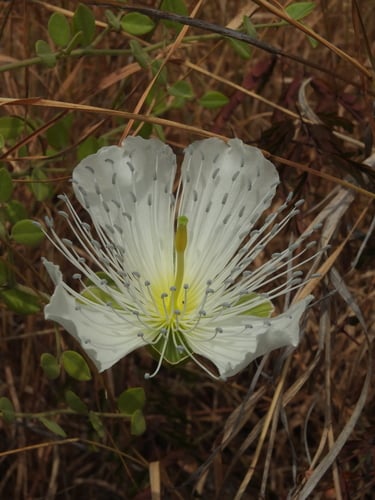
Capparis tomentosa
Lam.
Woolly caper-bush
iNaturalist· cc-by-nc
(c) jderasmus, some rights reserved (CC BY-NC)
iNaturalist· cc-by
(c) Wynand Uys, some rights reserved (CC BY), uploaded by Wynand Uys
iNaturalist· cc-by
(c) Wynand Uys, some rights reserved (CC BY), uploaded by Wynand Uys
Summary
Source: WikipediaCapparis tomentosa, the woolly caper bush or African caper, is a plant in the family Capparaceae and is native to Africa.
Description
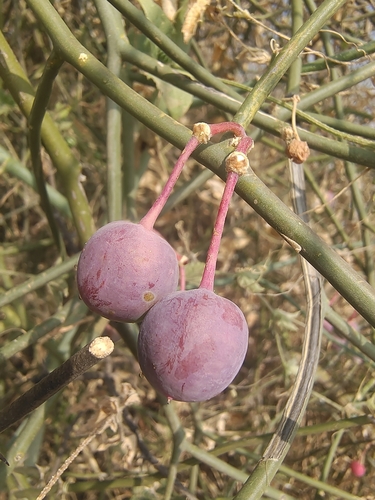
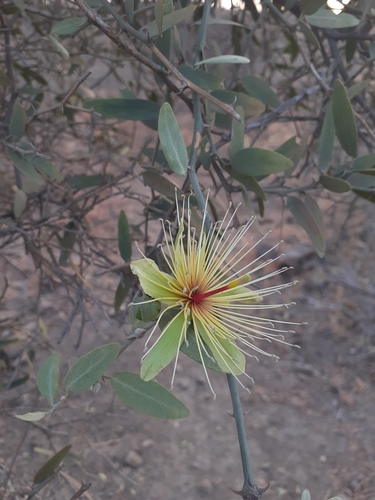
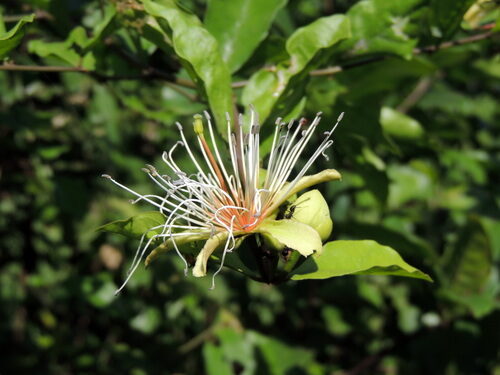
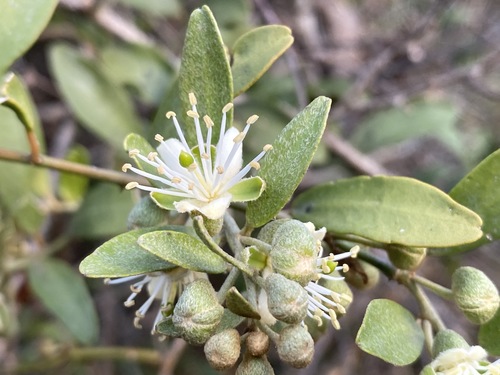
It is a spiny scrambling shrub or dense climber. The trunk can be 13-15 cm across and is covered with spines. The branches are covered with thick yellow hairs. The leaves are soft and grey-green. They are oval and 2.5-7 cm long and 1.5-4 cm wide. They have a rounded tip with short sharp point. The spines grow in the axils of the leaves. They are short, hooked and point downwards. The flower buds are round and velvety. They grow in clusters at the ends of branches. The flowers are large, pale green and have a smell. The fruit are long and hang downwards. They have a stout neck and stalk. They are reddish orange when ripe.
Edible Uses
The fruit are occasionally eaten by children, the flower buds are eaten in salted vinegar, and the leaves are cooked and eaten.
Traditional Uses
The fruit are occasionally eaten by children. The flower buds are eaten in salted vinegar. The leaves are cooked and eaten. Caution: The roots are very poisonous.
Medicinal Uses
Although there are various reports of toxicity, the plant is used medicinally throughout the areas of Africa in which it grows. The alkaloid, l-stachydrine, has been isolated from the pericarp, endocarp and seed-husk of the fruit, and is also in the roots. An alkaloid of the pyrrolidine group has been found and a sulphur-oil is present in the root. The plant is used to cure madness, snakebite, headache, impotence and sterility (in women). A decoction of leafy-stems is a common treatment for venereal disease discharges. A decoction of the leaves is used for the treatment of asthma. Applied externally, the pounded leaf is used as an eye-remedy, whilst a powder of the stem and leaf is used as a wound-dressing. The roots have diuretic and purgative properties. They are used internally for treating urethral discharges and syphilis. The powdered root is taken in a little water for treating snake-bite and a root-decoction, combined with Gardenia sp., is used for a poison-antidote. Externally, the powdered roots are applied to chancres, and orchites (in serious cases the treatment is combined with internal dosing with other drugs as well). A root macerate, combined with Waltheria americana, is used on the eyelids for treating ophthalmia and a steam-fumigation from an infusion of the pounded root is used for treating conjunctivitis. The pounded root-bark is used to maturate abscesses, and as a cough cure. A decoction prepared by scraping the bark and mixing it with goat soup is drunk as a remedy for chest pains. The fruit, or the root, can be used for diseases calling for clearing of the bowels, e.g. Hernia and sterility. The sap (of the root?) is used to treat inflammations of the ear. The plant also has applications in southern Africa for treating colds, coughs and bronchial troubles, malaria, jaundice, etc.
Known Hazards
The roots are toxic. There are conflicting reports about the leaves and fruit, they are considered to be edible in some areas and toxic in others. The leaves are browsed by livestock without apparent harm.
Distribution
It is a tropical or warm climate plant. In East Africa it grows between 1,200-2,300 m altitude. It grows in the Sahel. It can grow in arid places. It occurs on termite mounds.
Where It Grows
Africa, Benin, Botswana, Burkina Faso, Côte d'Ivoire, East Africa, Eritrea, Ethiopia, Eswatini, Ethiopia, Gambia, Ghana, Guinea, Guinée, Ivory Coast, Kenya, Lesotho, Mali, Mauritania, Mozambique, Namibia, Niger, Nigeria, Rwanda, Sahel, Sao Tome and Principe, Senegal, South Africa, Southern Africa, South Sudan, Swaziland, Tanzania, West Africa, Zambia, Zimbabwe,
Cultivation
A plant of the drier tropics, where it is found at elevations up to 2,300 metres. It grows best in areas where annual daytime temperatures are within the range 24 - 34°c, but can tolerate 16 - 40°c. It prefers a mean annual rainfall in the range 500 - 1,000mm, but tolerates 300 - 1,250mm. Requires a sunny position. Prefers a well-drained, medium to light textured soil. Prefers a pH in the range 6.5 - 8, tolerating 6 - 8.5. Established plants are very drought tolerant.
Other Uses
The seed is moderately rich in oil with a 29·1% content consisting, in a Sudan sample, of oleic acid 29%, linoleic acid 26%, palmitic acid 23% and stearic acid 21%. The wood is used for fuel. The trees are grown as a live fence.
Other Information
The fruit are popular with children.
Notes
The plant is claimed to have a range of medicinal uses. There are about 250 Capparis species. There are about 50 Capparis species in tropical America.
Synonyms
Also Known As
Cana, Carango, Chikatavuwa, Gonashindi, Gumero, Harenigema, Kdow, Kduwu, Khawa, Kowangee, Kudow, Motawana, Mucudureia, Mufurura, Tipoyuo, uMabusane, Umkanyengwe, Umukorokoombe, Ungiero
References (33)
- Asfaw, Z. and Tadesse, M., 2001, Prospects for Sustainable Use and Development of Wild Food Plants in Ethiopia. Economic Botany, Vol. 55, No. 1, pp. 47-62
- Bahru, T., et al, 2013, Wild Edible Plants: Sustainable Use and Management by Indigenous Communities in and the Buffer Area of Awah National Park, Ethiopia. Ethiop. J. Sci., 36(2): 93-108
- Bekele-Tesemma A., Birnie, A., & Tengnas, B., 1993, Useful Trees and Shrubs for Ethiopia. Regional Soil Conservation Unit. Technical Handbook No 5. p 128
- Bircher, A. G. & Bircher, W. H., 2000, Encyclopedia of Fruit Trees and Edible Flowering Plants in Egypt and the Subtropics. AUC Press. p 81 (As Capparis corymbifera)
- Burkill, H. M., 1985, The useful plants of west tropical Africa, Vol. 1. Kew.
Show all 33 references Hide references
- Bussman, R. W., 2006, Ethnobotany of the Samburu of Mt Nyiru, South Turkana, Kenya. Journal of Ethnobiology and Ethnomedicine. 2:35
- Codjia, J. T. C., et al, 2003, Diversity and local valorisation of vegetal edible products in Benin. Cahiers Agricultures 12:1-12
- Encycl. 1:606. 1785
- Ethiopia: Famine Food Field Guide. http://www.africa.upenn.edu/faminefood/category3.htm
- Fowler, D. G., 2007, Zambian Plants: Their Vernacular Names and Uses. Kew. p 16
- Fox, F. W. & Young, M. E. N., 1982, Food from the Veld. Delta Books. p 146
- Gallagher, D. E., 2010, Farming beyond the escarpment: Society, Environment, and Mobility in Precolonial Southeastern Burkina Faso. PhD University of Michigan.
- Grubben, G. J. H. and Denton, O. A. (eds), 2004, Plant Resources of Tropical Africa 2. Vegetables. PROTA, Wageningen, Netherlands. p 560
- Hedrick, U.P., 1919, (Ed.), Sturtevant's edible plants of the world. p 151
- Jardin, C., 1970, List of Foods Used In Africa, FAO Nutrition Information Document Series No 2.p 62 (As Capparis corymbifera)
- Le Houerou, H. N., (Ed.), 1980, Browse in Africa. The current state of knowledge. International Livestock Centre for Africa, Ethiopia. p 162
- Lulekal, E., et al, 2011, Wild edible plants in Ethiopia: a review on their potential to combat food insecurity. Afrika Focus - Vol. 24, No 2. pp 71-121
- Maydell, H. von, 1990 Trees and shrubs of the Sahel: their characteristics and uses. Margraf. p 218
- Molla, A., Ethiopian Plant Names. http://www.ethiopic.com/aplants.htm
- Mutie, F. M., et al, 2023, Important Medicinal and Food Taxa (Orders and Families) in Kenya, Based on Three Quantitative Approaches. Plants 2023, 12, 1145
- Palgrave, K.C., 1996, Trees of Southern Africa. Struik Publishers. p 184
- Palmer, E and Pitman, N., 1972, Trees of Southern Africa. Vol. 1. A.A. Balkema, Cape Town p 615
- Peters, C. R., O'Brien, E. M., and Drummond, R.B., 1992, Edible Wild plants of Sub-saharan Africa. Kew. p 76
- Pickering, H., & Roe, E., 2009, Wild Flowers of the Victoria Falls Area. Helen Pickering, London. p 47
- Roodt, V., 1998, Trees & Shrubs of the Okavango Delta. Medicinal Uses and Nutritional value. The Shell Field Guide Series: Part 1. Shell Botswana. p 57
- Ruiters-Welcome, A. K., 2019, Food plants of southern Africa. Ph.D. thesis. Univ. of Johannesburg p 42
- Swaziland's Flora Database http://www.sntc.org.sz/flora
- Tebkew, M., et al, 2018, Uses of wild edible plants in Quara district, northwest Ethiopia: implication for forest management. Agriculture and Food Security (2018) 7:12
- Termote, C., et al, 2014, Assessing the potential of wild foods to reduce the cost of a nutritionally adequate diet: An example from eastern Baringo District, Kenya. Food and Nutrition Bulletin, vol. 35, no. 4
- Welcome, A. K. & Van Wyk, B.-E., 2019, An inventory and analysis of the food plants of southern Africa. South African Journal of Botany 122 (2019) 136–179
- World Checklist of Useful Plant Species 2020. Royal Botanic Gardens, Kew
- www.zimbabweflora.co.zw 2011
- www.worldagroforestrycentre.org/sea/products/afdbases/af/asp/SpeciesInfo.asp?SpID=439