Capparis micracantha
DC
iNaturalist· cc-by-nc
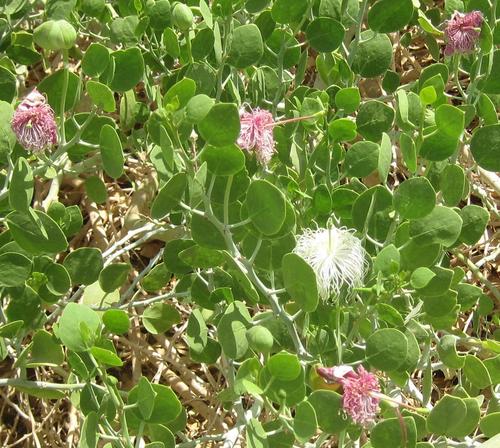
(c) Liu JimFood, some rights reserved (CC BY-NC), uploaded by Liu JimFood
iNaturalist· cc-by-nc
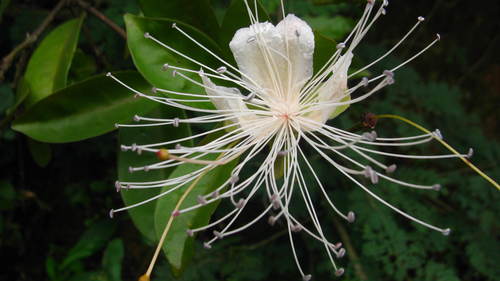
(c) 梁士明, some rights reserved (CC BY-NC), uploaded by 梁士明
Summary
Source: WikipediaCappparis micracantha is a species of flowering plant in the caper family (Capparaceae). It grows as a shrub or small tree, sometimes with a more or less climbing habit. It is native to Southeast Asia - the Andaman and Nicobar Islands, Indochina, Indonesia and the Philippines. Certain parts of the plant are locally used as a source of medicines and rarely for food.
Description
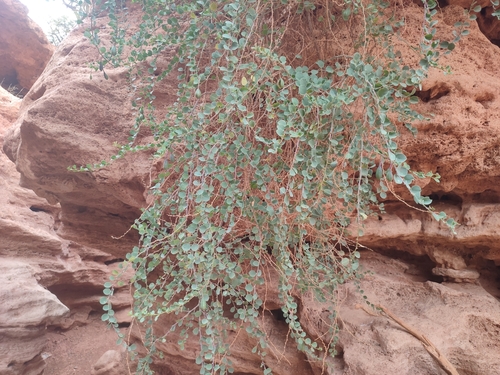
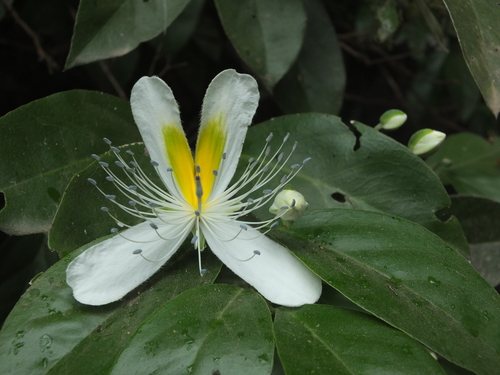
A vine or half erect shrub with drooping branches. It grows 4-5 m tall. It is thorny. The leaves are alternate, leathery and shiny. Both the tips and base of the leaves are usually rounded. Flowers occur on the stem above the leaf axils. They are on trailing branches. The flower petals are white with lower ones yellow or reddish. There are 20 long stamens. The fruit are oval and 3 or 4 cm long. They are smooth and bright red when ripe. The fruit is on a long stalk.
Edible Uses
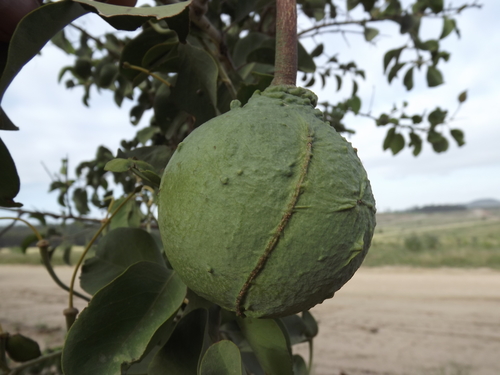
Fruit - raw. The pulp of the round, red to purple fruit has a sweet aromatic flavour, but is unsafe to eat when unripe. The orangish-red, spheroid to ellipsoid fruit is 3 - 7cm in diameter and 3 - 4cm long, containing numerous small seeds in a whitish, slimy, sweet pulp.
Traditional Uses
The fruit are eaten raw when ripe. They are also used like capers.
This uses section is brief — help expand it
Medicinal Uses
The roots are diuretic, stomachic and tonic. A decoction is used in the treatment of stomach-ache, TB, and as a uterine tonic after childbirth. Grated with water, the root is used to treat quotidian fever. Combined with other plants, it is used in the treatment of bronchitis. The wood is used in the treatment of biliousness, stomach-ache and giddiness. The bark is used as diuretic and in the treatment of bronchitis and nasal ulcerations. The stem is used in the treatment of breast cancer. The stem is crushed with water and applied topically to relieve pain and swellings. The plant (part no specified) is used in the treatment of asthma.
Distribution
A tropical plant. They occur in areas of shrubs and secondary forest at low and medium altitudes from northern Luzon to southern Mindanao in the Philippines.
Where It Grows
Africa, Asia, Cambodia, China, East Timor, India, Indochina, Indonesia, Laos, Malaysia, Myanmar, Northeastern India, Pacific, Philippines, SE Asia, South Sudan, Taiwan, Thailand, Timor-Leste, Vietnam,
Cultivation
Plants are grown from seed.
Production
In southern China plants flower in March to May and fruit in July and August.
Notes
There are about 250 Capparis species. There are about 50 Capparis species in tropical America.
Synonyms
Also Known As
Cap gai-nho, Chai chu, Chieng chi, Ching-chee, Halubagat-Kahoi, Halubagat, Kanchee baaydaac, Kanh che bay dach, Melada, Saisu
References (19)
- Ambasta S.P. (Ed.), 2000, The Useful Plants of India. CSIR India. p 102
- Bircher, A. G. & Bircher, W. H., 2000, Encyclopedia of Fruit Trees and Edible Flowering Plants in Egypt and the Subtropics. AUC Press. p 81 (Also as Capparis myrioneura)
- Brown, W.H., 1920, Wild Food Plants of the Philippines. Bureau of Forestry Bulletin No. 21 Manila. p 62
- Burkill, I.H., 1966, A Dictionary of the Economic Products of the Malay Peninsula. Ministry of Agriculture and Cooperatives, Kuala Lumpur, Malaysia. Vol 1 (A-H) p 449
- Cengel, D. J. & Dany, C., (Eds), 2016, Integrating Forest Biodiversity Resource Management and Sustainable Community Livelihood Development in the Preah Vihear Protected Forest. International Tropical Timber Organization p 123
Show all 19 references Hide references
- Coronel, R.E., 1982, Fruit Collections in the Philippines. IBPGR Newsletter p 9
- Cowie, I, 2006, A Survey of Flora and vegetation of the proposed Jaco-Tutuala-Lore National Park. Timor-Lests (East Timor) www.territorystories.nt/gov.au p 45 (subsp. micrantha)
- Kachenchart, B., et al, 2008, Phenology of Edible Plants at Sakaerat Forest. In Proceedings of the FORTROP II: Tropical Forestry Change in a Changing World. Bangkok, Thailand.
- Llamas, K.A., 2003, Tropical Flowering Plants. Timber Press. p 150 (var. henryi)
- Martin, M.A., 1971, Introduction L'Ethnobotanique du Cambodge. Centre National de la Recherche Scientifique. Paris.
- McMakin, P.D., 2000, Flowering Plants of Thailand. A Field Guide. White Lotus. p 13
- Milow, P., et al, 2013, Malaysian species of plants with edible fruits or seeds and their evaluation. International Journal of Fruit Science. 14:1, 1-27
- Monsalud, M.R., Tongacan, A.L., Lopez, F.R., & Lagrimas, M.Q., 1966, Edible Wild Plants in Philippine Forests. Philippine Journal of Science. p 450
- Pham-Hoang Ho, 1999, An Illustrated Flora of Vietnam. Nha Xuat Ban Tre. p 593
- Prodr. 1:247.1824
- Phon, P., 2000, Plants used in Cambodia. © Pauline Dy Phon, Phnom Penh, Cambodia. p 130
- Singh, V. B., et al, (Ed.) Horticulture for Sustainable Income and Environmental Protection. Vol. 1 p 214
- World Checklist of Useful Plant Species 2020. Royal Botanic Gardens, Kew
- www.theplantlist.org